
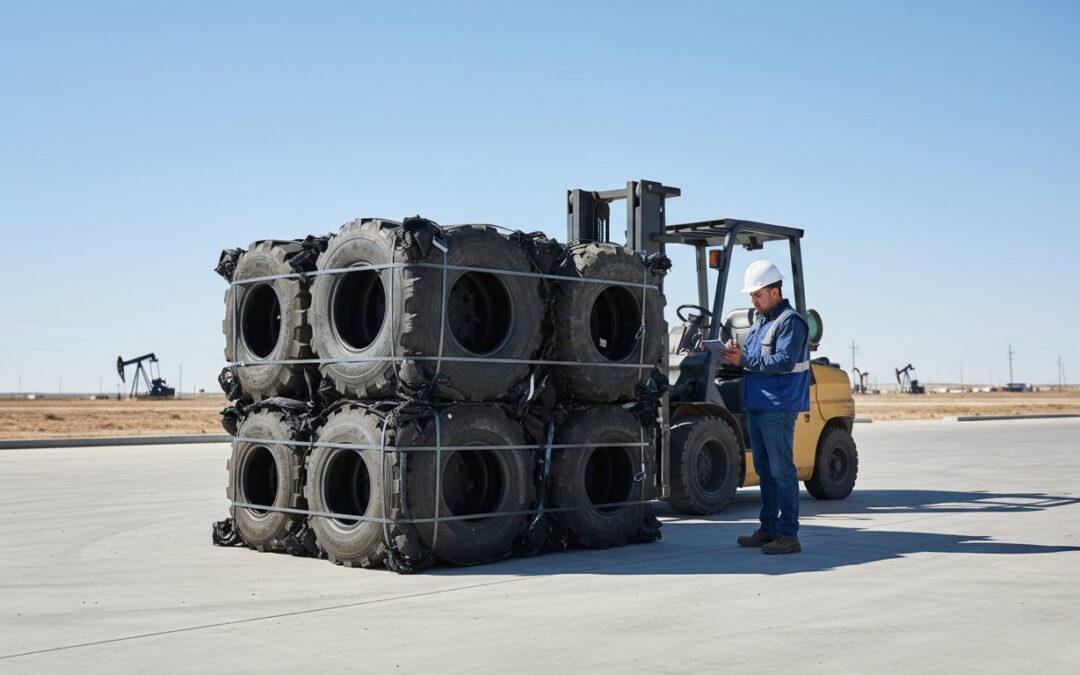
Did you know that the TCEQ issued more than $2.4 million in penalties for improper scrap tire management in 2025? For a business in West Texas, even a small stack of forgotten OTR or semi tires can lead to fines of up to $25,000 per day if your site is classified as unauthorized. Finding reliable TCEQ compliant tire disposal Odessa services isn’t just about cleaning up your lot. It’s a critical step in protecting your bottom line from catastrophic regulatory action and local municipal fines.
You likely already realize that Odessa’s regular waste services won’t touch your heavy duty, agricultural, or industrial scrap rubber. This guide provides a clear roadmap to navigate the 2026 Texas tire regulations and ensures your manifest paperwork is legally valid every time. We’ll examine the latest storage limits, annual reporting deadlines, and the exact steps to maintain a clean, safe job site. By the end of this article, you’ll know exactly how to handle everything from passenger tires to scrap conveyor belts without risking a single dollar in environmental penalties.
Key Takeaways
- Understand why even small stockpiles of scrap rubber can trigger massive TCEQ penalties under 2026 enforcement rules.
- Learn how the scrap tire manifest system acts as your primary legal defense against illegal dumping liability.
- Compare the limitations of City of Odessa landfills with professional TCEQ compliant tire disposal Odessa services for bulk OTR and semi tires.
- Follow a 5-step site audit to ensure your rubber storage meets state requirements for pest control and fire safety.
- Discover the most efficient ways to handle industrial waste like scrap conveyor belts and skid steer tracks without disrupting your operations.
Understanding TCEQ Compliance for Odessa Tire Disposal
Texas law defines a scrap tire as any tire that can no longer be used for its original purpose due to wear, damage, or defect. This definition covers everything from a blown-out semi tire to a worn-down skid steer track. In Odessa, the municipal code is even stricter. It’s unlawful to place any tire in a city-provided waste container. The TCEQ acts as the primary watchdog for West Texas, monitoring waste streams to ensure industrial rubber doesn’t end up in unauthorized pits or vacant lots across Ector County.
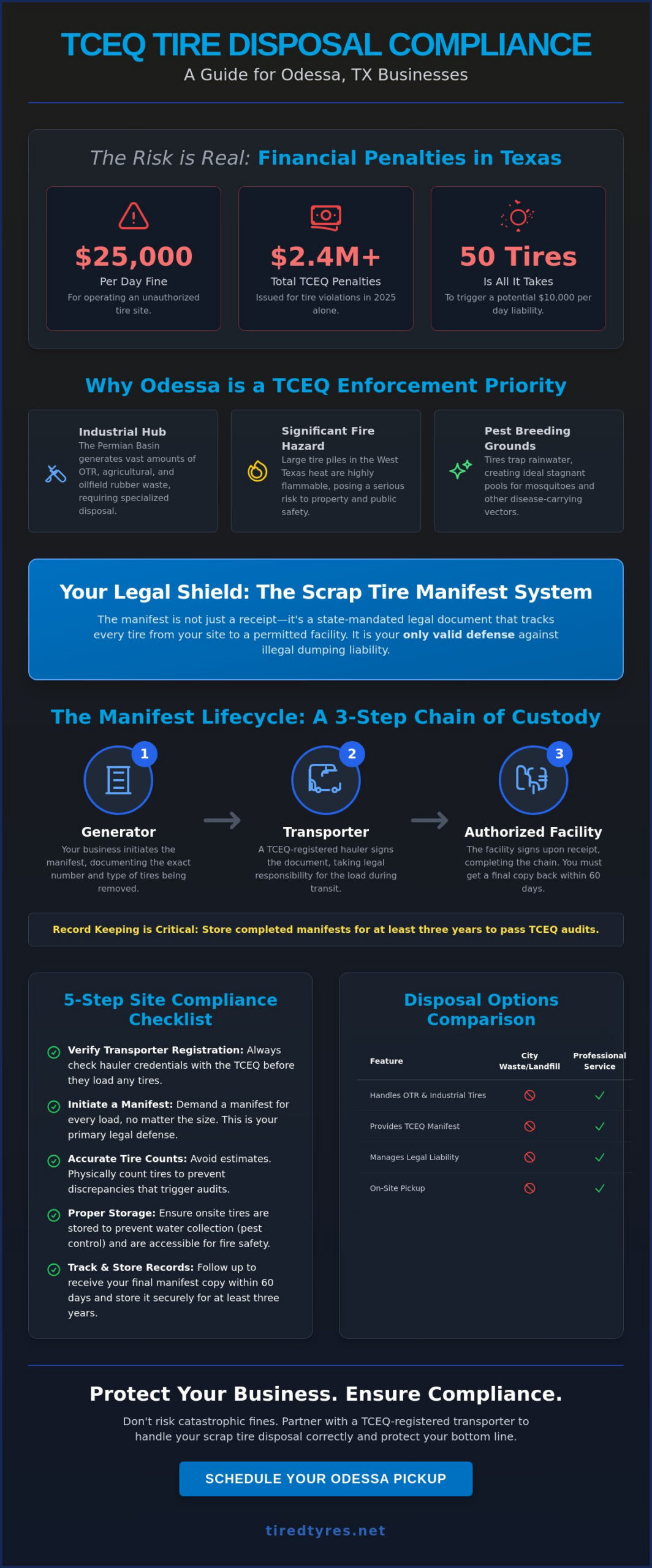
Accepting a “free” disposal offer from an unverified source is a dangerous gamble. If those tires are eventually found in a ditch or an illegal dump, the paper trail leads directly back to your business. The financial landscape for 2026 is unforgiving. In 2025, the TCEQ issued over $2.4 million in penalties for improper management. Storing as few as 50 scrap tires improperly can result in a $10,000 per day liability. Understanding the Tire recycling process helps illustrate why professional handling is a regulatory necessity, not just a cleanup task. Using TCEQ compliant tire disposal Odessa services ensures you aren’t part of those penalty statistics.
Why Odessa Businesses are High-Priority for TCEQ
The Permian Basin is a hub for heavy machinery. This means Odessa generates a disproportionate amount of OTR, agricultural, and oilfield rubber waste. TCEQ inspectors prioritize this region because large tire piles in the West Texas heat are significant fire hazards. These piles also trap rainwater, creating ideal breeding grounds for mosquitoes. Local enforcement in Ector County has stayed aggressive, with the City of Odessa imposing fines of up to $2,000 for illegal dumping on top of state-level environmental penalties.
The Legal Definition of a Registered Transporter
A TCEQ-registered hauler is more than just a person with a trailer. They are part of a regulated system that tracks every tire from your site to a permitted facility. If you hire an unregistered hauler, the legal burden never leaves your shoulders. You remain responsible for those tires until they reach an authorized destination. You should always verify a hauler’s credentials before they load your scrap. Secure TCEQ compliant tire disposal Odessa by demanding a manifest before any rubber leaves your property. This document is your only valid defense if an auditor visits your site to check your disposal history.
The Scrap Tire Manifest System: Your Shield Against Fines
The scrap tire manifest is the most critical document for any business managing TCEQ compliant tire disposal Odessa. It isn’t just a simple receipt or a hauling log. It’s a state-mandated legal record that tracks the chain of custody for every tire leaving your property. Without a properly executed manifest, you have no proof that your waste didn’t end up in an illegal dump site. If the TCEQ audits your Odessa facility, these forms are the first things they’ll ask to see. They’re your only valid defense against claims of environmental negligence.
The system relies on a three-part chain of custody involving the generator, the transporter, and the authorized facility. As the generator, your business initiates the process. You’re responsible for documenting the exact number and type of tires being removed. The transporter then signs the document, taking legal responsibility for the load during transit across West Texas. Finally, the authorized processing facility signs the manifest upon arrival. For a complete legal record, you must receive the final signed copy back from the transporter within 60 days. If you’re dealing with bulk loads of semi-truck or OTR tires, having a partner like Tired Tyres ensures this paperwork is handled with professional precision.
Step-by-Step: The Manifest Lifecycle
The process starts the moment a truck arrives at your Odessa site. You’ll fill out the generator section, noting whether you’re disposing of passenger tires, agricultural tires, or scrap rubber like conveyor belts. Once the transporter signs, they carry the manifest through the haul. Their job is to ensure the load reaches a permitted destination. The lifecycle only ends when the facility confirms receipt. You should store these completed records for at least three years. This long-term record-keeping is essential for passing surprise state inspections without issues.
Common Paperwork Errors That Trigger Audits
Inaccurate tire counts are the most frequent red flag for state auditors. If your manifest says 100 tires but the facility logs 85, the TCEQ may investigate the discrepancy. This often happens when businesses estimate “truckloads” instead of performing a physical count. Missing signatures are another major risk. A manifest without the final facility signature is legally worthless. It doesn’t prove disposal; it only proves the tires left your lot. You should also watch for illegible entries. If an inspector can’t read the transporter’s registration number or the date of the haul, they may cite you for incomplete documentation. Clear, printed entries are always safer than rushed handwriting.
Odessa Landfills vs. Professional Collection Services
Many Odessa business owners assume the local landfill is the default choice for waste rubber. While the City of Odessa manages residential trash efficiently, their solid waste collection does not accept tires. It’s actually unlawful to place any tire in a city-provided container. For commercial entities, this creates a significant logistical bottleneck. Even if you attempt to haul them yourself, municipal landfills often have strict volume limits or flat-out reject industrial rubber. Choosing TCEQ compliant tire disposal Odessa services moves the burden from your staff to a specialized team.
DIY hauling hides costs that don’t appear on a simple receipt. You have to account for employee hourly rates, fuel, and the wear on your own fleet. Most importantly, you’re losing the productivity of your crew while they wait in line at a scale house. A professional collection service calculates these factors into a single, transparent fee. This approach simplifies your “Total Cost of Compliance” by removing the variables of labor and potential municipal fines. It’s a more predictable way to manage your West Texas facility’s overhead.
When the Odessa Landfill Isn’t an Option
Municipal facilities are designed for household waste, not the heavy industrial rubber common in the Permian Basin. Large OTR (Off-the-Road) and agricultural tires are frequently rejected because they are too difficult to process or bury. If your lot is full of bulk semi-truck tires, you might exceed the daily commercial intake limits of local landfills. Specialized items like scrap skid steer tracks, industrial hoses, and scrap conveyor belts present even more challenges. These materials require specialized handling and transportation that city services simply don’t provide. Attempting to drop these at a standard landfill usually results in a wasted trip and a firm rejection.
The Efficiency of Scheduled On-Site Pickup
Regularly scheduled collection keeps your job site organized and safe. Stagnant piles of scrap rubber are more than just an eyesore; they are fire hazards and mosquito breeding grounds. By streamlining your commercial tire disposal strategy, you ensure that waste never accumulates past the legal storage limits. Professional teams handle the heavy lifting of OTR and solid tires, using equipment designed for the task. This protects your workers from potential injuries associated with manually moving heavy agricultural or semi tires. Secure TCEQ compliant tire disposal Odessa by letting the experts manage the logistics while your team focuses on their core operations.
5-Step Compliance Checklist for Odessa Site Managers
Managing a commercial lot in West Texas requires more than just keeping the yard clean. You need a systematic approach to avoid the $25,000 per day fines that can cripple a local business. Follow this 5-step checklist to maintain TCEQ compliant tire disposal Odessa standards without disrupting your daily workflow.
- Audit your stockpile: Categorize your rubber waste by type, such as semi tires, OTR, or scrap conveyor belts. Knowing your counts helps you stay under the 500-tire limit for ground storage.
- Verify your storage: Ensure tires are stacked or covered. This prevents water accumulation and meets state vector control requirements.
- Select a registered hauler: Don’t just hire the cheapest option. Confirm their TCEQ registration number is active and valid for the current year.
- Execute the manifest: Never let a single tire leave your property without a signed document. This is your only legal proof of transfer.
- Archive your records: Create a dedicated “TCEQ Compliance” file. Keep every manifest for at least three years to satisfy any surprise audits.
Best Practices for On-Site Tire Storage
Vector control is a major priority for state inspectors in the Permian Basin. Stagnant water inside tires creates a perfect breeding ground for mosquitoes, which can lead to immediate citations in Ector County. If you store tires outdoors, they must be stacked or covered to prevent rain from pooling inside the casings. Indoor storage is often the safest bet for high-value scrap like OTR tires, but you must still maintain clear fire lanes. The Odessa Fire Department requires specific distances between piles to prevent a localized fire from spreading. Keeping your lot organized isn’t just about aesthetics; it’s a vital part of your fire safety and health compliance.
Preparing for a TCEQ Inspection
An inspector’s visit is usually unannounced. They’ll look for “abandoned” tires that aren’t part of your current inventory or appear to have been sitting for years. If you’ve recently taken over a new site in Odessa, clear out any legacy rubber immediately so you aren’t held liable for the previous owner’s neglect. Organizing your manifest trail for quick retrieval is the best way to keep an inspection short and professional. If you can produce a clean binder of records in seconds, it signals to the inspector that you take your environmental responsibilities seriously. If you’re currently overwhelmed by an overflowing lot, you can schedule a professional collection to reset your site to a fully compliant state.
Partnering with Tired Tyres for Odessa Compliance
Tired Tyres provides a dedicated solution for 100% TCEQ compliant tire disposal Odessa. We understand that Permian Basin businesses face unique challenges with high-volume industrial waste. Our team specializes in the “hard stuff” that municipal services and standard haulers often won’t touch. This includes OTR (Off-the-Road) tires, agricultural tires, and scrap conveyor belts. We also manage the collection of scrap skid steer tracks, solid tires, scrap hoses, and general scrap rubber. By handling these difficult waste streams, we help local companies avoid the common waste tire problems that lead to environmental citations and site safety hazards.
Our commitment to compliance goes beyond just picking up rubber. We’ve developed a system for manifest management that simplifies the regulatory burden for our Odessa commercial partners. We ensure that every piece of scrap rubber, from passenger tires to heavy duty semi-truck tires, is tracked according to state law. This proactive approach protects your business from the liability of illegal dumping. You don’t have to worry about whether your waste reached a permitted facility; we provide the proof for every load.
Comprehensive Collection in Odessa and Midland
Our service area covers the heart of the West Texas oilfield, including Odessa, Midland, and all of Ector County. We offer flexible scheduling designed for high-volume auto shops, fleet yards, and industrial sites. We know that lot space is valuable, so we work to keep your yard clear of debris. We use specialized equipment specifically for OTR and heavy-duty rubber removal. This allows us to handle the weight and size of large agricultural machinery tires without requiring your staff to assist with the loading. It’s a professional, hands-off solution that keeps your operations moving forward while maintaining a clean job site.
Your Documentation Partner
Documentation is the core of our service. Every load we collect is backed by a legally valid TCEQ manifest. We provide the complete paperwork trail you need for insurance requirements and state audits. Our goal is to make TCEQ compliant tire disposal Odessa a seamless part of your business administration. You can learn more about our reliable tire disposal process to see how we protect your business from liability. We handle the manifest management so you can focus on your core business with total peace of mind. We ensure your records are accurate, legible, and ready for any inspector who walks through your door.
Securing Your West Texas Operation for 2026
Maintaining a clean and compliant job site in Ector County is a continuous process of documentation and smart logistics. You’ve seen that the manifest system is your primary defense against state audits; it’s the only way to prove you aren’t liable for illegal dumping. With municipal landfills rejecting bulk semi tires and industrial rubber, professional collection becomes the most efficient way to manage your West Texas overhead.
Tired Tyres is a TCEQ-Registered Transporter dedicated to the Permian Basin. We provide specialized OTR and industrial rubber handling, ensuring that every load is backed by full manifest documentation. Don’t let an overflowing lot become a fire hazard or a magnet for environmental fines. You can easily get a TCEQ-compliant tire pickup quote for your Odessa site today. Our team is ready to handle the heavy lifting while you focus on your core business operations. Securing your professional TCEQ compliant tire disposal Odessa strategy now protects your bottom line for years to come.
Frequently Asked Questions
Do I need a TCEQ registration to dispose of tires from my Odessa business?
You don’t need a registration to simply dispose of scrap tires. However, you must use a TCEQ-registered transporter to move them from your property. Registration is only required for your business if you store more than 500 tires on the ground at any given time. Using a professional service for TCEQ compliant tire disposal Odessa ensures that all your generator responsibilities are met without the need for extra paperwork on your end.
What is the maximum number of tires I can store in Odessa without a permit?
A registered scrap tire generator can store up to 500 tires on the ground or up to 2,000 tires if they are kept in enclosed and lockable trailers or containers. Exceeding these limits without a specific TCEQ permit can lead to your site being classified as an unauthorized dump. This classification carries heavy financial risks. It’s best to schedule regular pickups to stay well below these thresholds and maintain a safe, clean workplace.
Does the City of Odessa landfill accept semi-truck or OTR tires?
No, the City of Odessa solid waste services don’t accept tires of any kind. It’s actually unlawful to place tires in city-provided waste containers. While some local landfills may accept passenger tires for a fee, they almost always reject bulk loads of semi-truck or OTR tires. These oversized items require specialized processing that municipal facilities aren’t equipped to handle. You’ll need a private collection partner for these specific industrial waste streams.
What happens if I hire a tire hauler who isn’t registered with the TCEQ?
You retain full legal and financial liability for the tires if you hire an unregistered hauler. If those tires are later found in an illegal dump site, the state will hold your business responsible for the cleanup and fines. Since there’s no valid manifest from a registered hauler, you have no legal proof that the tires were disposed of correctly. This mistake can lead to TCEQ penalties reaching $25,000 per day until the site is cleared.
How long do I need to keep my scrap tire manifests in Texas?
You should keep your completed manifests for at least three years. This timeframe matches standard TCEQ record-keeping requirements for industrial waste. Having these documents organized and ready for inspection is vital. If an auditor visits your Odessa site, they’ll check these records to verify that every tire you’ve generated in recent years reached an authorized facility. Digital backups are a good idea, but keep the original signed copies in a secure file.
Are there specific fines for illegal tire dumping in Ector County?
Yes, illegal dumping in Odessa carries local and state-level consequences. The City of Odessa imposes a fine of up to $2,000 for illegal dumping violations. On top of that, the TCEQ can issue much larger administrative penalties. For example, storing as few as five unregistered off-the-road tires can trigger state fines exceeding $25,000. Investing in TCEQ compliant tire disposal Odessa is significantly more affordable than facing these combined legal costs.
Can I cut or shred my own tires to avoid TCEQ regulations?
No, cutting or shredding tires generally counts as processing, which requires its own specific TCEQ registration and permits. Simply altering the shape of the tire doesn’t remove the requirement for proper disposal and manifesting. In fact, improper processing can sometimes lead to additional environmental citations. It’s much safer to have the tires removed in their original state by a permitted professional who understands the legal recycling path for scrap rubber.
How do I report illegal tire dumping I see in Odessa?
You can report illegal dumping to the City of Odessa Code Enforcement division or the Ector County Sheriff’s Office. For larger sites, you should contact the TCEQ Region 7 office directly. Reporting these sites protects the local environment and prevents the spread of pests and fire hazards in our community. If you’ve discovered tires abandoned on your own commercial property, contact a registered hauler immediately to remove them before they become your legal liability.