
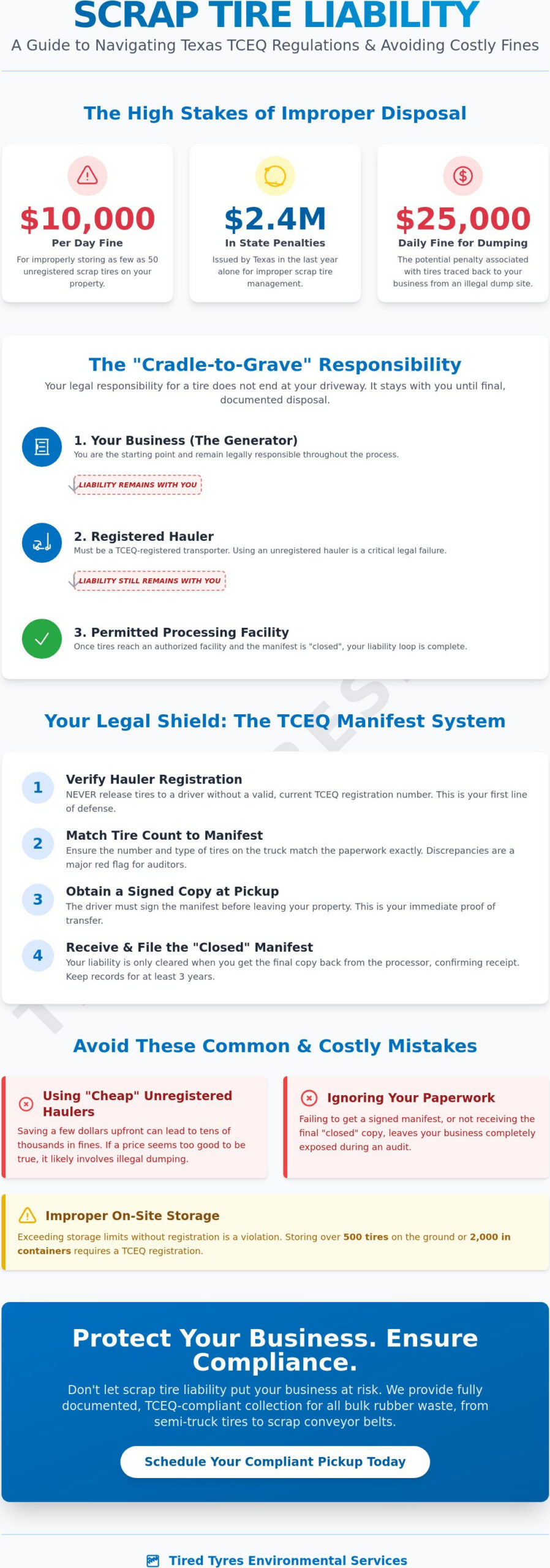
Did you know that storing just 50 unregistered scrap tires on your property could trigger TCEQ fines of $10,000 per day? In the Permian Basin, managing business liability for scrap tires Midland is no longer just about clearing space. It’s about avoiding the $2.4 million in penalties the state issued last year for improper management. You’ve likely felt the frustration of trying to find a hauler you can actually trust while worrying if your paperwork will hold up during a surprise audit.
It’s stressful to manage bulk rubber waste when the laws change and landfill restrictions tighten. We understand that you need a disposal process that’s as efficient as your daily operations. This article will teach you how to navigate current Texas environmental laws and eliminate the legal risks associated with commercial scrap tire disposal. We’ll cover the essential manifest system, the impact of new laws like HB1463, and the exact steps you need to take to ensure your company stays fully compliant through 2026.
Key Takeaways
- Grasp the “cradle-to-grave” principle that makes you legally responsible for tires even after they leave your property.
- Master the TCEQ manifest system to ensure your business has a clean, legal paper trail for every disposal.
- Avoid the $25,000 daily fines associated with illegal dumping by properly vetting your haulers and disposal sites.
- Implement professional storage and pickup standards to eliminate business liability for scrap tires Midland.
- Ensure total compliance for all bulk rubber waste, from semi-truck tires to scrap conveyor belts, with documented collection.
The Cradle-to-Grave Responsibility: Understanding Business Liability in Midland
In Texas, your responsibility for a scrap tire doesn’t end when the hauler pulls out of your driveway. Under the “cradle-to-grave” principle, the Texas Commission on Environmental Quality (TCEQ) holds the original generator of the waste responsible from the moment a tire is removed until it reaches a permitted processing facility. If a hauler dumps those tires in a West Texas ravine, the TCEQ won’t just look for the driver. They’ll follow the trail back to your business. This makes business liability for scrap tires Midland a critical concern for any company operating large fleets or heavy machinery.
Many Midland businesses in the oil and gas sector treat waste removal as an “out of sight, out of mind” task. This is a dangerous legal strategy. If those tires aren’t tracked correctly, you’re essentially handing a blank check to the state for future fines. The liability stays with you until the final tire recycling process is complete and documented. In an environment where regulatory oversight is increasing, assuming the tires were “taken care of” isn’t a valid legal defense.
What Constitutes a Scrap Tire Liability?
Texas law defines a scrap tire as any tire that can no longer be used for its original intended purpose. Liability falls into two main categories: storage and transportation. If you store more than 500 tires on the ground or 2,000 in locked containers, you must register as a storage site. However, even smaller quantities create business liability for scrap tires Midland if they aren’t disposed of through legal channels. Fleet operators, agricultural businesses, and tire shops in the Permian Basin are the most common entities carrying this risk. Even a few abandoned OTR tires can trigger massive penalties if they’re found on your property during an inspection.
The Legal Chain of Custody in the Permian Basin
The legal journey of a tire involves a strict chain of custody. It starts at your Midland job site, moves to a registered transporter, and ends at an authorized processing plant. The chain typically fails when a business hires an unregistered hauler. Local law enforcement and TCEQ investigators in Midland and Ector counties are trained to spot illegal transport. Without a signed manifest, you can’t prove the tire reached its destination. This gap in documentation is exactly where legal and financial trouble begins for local companies.
TCEQ Regulations and the Manifest System: Your Legal Paper Trail
The Texas Commission on Environmental Quality (TCEQ) acts as the primary watchdog for waste management in the state. They don’t just set the rules; they enforce them through rigorous inspections and heavy financial penalties. To stay protected, you must understand that the Texas Administrative Code for scrap tires requires every generator to document the movement of their waste. This isn’t just busywork. It’s the mechanism that shields your company from business liability for scrap tires Midland if those tires are later found in an illegal dump site.
A Waste Tire Manifest is the only legal proof of proper disposal in Texas. Without this document, you have no way to prove to an inspector that you followed the law. If you’re managing a local fleet or construction site, choosing compliant OTR tire collection ensures your paperwork stays in order from the moment the rubber leaves your lot. You should keep these records on file for at least three years to remain audit-ready at all times.
How to Execute a Compliant Tire Manifest
- Step 1: Verify the hauler’s TCEQ registration number. Never hand over tires to a driver who cannot provide a valid, current registration.
- Step 2: Ensure the number of tires matches the manifest count. Discrepancies between what you loaded and what’s written on the paper can trigger an investigation.
- Step 3: Obtain a signed copy of the manifest upon pickup. The driver must sign the document before they leave your property.
- Step 4: Receive the final “closed” manifest from the processor. Your liability loop only closes when you get the final copy back from the permitted processing facility.
Common Manifest Mistakes That Lead to Fines
Many businesses make the mistake of failing to verify the destination facility’s permit status. Under HB1463, transporters can be fined up to $500 per tire for taking waste to unregistered sites, and as the generator, you share that risk. Incomplete signatures or missing dates are also red flags for auditors. If a manifest is missing even one required field, it may be deemed invalid during a TCEQ inspection. Precision in your record-keeping is the only way to eliminate business liability for scrap tires Midland and protect your bottom line from the $2.4 million in penalties issued statewide last year.
The Hidden Risks of “Cheap” Disposal: Fines, Fire, and Public Health
Hiring a “budget” hauler might seem like a smart way to cut overhead, but in the Permian Basin, it’s often the fastest path to a legal nightmare. When a hauler lacks proper TCEQ registration, they’re more likely to dump your bulk rubber waste in unauthorized areas to avoid disposal fees. Because of the “cradle-to-grave” responsibility discussed earlier, the state won’t just penalize the driver. They’ll hold your company accountable for the cleanup. Choosing an unverified service to manage business liability for scrap tires Midland can result in costs that far exceed the price of professional collection.
The financial consequences of illegal dumping are staggering. Under the new state law, HB1463, transporters can be fined up to $500 per tire for taking scrap to unregistered sites. If those tires are traced back to your business, you could face daily fines of up to $25,000 for an unauthorized dump site. Beyond the legal fees, the reputational damage of being linked to an environmental crime in Midland can alienate partners and customers who value corporate responsibility.
Financial Penalties for Illegal Dumping in Texas
Texas doesn’t treat commercial violations lightly. While an individual might face a $500 local fine for a single tire, businesses are held to a much higher standard. If the TCEQ determines that a company intentionally bypassed legal disposal channels, multiple violations can escalate into criminal charges. You’re also responsible for site remediation. This means your company must pay to have the illegally dumped tires removed and processed by a legitimate facility, on top of paying the initial fines. It’s always cheaper to do it right the first time.
Environmental and Safety Hazards in the Midland Heat
The intense West Texas sun creates specific physical risks for stockpiled rubber. In the Midland heat, large piles of tires can actually undergo spontaneous combustion. Once a tire fire starts, it’s nearly impossible to extinguish. These fires release toxic smoke and oily residue that contaminates the soil and groundwater. This creates a long term environmental liability that can haunt a property owner for decades.
Public health is another major concern. A single scrap tire can breed over 500 mosquitoes in just seven days if it collects stagnant water from a rare West Texas rain. This increases the local risk for West Nile Virus and Zika. For a detailed look at how these issues impact our region, read our Waste Tire Problems in Midland, Odessa, and Lubbock guide. Managing your business liability for scrap tires Midland isn’t just about paperwork; it’s about protecting the community and your property from preventable disasters.
Mitigating Risk: Best Practices for Commercial Tire Management
Protecting your company requires more than just understanding the law. You need active management strategies to reduce your risk profile. Establishing clear protocols for on-site storage and hauler selection is the most effective way to manage business liability for scrap tires Midland. By treating scrap rubber with the same diligence as your primary inventory, you prevent small oversights from turning into state-level investigations. Proactive management ensures your site remains clean and your legal records remain beyond reproach.
Training your staff is a vital part of this process. Every employee involved in fleet maintenance or site cleanup must understand the documentation requirements mentioned earlier. If a worker hands off a load of OTR tires to an unregistered driver without a manifest, the legal consequences fall on the business owner, not the employee. Implementing a simple compliance checklist for every pickup can stop these errors before they happen.
Secure On-Site Storage Requirements
Midland County businesses must follow specific guidelines to avoid being classified as an unauthorized dump site. If you store more than 500 tires on the ground, you must register with the TCEQ. To minimize fire risks, keep tire stacks at least 50 feet away from property lines and buildings. For outdoor storage, you must prevent water from pooling inside the tires to stop mosquito breeding. Using heavy-duty tarps or storing tires in enclosed trailers are effective ways to meet these standards. Proper stacking also makes it easier for your hauler to perform a quick and efficient scrap rubber collection, keeping your inventory levels low and your risk minimal.
Vetting Your Tire Disposal Partner
Don’t take a hauler’s word for their legal status. Use the TCEQ database to verify their registration number before signing any contracts. A professional partner should openly share their registration and provide proof of insurance and bonding. General liability insurance is standard, but it often doesn’t cover environmental fines. Bonding provides an extra layer of security for your business if the hauler fails to deliver the tires to a permitted facility. Ask specifically which processing plant they use and ensure that facility is also in good standing with the state. This level of due diligence is the only way to truly eliminate business liability for scrap tires Midland and ensure your waste doesn’t end up in a West Texas ravine.
How Tired Tyres Protects Your Business from Scrap Tire Liability
Managing the legal complexities of waste management shouldn’t distract you from running your company. Tired Tyres provides a direct solution to the legal risks we’ve discussed. We operate with a commitment to 100% TCEQ compliance for every pickup in the Permian Basin. By partnering with us, you effectively transfer the physical burden of waste while maintaining a perfect record of legal disposal. This proactive approach is the most reliable way to handle business liability for scrap tires Midland.
We don’t just pick up rubber. We provide the manifest documentation required to close your liability loop. As a permitted hauler, we ensure every load of semi-truck tires or agricultural tires is tracked from your site to a certified processing facility. This means you won’t have to worry about surprise audits or the $2.4 million in penalties the state issued recently. Our team handles the heavy lifting and the administrative details. Your staff can focus on their primary tasks instead of paperwork.
Comprehensive Collection for All Industrial Rubber
Industrial sites often accumulate more than just standard tires. We provide specialized collection for a wide range of rubber waste, including scrap conveyor belts, scrap hoses, and scrap skid steer tracks. Whether you manage an agricultural operation or a large oilfield fleet, we offer customized pickup schedules tailored to your volume. We have the specialized equipment needed for OTR (Off-the-Road) tire collection, passenger tires, and scrap solid tire collection. For a deeper look at regional requirements, see our Commercial Tire Disposal in Midland, Odessa & Lubbock guide.
The Tired Tyres Compliance Guarantee
Our role as a permitted hauler is built on transparency. We maintain strong partnerships with certified processors to ensure your scrap rubber is recycled responsibly. This supports the Permian Basin economy while keeping our local environment clean. We simplify the entire paperwork process. We provide you with the signed manifests needed for your three-year record-keeping requirement. It’s a professional, straightforward service designed for businesses that can’t afford legal mistakes. Don’t leave your company’s reputation to chance. Protect your business today and get a professional tire disposal quote in Midland.
Secure Your Permian Basin Operations for 2026
Your company’s legal safety depends on how you handle the waste leaving your lot. We’ve explored why the “cradle-to-grave” principle means you’re responsible for tires until final processing is complete. Without a closed manifest in your files, you’re exposed to the significant penalties the TCEQ issues for improper disposal. Managing business liability for scrap tires Midland requires a partner who understands these high stakes and provides a foolproof paper trail.
Tired Tyres operates as a licensed and permitted West Texas hauler. We provide the TCEQ-compliant manifest documentation you need to stay audit-ready at all times. Whether you require specialized OTR and industrial rubber collection or a regular schedule for your fleet, we ensure every load is handled legally and professionally. Don’t let an unverified hauler turn into a $25,000 daily fine for your business. You can protect your reputation and your bottom line starting today. Secure your business with a legal tire disposal quote and move forward with the confidence that your compliance is in expert hands.
Frequently Asked Questions
Is my business liable if a hired hauler dumps tires illegally?
Yes, your business remains legally responsible for the tires until they reach a permitted processing facility. Under Texas law, hiring a third party doesn’t transfer your liability. If a hauler dumps your waste illegally, the TCEQ can hold you accountable for the cleanup costs and associated fines. This is why vetting your hauler is the most critical step in managing business liability for scrap tires Midland.
What is a TCEQ tire manifest and why does my Midland business need one?
A TCEQ tire manifest is a legal tracking document that records the movement of scrap tires from the generator to the processor. You need one because it’s your only legal defense against illegal dumping allegations. It proves you handed the tires to a registered hauler and that they arrived at a legal destination. Without a signed manifest, you have no way to verify compliance during a state audit.
How much are the fines for illegal tire dumping in Texas?
Fines for illegal dumping can reach $25,000 per day if the site is deemed an unauthorized dump. For smaller violations, such as transporting more than five tires without a manifest, local fines often start at $500. Additionally, the TCEQ issued over $2.4 million in total penalties in 2025 alone. These costs don’t include the price of remediating the site and paying for proper disposal afterward.
Can I take my business scrap tires to the Midland city landfill?
No, you cannot place whole tires in residential trash bins or standard Midland landfills. As of 2026, local facilities have enforced even stricter restrictions, particularly for tires with the rims still attached. Business owners must instead use authorized collection points or permitted haulers. Self-hauling to these points typically incurs a fee between $3.00 and $7.00 per tire depending on the size and weight.
Do I need a special permit to store scrap tires on my commercial property?
You only need to register with the TCEQ if you store more than 500 scrap tires on the ground or more than 2,000 in enclosed, lockable containers. However, even if you store fewer than these amounts, you must follow fire safety and mosquito prevention rules. Storing just 50 unregistered tires can lead to fines of $10,000 per day, so maintaining a regular pickup schedule is safer.
How do I verify if a tire hauler is legally registered in Texas?
You can verify a hauler’s status by searching the TCEQ’s registered scrap tire transporter database. Always ask the driver for their registration number before they load any bulk rubber waste. A legitimate hauler will have no issue providing this number and showing their current registration certificate. Verifying this information is a key part of reducing business liability for scrap tires Midland and ensuring your waste is handled correctly.
What happens to the tires after Tired Tyres picks them up?
We transport all collected tires, conveyor belts, and industrial rubber to permitted processing facilities in West Texas. There, the materials are recycled into new products or processed for energy recovery. We ensure the manifest loop is closed by obtaining the final signature from the processor. This process keeps your records clean and ensures your waste contributes to a sustainable local economy instead of a landfill.
Does business insurance cover environmental fines for improper tire disposal?
Most general liability insurance policies do not cover fines or penalties resulting from regulatory violations. While insurance might cover accidental damage or fires, it won’t pay for TCEQ fines caused by hiring an unregistered hauler or failing to maintain manifests. You should check your specific policy for environmental riders, but the most cost-effective protection is following the state’s disposal laws from the start.