
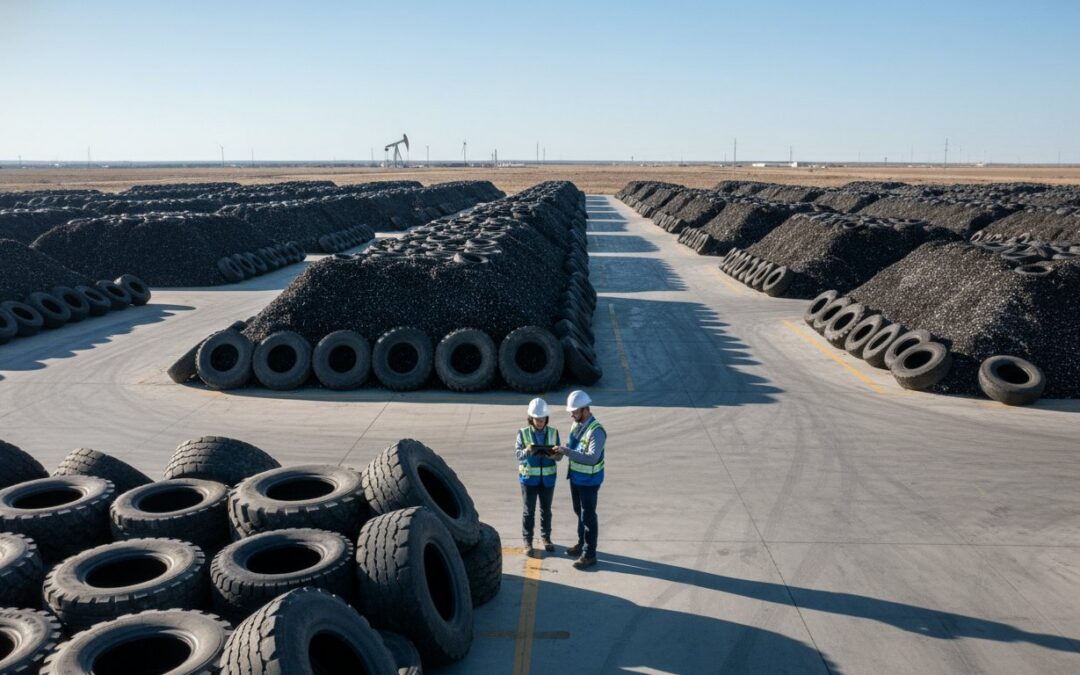
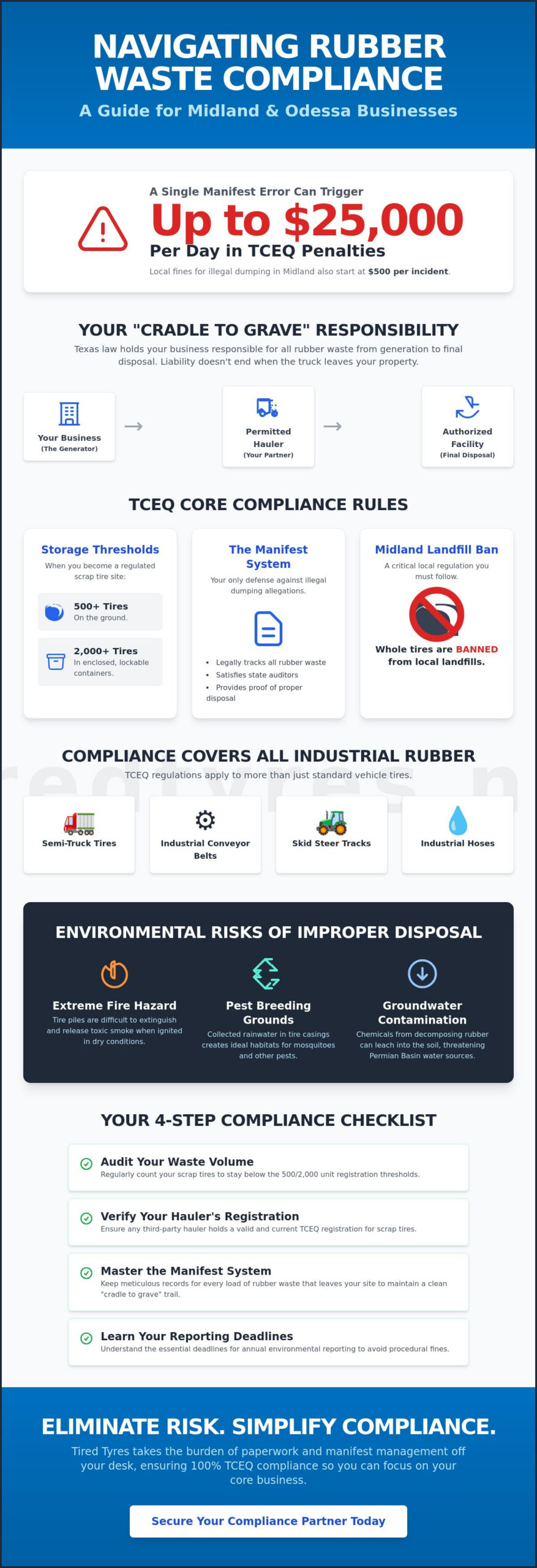
A single administrative error in your manifest trail can trigger TCEQ penalties of up to $25,000 per day. If you’re operating in the Permian Basin, you already know that managing scrap tires and industrial rubber isn’t just a logistics problem, it’s a legal one. The complexity of Texas manifest requirements often feels like a full-time job that pulls you away from your actual operations. Maintaining environmental compliance for rubber waste Midland requires more than just a truck. It demands a precise cradle to grave tracking system that satisfies every state auditor, especially since Midland landfills don’t accept whole tires.
We understand the frustration of trying to find reliable, permitted haulers who actually understand the local landscape. This 2026 guide will simplify the current TCEQ regulations, helping you protect your business from heavy fines while ensuring 100% compliance. You’ll learn the exact storage thresholds for registration, the essential deadlines for annual reporting, and a repeatable process for legal disposal. We’ll also show you how to find a local partner who takes the burden of paperwork off your desk so you can focus on your core business.
Key Takeaways
- Identify the specific TCEQ reporting deadlines and storage thresholds to avoid daily fines of up to $25,000.
- Master the “cradle to grave” manifest system to ensure every piece of rubber waste is legally tracked and documented.
- Understand the unique requirements for environmental compliance for rubber waste Midland, covering everything from semi-truck tires to industrial conveyor belts.
- Follow a practical checklist to audit your waste volume and verify that your hauler holds a valid TCEQ registration.
- Learn how professional manifest management can eliminate administrative errors and simplify your annual environmental reporting.
The Importance of Environmental Compliance for Rubber Waste in Midland
In West Texas, rubber waste management isn’t just a minor operational detail. It’s a significant legal requirement. For businesses in the Permian Basin, environmental compliance for rubber waste Midland involves strictly following the Texas Commission on Environmental Quality (TCEQ) guidelines. This compliance covers everything from standard truck tires to specialized oilfield equipment like scrap conveyor belts and industrial hoses. As of 2026, local authorities have intensified their oversight. They’re actively looking for gaps in the manifest trail that often lead to unauthorized dumping sites across the county.
The stakes for commercial entities are high. A major violation related to hazardous waste or improper rubber disposal can result in penalties of up to $25,000 per day. Even local fines for illegal dumping in Midland start at $500 per incident. Beyond the financial burden, there’s a serious reputational risk. Companies that fail to maintain environmental compliance for rubber waste Midland face public scrutiny and potential disruptions to their operating permits. Proper disposal isn’t just about avoiding a ticket; it’s about keeping your business running without legal interference.
Environmental stewardship also plays a role in protecting our local resources. When rubber waste isn’t handled correctly, it can leach chemicals into the soil, potentially threatening Permian Basin groundwater. Understanding the Tire recycling process helps businesses see how these materials are safely diverted and repurposed. By choosing legal disposal routes, you ensure that scrap rubber is processed into useful materials rather than becoming a permanent pollutant in the West Texas landscape.
The Legal Liability of the Waste Generator
Texas law operates on a cradle-to-grave principle. This means your business is responsible for every piece of rubber waste from the moment it’s discarded until it reaches a final, permitted disposal or recycling facility. You don’t lose liability just because the waste is loaded onto a truck and leaves your property. If a hauler dumps your scrap skid steer tracks or semi-truck tires illegally, the TCEQ will trace those items back to you. A Midland waste generator remains legally and financially liable for any third-party dumping or mismanagement associated with their specific waste stream.
Environmental Impact on the West Texas Landscape
The arid climate in the Midland and Odessa area creates specific risks for rubber accumulation. Massive tire piles are extreme fire hazards; once they ignite in our dry conditions, they’re incredibly difficult to extinguish and produce toxic smoke. These piles also serve as breeding grounds for mosquitoes and other pests when even small amounts of rainwater collect inside the rubber casings. You can explore more about these waste tire problems to see how improper storage affects community health. Professional collection ensures these risks never develop on your site.
Texas TCEQ Regulations: Navigating the Scrap Tire Manifest System
The Texas Commission on Environmental Quality (TCEQ) manages scrap tires through Title 30 of the Texas Administrative Code, Chapter 328. For businesses in the Permian Basin, environmental compliance for rubber waste Midland starts with understanding that the state doesn’t charge an application fee for registration. While the process is free, the rules are strict. TCEQ uses a “cradle to grave” manifest system to ensure that every tire, from a passenger vehicle to an OTR unit, is accounted for until it reaches an authorized facility. This system is vital because Midland landfills do not accept whole tires, making a legal paper trail your only defense against illegal dumping allegations.
You don’t necessarily need a registration just to have tires on-site, but you must monitor your volume closely. A business becomes a regulated scrap tire storage site if it holds more than 500 tires on the ground or more than 2,000 tires in enclosed, lockable containers. Once you cross these thresholds, you’re required to provide financial assurance for closure costs. These Tire Recycling Industry Standards help maintain a stable market, but for the individual business owner, they represent a significant administrative burden. If you’re overwhelmed by the volume on your lot, you can schedule a collection with a permitted hauler to bring your site back into compliance.
The 5-Part Manifest Process
The manifest is a multi-part document that tracks the transfer of waste. When a hauler arrives, the generator fills out the initial details and the transporter signs it. You must keep your copy immediately. Once the tires reach an authorized processor, the facility signs the final document and returns a completed copy to you. You’re required to retain these records for three years. Errors are common; research shows that up to 30% of manual manifests contain data inconsistencies, which can lead to TCEQ audits or fines if the trail appears broken.
Storage and Vector Control Standards
TCEQ regulations also dictate how you store rubber before it’s hauled away. Outdoor storage requires specific fire lanes to allow emergency vehicle access and must maintain a safe distance from property lines. Because tires easily collect water, they become breeding grounds for mosquitoes and rodents. You must document your vector control measures, such as chemical treatments or physical covers, to prove you’re mitigating these public health risks. Failing to provide these records during a routine inspection can result in moderate violations under the TCEQ penalty matrix.
Beyond Tires: Compliance for Industrial Rubber Waste
Midland’s industrial sector generates massive amounts of non-pneumatic rubber that often falls into a regulatory gray area for many business owners. Achieving environmental compliance for rubber waste Midland requires a strategy that goes beyond just car and truck tires. Scrap conveyor belts, industrial hoses, and heavy-duty rubber components are staples of Permian Basin operations. While these items don’t always trigger the same 500-tire storage threshold as pneumatic tires, they’re still subject to Texas “cradle-to-grave” liability. Leaving a pile of scrap hoses on a lease site isn’t just poor housekeeping; it’s a potential TCEQ violation.
Handling these materials requires a different approach than standard tire disposal. Reinforced conveyor belts, for instance, are incredibly heavy and difficult to transport without specialized equipment. The goal is to move these materials from your site to a permitted facility that can handle industrial-grade rubber. Documenting this transfer is essential. It provides the necessary evidence that your business is managing its environmental footprint responsibly. Without a receipt or manifest from a registered hauler, you’re left without a legal shield if that rubber is discovered in an unauthorized location.
Managing Oilfield Rubber Waste
Construction and oilfield sites in Midland frequently deal with scrap skid steer tracks. These tracks contain thick steel reinforcements, making them a challenge for standard shredders. If you’re also disposing of rubber hoses used for chemical or fluid transfer, you must ensure they’re drained and handled according to environmental safety protocols. For detailed insights on managing these high-volume industrial streams, you can read more about commercial tire disposal. Addressing these items promptly prevents the buildup of “legacy waste” that often attracts regulatory scrutiny during routine inspections.
Solid Rubber vs. Pneumatic Tires
Solid industrial tires used on forklifts and heavy machinery present unique recycling challenges. Unlike pneumatic tires, which are air-filled and easier to process into tire-derived fuel, solid rubber is incredibly dense. This density means many standard recycling paths are closed to them. When you’re coordinating a bulk shipment, categorize your solid rubber waste clearly. Some regional facilities have strict limits on the volume of solid rubber they’ll accept in a single day. Ensuring environmental compliance for rubber waste Midland means confirming that your disposal partner has the specific permits and equipment to handle solid industrial rubber before it leaves your facility.
Compliance Checklist for Midland and Odessa Businesses
Maintaining environmental compliance for rubber waste Midland requires a proactive approach. You can’t wait for a TCEQ inspection to find gaps in your records. Start by conducting a monthly internal audit. Count your scrap tires and industrial rubber pieces to ensure you haven’t crossed the storage thresholds that require additional registration. If you’re nearing 500 tires on the ground, you need to clear the lot immediately. Next, designate a specific storage area that meets Texas fire codes. This zone must include clear fire lanes and proper setbacks from property lines to ensure emergency vehicle access. Training your staff is the final piece of the puzzle. Every person handling rubber should know that a manifest isn’t just a receipt. It’s a legal requirement for every load that leaves the gate.
Implementing a rigorous record-keeping system is your best defense against administrative penalties. You should keep a dedicated file for all completed manifests and disposal receipts. Texas law requires you to retain these documents for at least three years. Digital copies are helpful, but having the physical signed manifests organized and ready for a surprise audit can save you significant stress. If you’re looking for a partner who prioritizes this level of documentation, contact us for a compliant collection quote today.
Vetting Your Waste Hauler
Don’t take a hauler’s word for their compliance. Ask for their TCEQ registration number and verify it on the state’s Central Registry database. A legitimate partner will have no trouble providing this information. Watch for red flags. If a hauler offers a price that seems too good to be true, they might be cutting corners on disposal. Another major red flag is a hauler who refuses to sign or provide a manifest. Remember, if they dump your waste illegally, the “cradle-to-grave” liability means the TCEQ will come back to your business for the cleanup costs and fines.
Landfill and Facility Coordination
The City of Midland landfill has strict rules that catch many businesses off guard. They don’t accept whole tires under any circumstances. If you’re attempting to use local municipal facilities, you’ll likely need to shred or cut the rubber into quarters first. This pre-processing adds significant labor costs and requires specialized equipment. To stay current on the latest statutes and processing requirements, refer to the Texas tire disposal regulations. Understanding these local limitations helps you choose a disposal route that keeps your environmental compliance for rubber waste Midland intact without unexpected facility rejections.
How Tired Tyres Ensures Your Business Stays Compliant
Tired Tyres acts as your professional buffer against the regulatory risks associated with industrial rubber. As a fully permitted and insured hauler operating in the Permian Basin, we focus on keeping your facility within legal storage limits. Maintaining environmental compliance for rubber waste Midland is a continuous process that requires more than just occasional pickups. We provide a reliable solution for collecting passenger, semi-truck, and OTR tires, as well as specialized industrial items like scrap conveyor belts and skid steer tracks. By establishing a consistent schedule, you prevent your facility from ever reaching the TCEQ storage thresholds that trigger mandatory financial assurance and additional registrations.
Our team understands that West Texas businesses face unique logistical challenges. We use specialized equipment designed to handle the weight and bulk of agricultural and off-the-road tires that standard waste services often refuse. We also collect scrap hoses and solid tires, ensuring that every piece of rubber on your site has a documented path to a legal end-point. Our goal is to streamline your operations while providing the transparency required to satisfy state auditors and local inspectors.
Professional Documentation and Peace of Mind
We take the administrative burden of manifest management off your desk. Our team handles the multi-part TCEQ manifest process for every commercial client, ensuring that your records are always accurate and audit-ready. Tired Tyres verifies the weight, count, and destination of every load to ensure the paper trail remains unbroken from your gate to the processing facility. This commitment to legal, environmentally sound disposal means you don’t have to worry about the “cradle-to-grave” liability discussed earlier in this guide. We provide the physical and digital receipts you need to prove 100% compliance at a moment’s notice.
Serving the Permian Basin and Beyond
Our service network covers the core of West Texas, including Midland, Odessa, and Lubbock. We don’t believe in one-size-fits-all disposal. Instead, we offer customized collection plans tailored to the specific needs of the oilfield, automotive, and agricultural sectors. Whether you’re managing a high-volume tire shop or a remote lease site with accumulated scrap hoses, we have the capacity to handle your waste stream. You can contact Tired Tyres for a compliance-focused disposal quote to see how we can simplify your environmental reporting and protect your business from unnecessary fines.
Secure Your Permian Basin Operations Today
Maintaining environmental compliance for rubber waste Midland doesn’t have to be a source of constant stress for your team. You’ve learned how the TCEQ manifest system acts as your legal shield and why strictly monitoring your storage volume prevents heavy administrative penalties. Whether you’re managing scrap conveyor belts from a mining site or a stockpile of semi-truck tires; a repeatable, documented disposal process is your best defense against surprise audits.
Tired Tyres has served the Permian Basin since 2026 with a focus on professional documentation and specialized industrial rubber handling. We ensure your manifest tracking is always 100% TCEQ-compliant so you can focus on your primary business operations. Request a Compliant Rubber Waste Pickup Quote for Your Midland Business and let our experts handle the logistics and paperwork for you.
Protecting your commercial interests and the West Texas landscape is a shared goal. We’re ready to help you achieve full compliance and keep your facility running smoothly.
Frequently Asked Questions
What is a TCEQ scrap tire manifest and why do I need one?
A TCEQ scrap tire manifest is a multi-part tracking document that records the movement of rubber waste from your business to a final authorized facility. You need this manifest to prove your business has met the “cradle to grave” legal requirements for disposal. Without a signed copy on file, you have no evidence to protect your company from liability if the waste is later found in an unauthorized location during a state audit.
How many tires can I legally store at my Midland business without a permit?
Texas law allows you to store up to 500 scrap tires on the ground or up to 2,000 tires in enclosed, lockable containers without a storage site registration. If your inventory exceeds these specific thresholds, you’re required to register with the TCEQ and provide financial assurance for closure costs. Monitoring these numbers is a critical part of maintaining environmental compliance for rubber waste Midland.
Can I take industrial rubber waste to the Midland landfill myself?
No, the City of Midland landfill does not accept whole tires or bulk industrial rubber waste. To use municipal facilities, you’d generally need to quarter or shred the materials first, which requires specialized industrial equipment. Most businesses find it more efficient to use a permitted hauler who can transport the waste directly to an authorized recycling or processing center that handles large-scale rubber debris.
What are the fines for illegal tire dumping in Texas in 2026?
Local fines for illegal dumping in Midland start at $500 per incident. However, state-level penalties from the TCEQ are much more severe, reaching up to $25,000 per day for each violation. These heavy fines often target businesses that fail to maintain a proper manifest trail or those that use unregistered haulers who dump waste in unauthorized areas across the Permian Basin.
Do I need a special permit to transport my own business’s scrap tires?
You don’t need a transporter registration to haul your own scrap tires to an authorized facility, but you must still comply with all manifest and record-keeping rules. If you begin transporting tires for other entities or if you’re hauling large volumes as a primary business activity, you must obtain a formal registration from the TCEQ. Most commercial entities prefer using a registered service to ensure the paperwork is handled correctly.
How do I verify if a tire hauler is properly registered with the state?
You should always ask for the hauler’s TCEQ registration number and verify it through the TCEQ Central Registry online database. A legitimate, compliant hauler will provide this number without hesitation and will always sign your manifest at the time of collection. If a hauler refuses to provide a registration number or a manifest, it’s a major red flag that they aren’t following state disposal laws.
What happens to the industrial rubber waste after Tired Tyres picks it up?
We transport your scrap rubber to authorized processing facilities where it’s shredded or repurposed according to state environmental standards. This process ensures your environmental compliance for rubber waste Midland by providing a documented path to a legal end-point. By diverting these materials from the local landscape, we help turn industrial waste into useful products like tire-derived fuel or rubberized mulch.
Are there specific rules for disposing of OTR or agricultural tires in West Texas?
OTR and agricultural tires follow the same TCEQ manifest and storage rules as standard tires, but their massive size requires specialized removal equipment. Because these units are too large for standard municipal shredders, they must be taken to industrial-grade facilities. Properly managing these large-scale units is essential for oilfield and farming operations to avoid the fire and pest hazards associated with long-term on-site storage.