
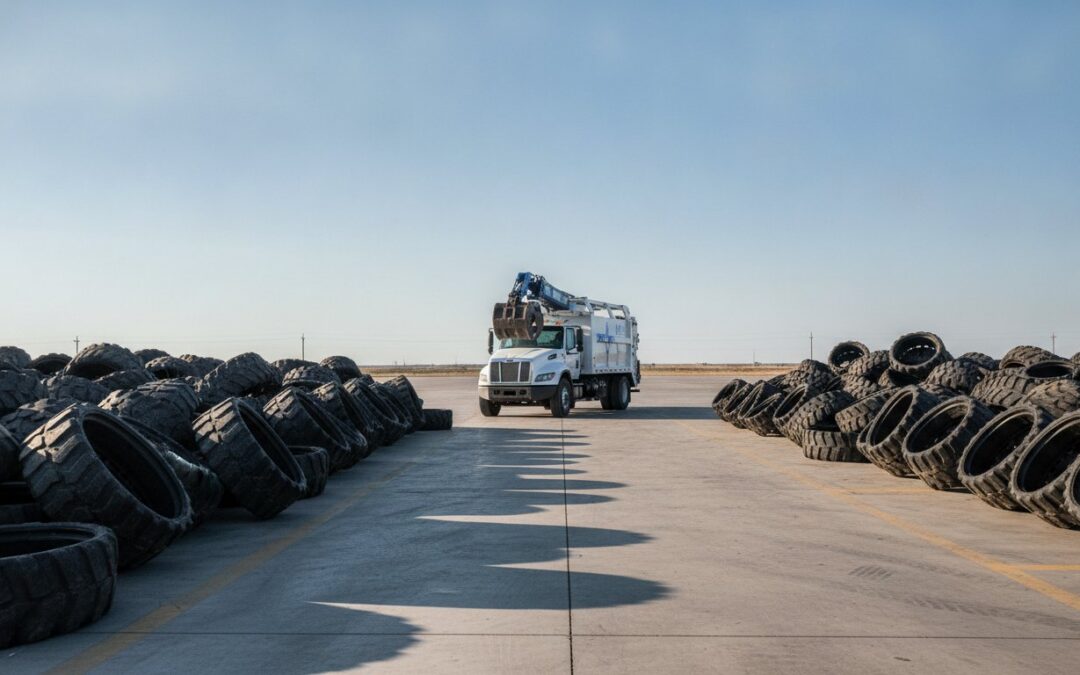
Stacking old skid steer tracks in the corner of your yard isn’t just a space problem; it’s a regulatory risk that could cost you thousands in TCEQ fines. Most operators discover too late that skid steer track disposal Midland is a specialized logistics challenge rather than a standard trash run. Since local landfills now reject these tracks because their internal steel cables damage shredding equipment, you’re often left with heavy, space-consuming scrap piles that refuse to go away. It’s a frustrating bottleneck that drains labor hours and complicates your environmental reporting.
Key Takeaways
- Understand why Midland landfills reject whole skid steer tracks and how to avoid costly turn-aways at the gate due to internal steel reinforcement.
- Learn how to correctly use the TCEQ manifest system to shield your business from heavy illegal dumping fines and long-term liability.
- Discover why professional skid steer track disposal Midland services are more cost-effective than manual cutting, saving you significant labor and equipment costs.
- Identify legal disposal routes for other Permian Basin industrial scrap, including heavy-duty hoses and reinforced conveyor belts.
- See how partnering with a permitted hauler simplifies your operations by handling all compliance paperwork while recycling waste into crumb rubber.
Why Skid Steer Tracks are Rejected by Midland Landfills
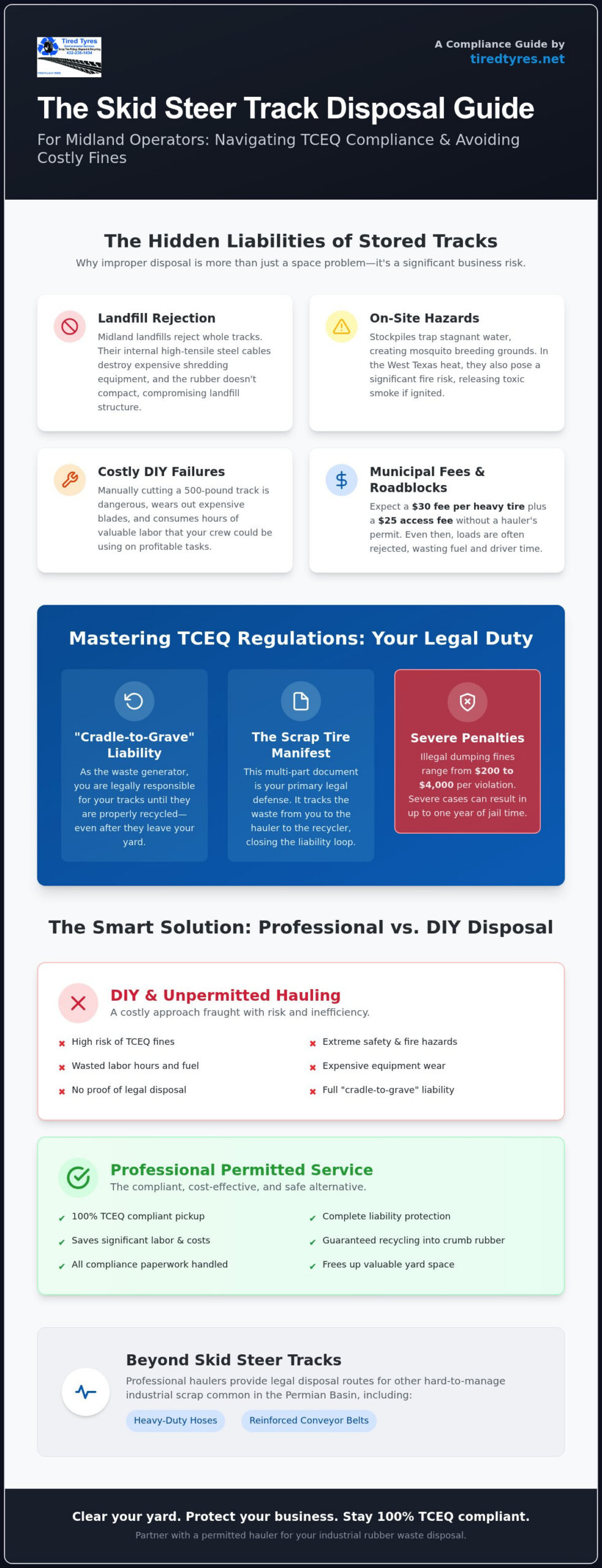
Driving a trailer full of old rubber to the Garden City Highway gate often ends in a frustrating U-turn. The City of Midland landfill has strict policies against accepting whole, heavy-duty tires and tracks. They don’t compact well. Over time, these large items trap air and “float” back to the surface of the waste pile. This migration compromises the landfill’s structural integrity and creates a long-term maintenance nightmare for city operators. This rejection policy is the primary reason why skid steer track disposal Midland requires a specialized approach rather than a standard trash run.
Stockpiling these tracks in the West Texas heat creates additional liabilities. Rubber piles are notorious for trapping stagnant water, becoming ideal breeding grounds for mosquitoes. In the intense heat of the Permian Basin, these piles also represent a significant fire hazard. Once a rubber pile ignites, it’s incredibly difficult to extinguish and can burn for days, releasing toxic smoke into the atmosphere. Leaving these tracks in your yard isn’t just an eyesore; it’s a safety risk for your crew and your property.
The Problem with Integrated Steel Reinforcement
The real conflict lies beneath the rubber. Skid steer tracks are built with high-tensile steel cables and forged steel drive lugs. While standard passenger tires can be processed using common tire recycling methods, these industrial tracks are different. The integrated steel is designed to be indestructible, but that same durability destroys municipal shredding blades. Most city facilities aren’t equipped to handle the high-torque demands of shearing through reinforced industrial rubber. Because of their internal metal structure, skid steer tracks are classified as specialized industrial waste rather than consumer scrap. Attempting to manually “quarter” a 500-pound track with a saw is dangerous, wears out expensive blades, and takes hours of labor that your crew can’t afford to waste.
Municipal Limitations and Residential Free Days
Don’t rely on Midland’s residential “Free Trash Days.” Those events are strictly for household waste and typically exclude commercial-grade industrial rubber. For standard disposal attempts, the city charges a $30.00 fee per tire for heavy equipment or commercial tires. If you arrive in a vehicle without a valid Garbage Hauler’s Permit, you’ll also face a $25.00 access fee per visit. Even if you’re willing to pay these fees, the landfill often enforces a strict limit on the number of items they’ll accept. If a gate attendant determines your tracks are too large or contain too much steel, they’ll reject the load entirely. Hauling a rejected load back to your yard wastes fuel, driver hours, and machine time, turning a simple disposal task into a costly logistical failure.
Navigating TCEQ Regulations for Industrial Rubber in Texas
Compliance with the Texas Commission on Environmental Quality (TCEQ) is the most critical part of managing industrial waste in the Permian Basin. For businesses handling skid steer track disposal Midland, the law is clear: you’re responsible for that waste from the moment it’s removed from the machine until it’s officially processed at a registered facility. This “cradle-to-grave” liability means that if an unpermitted hauler dumps your tracks in a ditch, the TCEQ can trace them back to your job site or yard. It’s not just about getting rid of the rubber; it’s about documenting where it goes.
The Scrap Tire Manifest is your primary defense against legal trouble. This multi-part tracking document records the generator, the hauler, and the final disposal site. When you hand off tracks, you must receive a signed copy from the driver. Once the tracks reach a permitted recycling center, you’ll receive a final copy confirming the loop is closed. According to national rubber recycling data, millions of tons of rubber are generated annually. State systems like the Texas manifest program are designed to ensure this massive volume doesn’t end up in illegal stockpiles that threaten local groundwater and public safety.
Understanding Your Liability as a Waste Generator
Hiring an unpermitted “man with a truck” might seem like a cost-saving move, but it often leads to secondary fines that range from $200 to $4,000 per violation. In severe cases, illegal dumping can lead to a jail sentence of up to one year. For a deeper compliance dive, you can read our detailed breakdown of Texas Tire Disposal Regulations. Remember that Midland businesses must store these disposal documents for at least three years. If a state inspector visits your shop, these manifests are the only proof that you’ve followed the law.
How to Spot a Permitted Hauler
A legitimate hauler will always have a TCEQ registration number available. Be wary of any service provider who asks for cash only or refuses to provide a manifest. These are major red flags. Ensuring reliable tire disposal requires verifying that your partner is state-approved and properly insured. If you’re dealing with a growing scrap pile, choosing a permitted partner ensures your skid steer track disposal Midland stays fully compliant with 2026 standards. If you want to clear your yard without the regulatory headache, you can trust Tired Tyres to manage the paperwork and the pickup for you.
Comparing Disposal Methods: Professional Hauling vs. DIY
Choosing between a DIY approach and professional skid steer track disposal Midland often comes down to a simple calculation of time versus money. While the upfront cost of a hauling service is visible, the hidden expenses of self-hauling are often buried in lost productivity and damaged equipment. Many fleet managers initially believe they’ll save money by handling the task in-house, but the reality of industrial rubber disposal in West Texas usually proves otherwise.
The DIY cutting method is a primary example of a false economy. Skid steer tracks are designed to be indestructible, and they don’t give up easily. Standard reciprocating saws or circular saws struggle with the high-tensile steel reinforcement embedded in the rubber. You’ll likely go through multiple expensive carbide blades just to quarter a single 500-pound unit. When you factor in the hourly rate of a skilled technician and the cost of these consumables, the “free” disposal method quickly becomes a financial drain on your operations.
Site safety should also be a top priority for any Permian Basin contractor. Leaving heavy scrap rubber in high-traffic areas creates significant trip hazards for your crew. These piles also attract pests and trap heat. Removing these obstacles immediately improves the workflow of your yard and reduces the risk of workplace accidents. A clean site isn’t just about appearances; it’s about maintaining a professional, safe environment where your team can focus on billable work rather than navigating around scrap piles.
The Hidden Costs of Self-Hauling
Every hour your crew spends at the landfill is an hour they aren’t on a billable job site. If they face a rejection at the gate, which is a common occurrence for whole tracks in Midland, that lost time is doubled. Loading and unloading 500-pound tracks also takes a toll on company trailers. The concentrated weight of steel-reinforced rubber can bend ramps and strain axles not specifically designed for industrial waste transport. When you add the $25 landfill access fee and the potential $30 per-item charge for heavy equipment tires, the DIY route loses its appeal fast.
B2B Benefits of Scheduled Collection
Moving to a scheduled pickup model allows for predictable overhead regarding commercial tire disposal and industrial rubber management. Instead of waiting for a scrap pile to become unmanageable, you can maintain a clean, professional yard. This “set it and forget it” strategy clears valuable space for active inventory and equipment. Partnering with a specialist for skid steer track disposal Midland ensures your facility operates at peak efficiency while you stay focused on your core business goals.
Disposing of Other Industrial Rubber Waste in Midland
While skid steer track disposal Midland is a top concern for construction crews, the Permian Basin’s industrial sector generates a wide variety of other difficult-to-handle rubber. Scrap conveyor belts from mining operations and heavy-duty industrial hoses from oilfield sites present similar logistical hurdles. These materials are often reinforced with fabric or steel, making them just as resilient and “un-shreddable” as equipment tracks. Standard waste management services often refuse these items because they don’t fit the profile of municipal trash or residential scrap.
Conveyor Belt and Hose Logistics
Handling “long-form” rubber waste is particularly challenging. A 100-foot section of heavy-duty conveyor belt can weigh thousands of pounds and won’t fit into a standard roll-off dumpster without extensive, labor-intensive cutting. Many waste tire problems in West Texas are actually caused by the improper abandonment of these industrial materials. Because they’re so difficult to load and transport, they often end up as permanent fixtures in equipment yards. Proper disposal requires specialized trailers and loaders capable of handling high-density, awkward loads without damaging the transport vehicle.
Solid Tires and High-Density Rubber
Solid rubber tires, commonly used on forklifts and warehouse equipment, present a different challenge: extreme weight. Unlike pneumatic tires filled with air, solid tires are pure high-density rubber. Their weight-to-volume ratio is much higher, which often makes them more expensive to dump at facilities that charge by weight. However, these tires are prime candidates for recycling. They can be shredded and processed into heavy-duty industrial flooring or livestock mats. Keeping these materials out of Texas ravines and local landfills is a priority for state regulators. If you have a growing pile of industrial scrap, you can schedule a bulk industrial rubber collection with Tired Tyres to clear your site quickly and legally.
Tired Tyres: Your Partner for Skid Steer Track Disposal
Tired Tyres provides a direct solution to the logistical hurdles of skid steer track disposal Midland. We operate across the Permian Basin, offering reliable pickup services in Midland, Odessa, and Lubbock. Our team understands that your primary focus is on the job site, not on managing scrap rubber. We’ve built our service to be as efficient and unobtrusive as possible. This allows you to clear your yard without diverting your own crew from billable hours or risking damage to company trailers.
Our specialized fleet is equipped to handle the extreme weight of industrial rubber. Lifting a 500-pound reinforced track requires more than just a standard pickup truck. We use specialized loading equipment designed to move heavy tracks and solid tires safely. This prevents damage to your property and ensures a quick removal process. This specialized approach is what makes us a trusted partner for contractors who can’t afford the risks and labor costs of DIY hauling.
Compliance is often the biggest headache for local businesses. We handle the entire manifest process, ensuring every load is documented according to state law. This turnkey service means you don’t have to worry about the legal liability associated with industrial waste. We close the loop on your disposal needs. Our team provides the necessary paperwork to keep your business 100% compliant during any potential TCEQ inspection, protecting you from secondary fines.
From Scrap Track to Crumb Rubber
The lifecycle of your waste doesn’t end at our facility. Through professional tire recycling, your old tracks are processed into crumb rubber that supports Texas infrastructure. This sustainable approach turns steel-reinforced rubber into clean asphalt filler for local road projects. Choosing recycling over landfilling significantly improves your company’s ESG profile. It demonstrates a clear commitment to responsible waste management in the Permian Basin while keeping heavy rubber out of local landfills.
Get Started with a Midland Pickup Quote
Getting started is a straightforward process. To receive an accurate estimate, simply inventory your scrap pile and identify the type of tracks or industrial rubber you need removed. We offer both one-time cleanup options for completed projects and scheduled collection for high-volume sites. This flexibility ensures you only pay for the service you actually need. Don’t let scrap rubber accumulate and create a safety hazard in your yard. You can trust our experienced team to handle the heavy lifting and the paperwork. Request your professional skid steer track pickup quote today.
Secure Your Fleet Operations with Compliant Disposal
Managing heavy industrial rubber doesn’t have to be a recurring headache for your Midland job site. Navigating landfill rejections and complex TCEQ paperwork requires a specialized approach that protects your business from long term liability. By choosing a professional partner, you eliminate the high labor costs of manual cutting and the risk of expensive environmental fines. You’ve seen how the manifest system serves as your legal shield; now it’s time to put that protection into practice.
Tired Tyres is a TCEQ Permitted Hauler dedicated to simplifying skid steer track disposal Midland for contractors across the entire Permian Basin. We take pride in our 90% recycling rate, ensuring your scrap rubber is transformed into useful materials rather than sitting in a landfill. Our team handles the manifests and the heavy lifting, giving you back the yard space and time you need to focus on your core projects. We make it easy to maintain a clean, professional, and compliant facility.
Ready to clear your site? Request a Professional Skid Steer Track Pickup Quote in Midland today. We’re here to help you stay compliant and efficient as you grow your business in West Texas.
Frequently Asked Questions
Does the Midland landfill accept skid steer tracks from businesses?
The City of Midland landfill typically rejects whole skid steer tracks because they are classified as industrial waste that doesn’t compact. While the city fee schedule lists a charge for heavy equipment tires, gate attendants often turn away reinforced tracks to protect their shredding equipment. Using a specialized service for skid steer track disposal Midland ensures you don’t waste time and fuel on a rejected trip to the gate.
Why do landfills reject rubber tracks with steel cables?
Landfills reject these tracks because the integrated steel cables and lugs are “un-shreddable” for standard municipal machinery. These high-tensile cables can snap or dull expensive shredding blades instantly. Additionally, whole rubber tracks trap air and tend to “float” to the surface of the waste pile over time; this migration compromises the landfill’s structural integrity and creates long-term maintenance issues for city operators.
What is the cost of skid steer track disposal in Midland?
Disposal costs at the city landfill are $30.00 per heavy equipment tire plus a $25.00 access fee for vehicles without a hauler’s permit. However, because tracks are frequently rejected at the gate, many businesses find these fees are just the beginning of the actual cost. Professional hauling services provide a comprehensive quote based on your specific volume and location; this includes all necessary TCEQ manifest paperwork and guaranteed acceptance.
Do I need a TCEQ manifest for industrial rubber disposal?
Yes, a TCEQ manifest is mandatory for any business transporting more than five tires or tracks at one time. This document acts as your legal proof that the waste reached a permitted processing facility rather than an illegal dump site. Failing to maintain these records for at least three years can result in significant fines during a state environmental audit, even if the disposal was handled by a third party.
Can you pick up conveyor belts and industrial hoses in Odessa?
We provide full-service collection for industrial hoses and scrap conveyor belts across the entire Permian Basin, including Odessa and Lubbock. Our specialized trailers are designed to handle the awkward weight and length of these materials. We help local oilfield and industrial sites clear their yards of rubber waste that standard dumpster services won’t touch due to weight and contamination concerns.
How many skid steer tracks can you haul in one trip?
Our specialized fleet can handle bulk loads of dozens of tracks in a single trip, depending on the specific dimensions and weight of the units. We use heavy-duty trailers and loading equipment specifically designed for high-density industrial rubber. This efficiency allows us to clear large job sites or equipment yards much faster than a standard roll-off service or a crew using light trailers.
What happens to the steel inside the rubber tracks during recycling?
During the recycling process, the internal steel cables and lugs are mechanically separated from the rubber casing. This steel is then sent to metal recyclers for reuse in new products. The remaining rubber is processed into clean crumb rubber; this material is used in local infrastructure projects like rubberized asphalt for West Texas roads, ensuring that nearly 100% of the track is repurposed.
Is it illegal to bury old skid steer tracks on a job site in Texas?
Burying skid steer tracks on a job site is strictly illegal in Texas and is classified as illegal dumping at an unpermitted location. TCEQ regulations are clear that all scrap rubber and tracks must go to a registered facility. Violations can lead to fines between $200 and $4,000 and even potential jail time for offenders. Professional skid steer track disposal Midland is the only way to ensure your business stays compliant.