
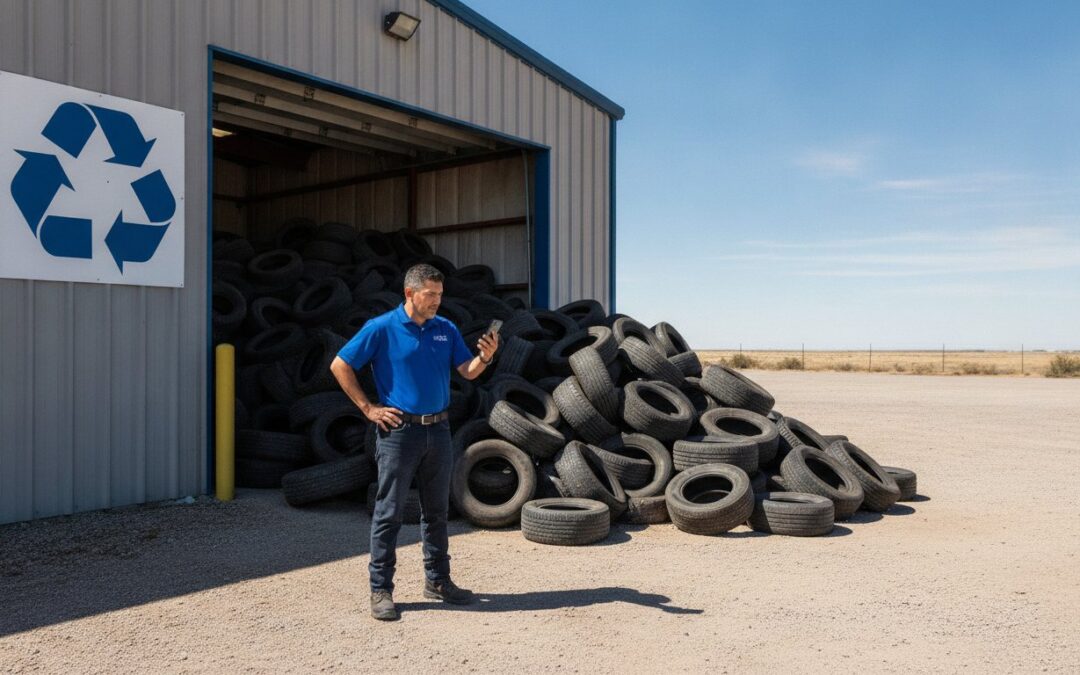
It is a sweltering afternoon in Odessa, and your scrap tire pile has officially crossed the line from a nuisance to a hazard because your scheduled pickup never arrived. If you are currently wondering what to do when your tire hauler doesn’t show up, you are likely feeling the pressure of limited space and the looming threat of a TCEQ inspection. You have worked hard to keep your shop compliant, and a single missed appointment shouldn’t put your business at risk for the types of penalties that totaled over $2.4 million across Texas in 2025.
We understand that a reliable partner is the only thing standing between you and a significant legal liability. It’s frustrating to be left in the lurch, but taking the right steps now can prevent pests, fire risks, and expensive fines. This guide provides the immediate checklist you need to follow to document the failure and protect your status with the state. You’ll learn the specific storage thresholds that trigger mandatory registration and how to vet a replacement hauler who actually shows up. We will give you the tools to clear the pile and ensure your scrap management is handled with professional precision.
Key Takeaways
- Document the missed appointment immediately with photos and timestamps to create a clear paper trail for compliance.
- Learn exactly what to do when your tire hauler doesn’t show up to prevent exceeding TCEQ storage limits and incurring fines.
- Understand your legal liability under the Texas manifest system, which holds generators responsible until tires reach a permitted site.
- Identify red flags like missing TCEQ registrations or inadequate equipment for handling large-scale OTR and agricultural tire collections.
- Establish a partnership with a reliable, local hauler who provides immediate, compliant documentation for every pickup.
Immediate Steps to Take When Your Tire Hauler Misses a Pickup
When your scheduled pickup window passes and the lot remains full, you are in a vulnerable position. Your business isn’t designed to be a long-term storage facility, and uncollected rubber quickly becomes a liability. Knowing exactly what to do when your tire hauler doesn’t show up is essential for protecting your bottom line. The first priority is to stop waiting and start documenting. A missed appointment is more than a scheduling glitch; it’s a gap in your compliance record that needs to be filled immediately.
Documenting the Failure for Regulatory Protection
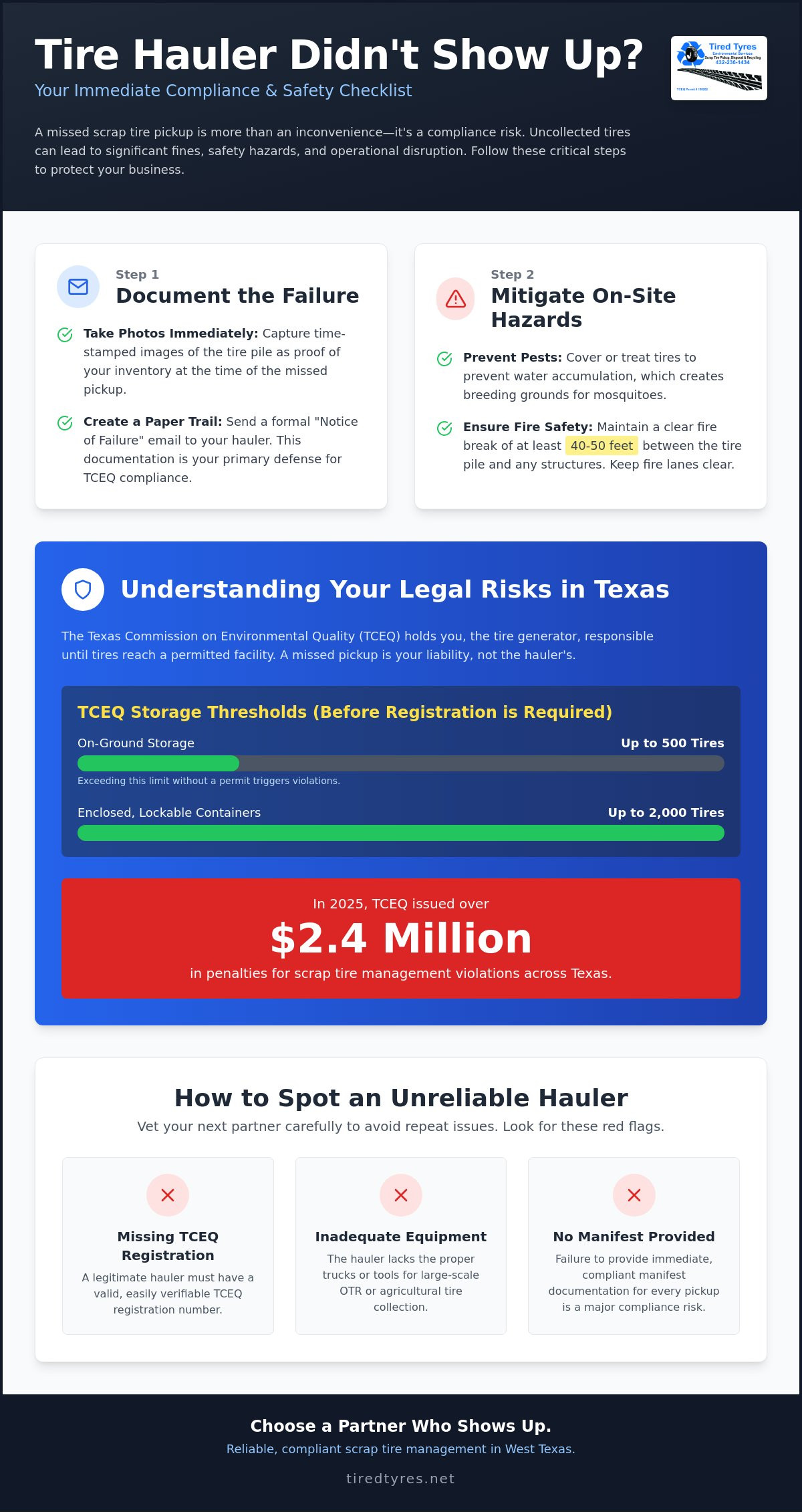
TCEQ inspectors don’t accept verbal excuses about a hauler’s mechanical issues or staffing shortages. If your inventory exceeds the 500-tire threshold for on-ground storage, you’re legally required to have a registered management plan. Take high-resolution photos of the pile immediately. Ensure the date and time are visible in the metadata or on the image itself. This creates a “snapshot” of your inventory at the moment the service failed.
Next, send a formal “Notice of Failure” via email to your current provider. This creates a digital paper trail that proves you attempted to fulfill your responsibility as a generator. Understanding the broader Tire recycling process helps you realize why the state is so strict about these manifests. The chain of custody must remain unbroken from your shop to the final disposal site. If the hauler stops responding, this documentation is your only shield against the significant penalties TCEQ issued in 2025.
Mitigating Immediate On-Site Hazards
West Texas weather presents unique challenges for uncollected rubber. In Midland and Odessa, even a brief rain can leave standing water inside tires, which creates a breeding ground for mosquitoes and other vectors. If your hauler misses a pickup for Passenger or Semi-Truck Tire Collections, you must ensure the pile is covered or treated to prevent water accumulation. Stagnant water is a health hazard that can draw unwanted city attention to your property.
Fire safety is equally critical. You must maintain a clear fire break of at least 40 to 50 feet between your tire pile and any permanent structures. If your lot is small and you’re dealing with an overflow of OTR (Off-the-Road) or Agricultural Tire Collections, prioritize clearing paths for emergency vehicles. Consider these immediate actions:
- Check Fire Lanes: Ensure no tires have spilled into designated emergency access routes.
- Verify Right-of-Ways: Move any tires encroaching on public sidewalks or alleys.
- Organize by Type: Keep Semi-Truck and OTR tires separate to make it easier for a backup hauler to load quickly.
Once the site is secure, reach out to a permitted backup hauler in West Texas. Don’t let a single missed pickup turn into a month-long backlog. A reliable partner will help you clear the area before the pile becomes unmanageable or attracts a formal inspection.
Understanding the Legal Risks of Uncollected Tires in Texas
When a service provider fails, the legal burden doesn’t shift; it stays exactly where it started. If you are trying to figure out what to do when your tire hauler doesn’t show up, you must recognize that the Texas Commission on Environmental Quality (TCEQ) holds you, the generator, accountable for every scrap casing on your lot. Texas law is specific about storage. You can store up to 500 scrap tires on the ground or 2,000 in enclosed, lockable containers before you are required to register as a storage site. Exceeding these limits without a permit is an invitation for heavy fines. In 2025, the TCEQ issued over $2.4 million in penalties for scrap tire management violations, proving that enforcement is a high priority for the state.
The Texas Scrap Tire Manifest System
The scrap tire manifest is the legal “chain of custody” document that tracks waste rubber from the point of generation to its final, authorized disposal or recycling facility. If a hauler misses a pickup, you’re left with an open manifest or no documentation at all, which is a major red flag during an audit. You’re legally responsible for ensuring your tires are transported by a permitted hauler and reach a registered facility. This responsibility is a core part of the Texas tire disposal regulations that every shop owner must follow. Proper documentation supports Sustainable tire recycling and ensures that tires don’t end up in unauthorized sites, which currently hold an estimated 13.1 million tires across Texas.
Environmental and Fire Hazards in the Permian Basin
The arid climate of West Texas creates a dangerous environment for uncollected rubber. Tire fires in the Permian Basin are incredibly difficult to extinguish because the shape of the tires traps heat and provides a constant oxygen supply. These fires can burn for weeks, leading to massive soil and air contamination. Beyond the fire risk, local authorities in Midland and Odessa are aggressive about nuisance abatement. Even in dry Lubbock, stagnant water in a single tire can breed enough mosquitoes to create significant public health risks. These waste tire problems often lead to daily fines from local code enforcement. To avoid these “nuisance” citations, it’s vital to maintain reliable scrap rubber collection services that keep your inventory below the legal thresholds.
Your liability doesn’t end until those tires are physically removed and the manifest is signed. If your current provider is unreliable, the risk of a vector control violation or a fire safety citation increases every day the rubber sits in the sun. Don’t let a hauler’s failure become your legal nightmare.
Why Tire Haulers Fail (And How to Spot the Red Flags)
Understanding the root cause of service failure helps you avoid making the same mistake twice. Most haulers don’t miss appointments because they’re simply busy; they miss them because they lack the infrastructure to sustain a legal business in Texas. Reliability is the cornerstone of any transport-based industry, from waste management to professional passenger services like Yellow Cabs Airdrie Taxi. When you are left wondering what to do when your tire hauler doesn’t show up, the answer often lies in the hauler’s inability to access a registered disposal facility. If a hauler can’t legally offload the rubber they’ve already collected, they’ll stop picking up new loads to avoid getting caught with an illegal stockpile of their own.
This cycle is often called the “dump and run” trap. Unregistered haulers collect disposal fees from businesses in Midland or Odessa, then disappear when they can no longer find a place to dump the tires illegally. Because the TCEQ oversees the removal of hundreds of thousands of tires from unauthorized sites every year, enforcement eventually catches up with these operators. When it does, they ghost their clients to avoid a paper trail. Spotting these red flags early is the only way to protect your shop from being part of an illegal disposal chain.
Equipment and Capacity Issues
Specialized inventory requires specialized equipment. A hauler might show up for a Passenger & Light Truck Tire Collection with a standard utility trailer, but that same setup will fail when faced with a Semi-Truck Tire Collection. Semi-truck tires are significantly heavier and require reinforced trailers and professional lift systems to manage the volume safely.
The challenge is even greater for OTR (Off-the-Road) and Agricultural Tire Collections. These tires can weigh hundreds of pounds each and require heavy-duty machinery for loading. If your hauler seems overwhelmed by the size of your casings or lacks the proper hydraulic equipment, they’re likely to start skipping appointments. A reliable partner should have a fleet capable of handling your specific tire types without multiple trips or mechanical delays.
Registration and Insurance Gaps
Every legitimate scrap tire hauler in Texas must have a Tire Program Identification (TPID) number. You can verify this through the TCEQ’s public database. If a hauler cannot provide a TPID or shows hesitation when asked for their manifest records, they’re not a professional service provider. Unregistered haulers also rarely carry the required $10,000 surety bond. This bond isn’t a luxury; it’s a legal safeguard that ensures the hauler follows state regulations.
Fly-by-night operators often avoid the Midland-Odessa-Lubbock corridor because the distance between registered disposal sites is significant. Without proper insurance and registration, the cost of fuel and legal disposal fees eats their margins, leading them to cut corners or stop showing up entirely. Verifying these credentials before you sign a service agreement is the best way to ensure your lot stays clear and your business stays compliant.
How to Vet a New Tire Disposal Service for Reliability
Finding a new partner after a service failure requires a more rigorous screening process. You already know what to do when your tire hauler doesn’t show up in terms of documentation, but the next step is ensuring the replacement is stable. A reliable hauler should be able to prove their TCEQ registration and provide a list of local references from the Permian Basin or the South Plains. If they cannot point to a single shop in Midland or Lubbock that they service weekly, they likely don’t have a consistent route or a physical footprint in the area.
Documentation is the non-negotiable part of the vetting process. Ask a potential hauler to show you a sample manifest. It should be clear, professional, and include their Tire Program Identification (TPID) number. A hauler who promises to “email the paperwork later” is a liability you cannot afford. You need a partner who hands you a signed, compliant manifest before the truck leaves your property. This immediate transparency is the hallmark of a professional operation that understands the weight of your legal responsibility.
Local Knowledge vs. National Brokers
Many West Texas businesses fall into the trap of hiring national waste brokers. These middle-men often don’t own their own trucks; they simply outsource the work to the lowest bidder. This frequently results in the very “ghosting” issues you are trying to solve. Achieving reliable tire disposal depends on a hauler knowing the specific routes and landfill capacities between Odessa and Big Spring. Direct communication with a local dispatcher ensures that when you have a question, you’re talking to the person who actually knows where the truck is located.
Specialized Handling for Industrial Rubber
Not every hauler is equipped to handle the diverse waste generated by industrial sites. If your business produces more than just standard passenger casings, you need to verify that the hauler can manage specialized items. This includes scrap skid steer tracks, rubber hoses, and heavy conveyor belts. These items require different handling and disposal protocols than standard tires. Following the rules for commercial tire disposal means hiring a team with the right equipment for these heavy, awkward materials. A “one size fits all” approach often leads to equipment failure and missed pickups at industrial yards.
Before you commit to a new schedule, assess the hauler’s fleet. Do they have the appropriate trailers for OTR or Agricultural Tire Collections? A professional fleet is a sign of a well-capitalized business that isn’t going to disappear when fuel prices fluctuate. If you need a partner who understands the demands of West Texas industry, contact Tired Tyres today for a dependable collection schedule that keeps your lot clear and compliant.
Reliable Scrap Tire Collection with Tired Tyres
When you are faced with a mounting pile of rubber and a provider who has vanished, you need a partner who values your time as much as your compliance. Tired Tyres was built to solve the specific frustrations West Texas businesses face. We understand that knowing what to do when your tire hauler doesn’t show up is only half the battle; the other half is finding a team that honors its schedule. We provide a professional, direct solution for scrap management that removes the burden of liability from your shoulders.
Our service is fully permitted and bonded in accordance with Texas regulations. We don’t just haul your tires away; we manage the entire manifest process. This ensures that your business has the necessary documentation to prove every casing reached a registered disposal site. Whether you are managing a Passenger & Light Truck Tire Collection or a massive OTR (Off-the-Road) Tire Collection, our fleet is equipped to handle the volume safely and efficiently. We take pride in being the reliable backup that becomes your permanent primary provider.
Serving the Permian Basin and South Plains
Our roots are deep in the Midland and Odessa industrial sectors. We understand the logistical challenges of the oilfield and the high-volume needs of local auto shops. Because we are local, we can offer response times and reliability that national brokers simply cannot match. For those seeking a comprehensive resource, our guide to tire disposal in Midland provides a detailed look at how we maintain legal scrap removal standards across the region.
We also provide dedicated support for Lubbock’s agricultural and commercial sectors. From Agricultural Tire Collections on the farm to Semi-Truck Tire Collections at regional transport hubs, we have the specialized trailers needed for heavy-duty work. We don’t leave you guessing about your next pickup date. Our routes are planned for maximum efficiency, ensuring your lot stays clear and your business remains in good standing with local code enforcement.
Beyond Tires: Industrial Rubber Waste Solutions
West Texas industry generates more than just standard tire waste. Many haulers will skip over the difficult items, but we provide a comprehensive solution for all your rubber disposal needs. Our team is trained in the efficient removal of scrap skid steer tracks and solid tires, which are often too heavy for standard tire haulers to manage. We also handle the following industrial materials:
- Scrap Hose Collection: Managing both standard and lay-flat hoses from oilfield and agricultural sites.
- Scrap Conveyor Belt Collection: Removing worn belts from industrial facilities without the hassle.
- Scrap Rubber Collection: Handling miscellaneous rubber waste that other providers refuse.
If you’re tired of waiting for a truck that never arrives, it’s time to switch to a partner that prioritizes your business. We offer the professional precision you expect and the reliability you deserve. Contact Tired Tyres today to set up a collection schedule that actually works for your shop or industrial yard.
Securing Your Business for the Long Term
Managing scrap rubber shouldn’t be a source of constant stress for your West Texas business. By documenting missed appointments and understanding your legal thresholds, you protect yourself from the types of penalties that hit Texas businesses hard in 2025. Now that you know exactly what to do when your tire hauler doesn’t show up, you can move from reactive panic to proactive management. The key is to prioritize a partner who provides a clear paper trail and possesses the infrastructure to handle your specific volume.
Finding a team that actually owns their trucks and understands the Permian Basin is the final piece of the puzzle. You need a service provider that provides TCEQ-compliant manifest documentation on the spot and has the specialized equipment to handle everything from standard passenger casings to massive OTR and Agricultural tires. Don’t let uncollected rubber threaten your site’s safety or your permit status in Midland, Odessa, or Lubbock.
You deserve a service that shows up on time, every time. Schedule a Reliable Tire Pickup with Tired Tyres today to clear your backlog and ensure your business stays fully compliant. We’re here to take the weight of scrap management off your shoulders.
Frequently Asked Questions
What should I do if my tire hauler stops answering my calls?
Document the failure immediately and contact a permitted backup hauler to clear your lot. Start by recording the date and time of the missed appointment and the number of tires currently on your property. This paper trail is necessary for regulatory protection if the TCEQ conducts an inspection before you can find a replacement. Once documented, reach out to a reliable, local provider in West Texas to restore your pickup schedule.
Can I be fined if my hauler doesn’t show up and my tire pile gets too big?
Yes, you are legally responsible for any tires stored on your property, regardless of a hauler’s failure. Texas law is clear that generators are liable for maintaining safe storage limits and proper vector control. If you’re wondering what to do when your tire hauler doesn’t show up, the priority is keeping your inventory below the 500-tire threshold to avoid mandatory registration and potential fines from the TCEQ.
How do I check if a tire hauler is legally permitted in Texas?
You must verify their Tire Program Identification (TPID) number through the TCEQ’s public database. A legitimate hauler will also be able to provide proof of their $10,000 surety bond and a sample of their manifest documentation. Never rely on verbal promises. Professional haulers in the Midland-Odessa-Lubbock area will carry these credentials and present them upon request to ensure your business remains compliant and avoids illegal dumping risks.
Is it legal to take my own scrap tires to the Midland or Odessa landfill?
You can transport your own tires, but you must follow specific registration and manifest rules if you haul more than five tires at once. Most municipal landfills have strict daily limits and specific fees for scrap rubber disposal. For businesses with large inventories of semi-truck or OTR tires, hiring a permitted hauler is usually more efficient than managing the complex transport and disposal regulations on your own.
What is a scrap tire manifest and why is it important for my business?
A scrap tire manifest is the legal document that tracks the chain of custody from your shop to a registered disposal site. This document proves that you disposed of your waste rubber legally and responsibly. Without a signed manifest for every load that leaves your property, you remain liable for those tires even after they’re gone. It is your primary defense during a state environmental audit or code enforcement inspection.
How many scrap tires can I store at my business before I need a permit?
Texas law allows you to store up to 500 scrap tires on the ground or 2,000 in enclosed, lockable containers without a permit. Once you exceed these specific thresholds, you must register your site with the TCEQ. This registration is valid for 60 months. You must also submit annual activity reports by March 1st to maintain your compliance and avoid the significant state penalties issued for unauthorized storage sites.
Why do some tire haulers charge more for OTR or semi-truck tires?
Higher rates for OTR and semi-truck tires reflect the specialized equipment and increased labor required to transport these heavy items. These casings are significantly larger than passenger tires and often require reinforced trailers or hydraulic lift systems for safe loading. Additionally, disposal facilities often charge by weight or volume, making larger industrial rubber more expensive to process than standard light truck or passenger tires.
What happens if I give my tires to an unregistered hauler?
You can be held legally liable if an unregistered hauler dumps your tires illegally. If the TCEQ traces abandoned tires back to your business, you may face heavy fines and be forced to pay for the cleanup costs. This is why it’s critical to vet your providers and avoid the temptation of using unvetted, cheaper alternatives that lack proper permits, insurance, and $10,000 surety bonds.