
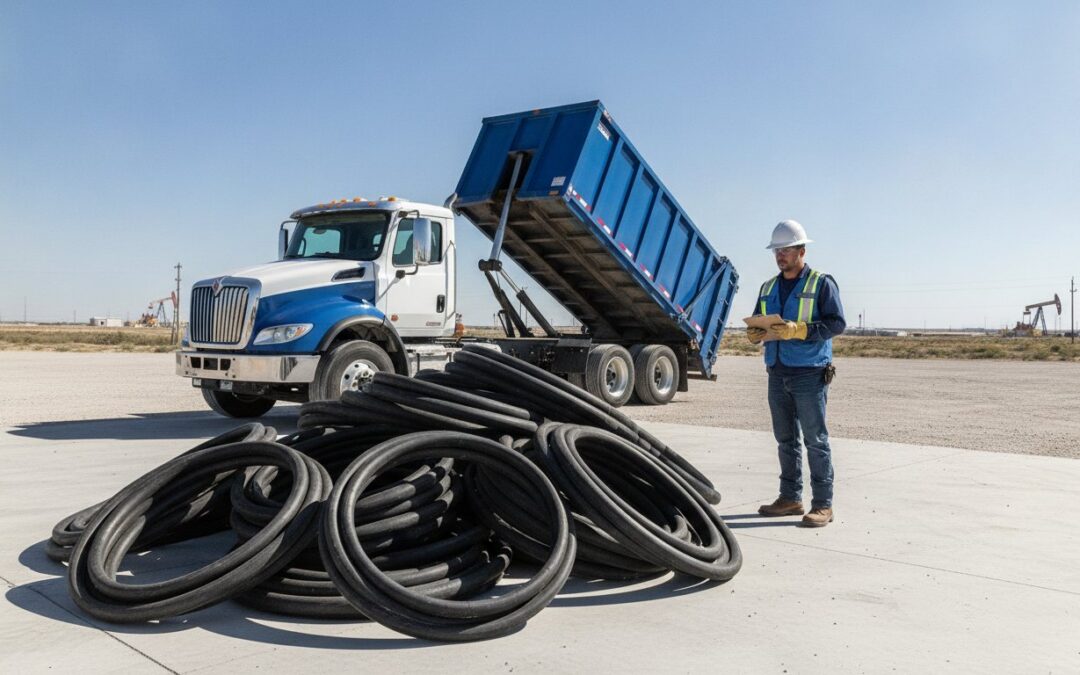
In Texas, your legal responsibility for a hydraulic line doesn’t end when it’s tossed onto a scrap pile; under “cradle-to-grave” liability, it follows your company until the moment of final disposal. You’ve probably watched bulk rubber waste clutter your yard, knowing that industrial hose disposal is a logistical nightmare that often leads to high landfill fees or the risk of TCEQ fines. It’s a common frustration for operators across the Permian Basin who need a clean site but struggle with the sheer weight and mess of contaminated rubber waste.
This 2026 guide teaches you how to manage bulk rubber waste legally and efficiently while maintaining full environmental compliance. You’ll learn exactly how to navigate current TCEQ manifest requirements and the benefits of professional collection in Midland, Odessa, and Lubbock. We will walk through the latest regulatory categories for waste generators, explain the necessity of a Solid Waste Registration number, and show you how a reliable hauling partner can remove your scrap rubber without the typical operational headaches.
Key Takeaways
- Understand why municipal landfills often reject bulk rubber and how to categorize your waste for specialized handling.
- Learn the essential steps to maintain TCEQ compliance and manage “cradle-to-grave” liability for industrial materials.
- Discover how to streamline your industrial hose disposal process to keep your West Texas facility clean and compliant.
- Master the proper techniques for draining and capping hoses to prevent hazardous leaks during the hauling process.
- Identify reliable collection services specifically designed for heavy-duty rubber waste in Midland, Odessa, and Lubbock.
Understanding Industrial Hose Disposal: Why It is Not Standard Trash
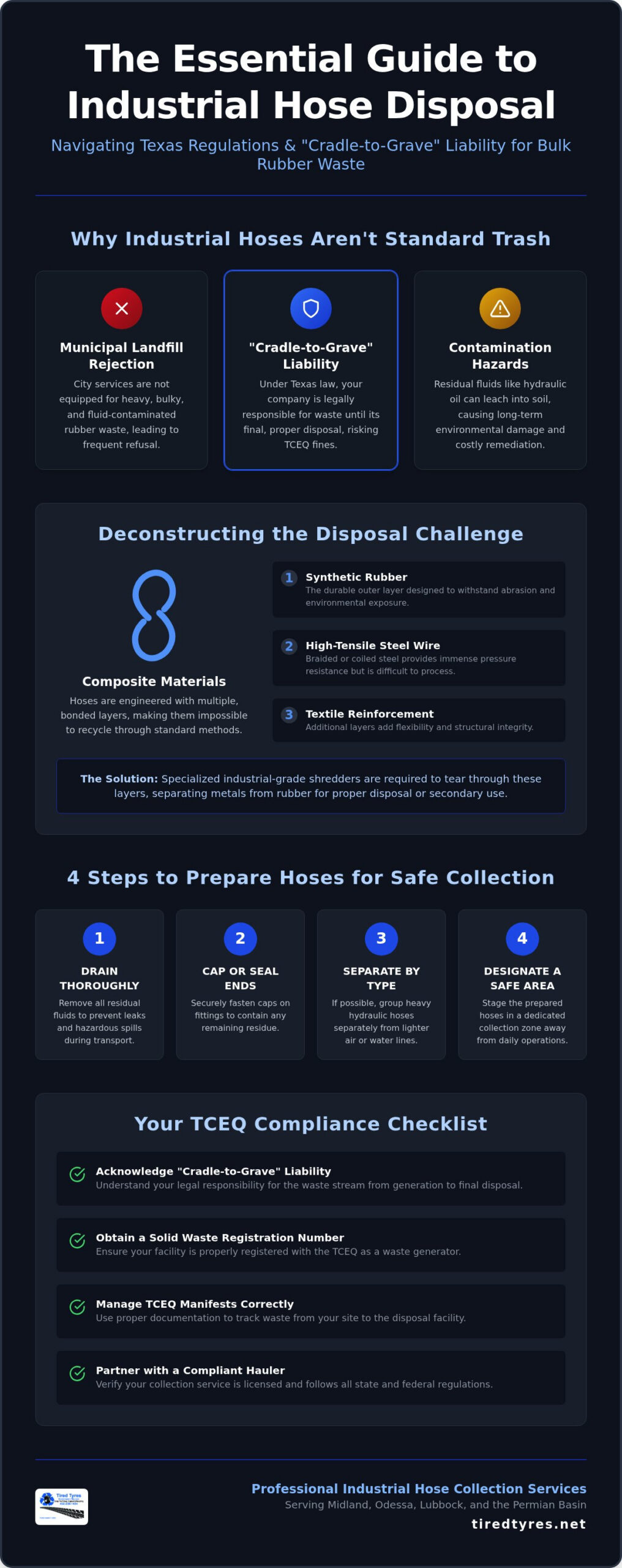
Industrial hose disposal is the managed removal of composite rubber-and-metal conduits. Unlike your breakroom trash or office paper, these items fall into a specialized waste stream that municipal services simply aren’t equipped to handle. Most city-run garbage trucks in West Texas won’t touch a 50-foot hydraulic line. They’re too heavy, too bulky, and often carry residual fluids that threaten local landfills. Abandoning these hoses on a job site isn’t just an eyesore; it’s a liability. Improperly discarded rubber can leach chemicals into the Permian Basin’s soil, leading to environmental degradation that stays on your company’s record for years. When you handle industrial hose disposal correctly, you protect your site from long-term environmental risks and potential regulatory scrutiny.
The Complexity of Composite Materials
Industrial hoses are engineering marvels designed to withstand extreme pressure. This strength comes from a complex mix of synthetic rubber, high-tensile steel wire, and textile reinforcement. While these materials are durable, they make standard recycling nearly impossible. You can’t just toss them into a bin with plastic bottles. Much like the specialized processes used in Tire recycling, industrial hoses require heavy-duty processing. To break down these composite structures, professional facilities use industrial-grade shredders. These machines are powerful enough to tear through reinforced steel and rubber simultaneously, separating the components for potential secondary use. Without this equipment, the hoses remain intact for decades, taking up valuable landfill space and creating long-term waste management issues.
The Problem with Bulk Accumulation
It’s easy to let a few old hoses pile up in a corner. However, these scrap piles quickly become significant safety hazards. In the West Texas heat, rubber piles trap stagnant water, creating perfect mosquito breeding grounds. They also pose tripping risks and fire hazards. Beyond safety, there’s the operational cost of “dead space.” Every square foot of your yard occupied by a tangled mess of old hydraulic lines is space that isn’t being used for active inventory or equipment. During site inspections, visual clutter often signals poor management. A clean, organized facility reflects professional standards. It also ensures that your team isn’t wasting time moving heavy rubber waste around just to access the tools they actually need for the job.
The Challenges of Disposing of Hydraulic and Commercial Hoses
Not all rubber waste is created equal. While a standard air hose might seem simple, the high-pressure lines used in the Permian Basin present a different set of obstacles. The primary difficulty in industrial hose disposal lies in what’s inside the hose and how much it weighs. When you’re dealing with hundreds of feet of steel-reinforced rubber, the logistics of removal quickly outgrow standard company equipment. Self-hauling these items to a landfill often results in wasted man-hours and multiple trips, especially since many facilities require specific prep work before they’ll accept bulk industrial rubber.
Specialized equipment is a necessity, not a luxury. Moving bulk scrap requires more than just a flatbed; it requires the ability to load and secure heavy, shifting coils safely. Many operators find that their internal teams aren’t equipped to handle the physical strain or the mess associated with these materials. If you’re looking for a more efficient way to clear your site, a professional scrap hose collection service can manage the heavy lifting while you focus on your core operations.
Hydraulic Hose Hazards
Hydraulic lines are rarely clean. Even after draining, residual oil remains trapped in the inner liner and fittings. In Texas, this residual fluid is a regulated substance that can’t simply be dumped. If these hoses sit in a scrap pile, the oil eventually leaches out, creating a risk of soil contamination that can trigger expensive remediation projects. Beyond the environmental impact, oil-soaked rubber is a significant fire hazard. Large stockpiles can ignite easily and are notoriously difficult for local fire departments to extinguish, potentially leading to catastrophic site damage.
Heavy-Duty vs. Light-Duty Disposal
The handling requirements vary wildly based on the hose’s intended use. High-pressure, steel-braided hydraulic lines are incredibly dense and difficult to cut or coil. In contrast, oversized suction and discharge hoses take up massive amounts of volume, even if they’re lighter per foot. Managing the logistics for these different types requires a tailored approach. Forcing your crew to manhandle these heavy, slippery conduits increases the risk of back injuries and accidents. Specialized collection is safer for your team because it uses mechanical loaders and high-capacity trailers designed specifically for the weight of industrial rubber.
Compliance and Environmental Impact: Texas Regulations for Rubber Waste
In Texas, the law is clear: you own your waste from the moment it’s generated until it’s legally processed. This “cradle-to-grave” liability makes industrial hose disposal a high-stakes task for Permian Basin businesses. The Texas Commission on Environmental Quality (TCEQ) classifies industrial waste under Title 30, Chapter 335. If your facility generates bulk rubber waste, you must maintain a Solid Waste Registration (SWR) number and, in many cases, an EPA ID. These regulations ensure that heavy-duty materials don’t end up in unauthorized locations where they can cause long-term damage.
Compliance isn’t just about paperwork; it’s about staying on the right side of Texas Tire Disposal Regulations. While hoses aren’t tires, they fall under similar industrial rubber scrap categories that TCEQ monitors closely. Proper industrial hose disposal documentation, specifically through the waste manifest system, is your only shield against liability. Using an unpermitted hauler might seem like a quick fix, but it exposes your company to massive legal risks. If an unauthorized hauler dumps your scrap in a ditch, the TCEQ will trace those hoses back to your site, regardless of who drove the truck.
Illegal Dumping Fines in West Texas
The cost of cutting corners in Midland and Lubbock counties is staggering. TCEQ fines for improper industrial waste management can reach thousands of dollars per day, per violation. Beyond the fines, “midnight dumping” often results in massive site remediation costs that the generator must pay. Businesses with an active SWR number must submit an Annual Waste Summary (AWS) by March 1st every year. This report tracks every pound of rubber that leaves your site. Failing to account for your scrap hoses in this summary is a red flag for auditors. Reliable documentation proves you’ve followed the law and protects your professional reputation.
Environmental Stewardship in the Permian Basin
Groundwater is a precious resource in West Texas. When industrial rubber degrades in the wild, it releases polymers and residual chemicals that can leach into local aquifers. Responsible disposal is a key component of modern corporate ESG (Environmental, Social, and Governance) goals. By choosing a permitted collection service, you ensure that materials are handled in a way that minimizes ecological footprints. Understanding the broader Waste Tire Problems in Midland, Odessa, and Lubbock helps illustrate why the state is so aggressive about rubber waste enforcement. Proper management today prevents the contamination crises of tomorrow.
How to Prepare Your Scrap Hoses for Professional Collection
Preparation is the bridge between having a cluttered yard and achieving a compliant site. A few simple steps on your end make the pickup process faster and safer for everyone involved. Professional haulers need to know exactly what they’re picking up and how much space it will take on the trailer. This organization prevents surprises during loading and ensures your industrial hose disposal stays on schedule. If you want a smooth experience, treat the staging area as a professional workspace rather than a dumping ground.
Draining and Decontaminating
Fluid removal is the top priority for both safety and legal compliance. Residual oils and chemicals can leak during transport, creating environmental hazards on West Texas roads. All hydraulic hoses must be drained of residual fluids before collection. If you’ve used hoses for hazardous chemicals, ensure they are flushed or capped securely with plugs. This step prevents soil contamination at your staging area and keeps your manifest documentation clean. It also protects the collection crew from exposure to pressurized or caustic fluids that might remain in the lines.
Organizing and Estimating Volume
Organize your materials by type to get the most accurate quote and ensure the right equipment arrives at your site. Keep your scrap hoses separate from other rubber products like conveyor belts or skid steer tracks. Estimating volume is straightforward: measure the length, width, and height of your pile in feet. This data helps the hauler determine the trailer capacity needed for the job. To make the process even faster, consider these sorting tips:
- Bundle long lengths: Use heavy-duty zip ties or wire to keep long hoses from tangling during the loading process.
- Remove metal fittings: If possible, cut off heavy metal ends to reduce weight and simplify the recycling process.
- Stack flat: Lay flat hoses should be rolled or folded to minimize the “dead space” they occupy in the pile.
Bulk Staging for Efficient Pickup
Where you put your pile matters as much as what’s in it. Place your scrap rubber in an area that allows a heavy-duty truck and trailer to maneuver easily. Avoid soft ground, low-hanging power lines, or tight corners that could trap collection equipment. While loose piles are acceptable, staging them on a concrete or gravel pad prevents the rubber from becoming embedded in the mud. Ensure the site is clear of debris like wood pallets or metal scrap that isn’t part of the collection. Once your materials are staged and drained, you’re ready for removal. If you need a reliable partner to handle the heavy lifting, you can schedule a professional scrap hose collection today. Proper preparation ensures that your industrial hose disposal process is seamless and fully compliant with Permian Basin standards.
Professional Industrial Hose Collection Services in Midland, Odessa, and Lubbock
Most service providers in the Permian Basin focus exclusively on selling and installing new equipment. While they might replace a blown hydraulic line on-site, they frequently leave the oily, heavy scrap behind for your crew to manage. This leaves a gap in your operational workflow and creates a growing pile of liability in your yard. Tired Tyres fills this void by offering a specialized scrap hose collection service that mirrors our approach to Reliable Tire Disposal. We don’t just move rubber; we provide a professional end-of-life solution for industrial conduits that municipal services won’t touch. By integrating industrial hose disposal into your regular maintenance routine, you ensure that waste never has the chance to become a safety or compliance issue.
Logistics for the Permian Basin
Operating across Midland, Odessa, and Lubbock requires an understanding of the high-volume needs of industrial sites. We provide customized collection schedules that adapt to your production levels. If your facility generates a steady stream of scrap rubber, a scheduled pickup is far more efficient than reactive waste management. It keeps your loading docks clear and ensures your crew stays focused on production rather than hauling heavy waste. Our team handles the heavy lifting and loading, using equipment designed for the unique weight and bulk of industrial rubber. For businesses that also manage large fleets, our expertise extends to comprehensive Tire Disposal in Midland, providing a single point of contact for all your scrap rubber needs.
Getting a Quote for Your Scrap Hose Removal
The process from initial contact to a cleared site is designed to be straightforward and transparent. When you’re ready for a pickup, having a few details ready will help us provide an accurate assessment. We’ll need to know the approximate volume of the pile, the types of hoses involved, and your location within our West Texas service area. This information allows us to dispatch the right trailer and crew for the job, ensuring we clear your site in a single visit. We pride ourselves on being a correct and professional partner for the Permian Basin’s industrial sector. Our goal isn’t just to haul waste; it’s to provide a sustainable solution that keeps your business compliant and your yard clean. Contact Tired Tyres today for a professional scrap rubber assessment and take the first step toward a more organized, efficient facility.
Streamlining Your Permian Basin Waste Management
Managing a clean and compliant industrial site in West Texas requires more than just a standard dumpster. You’ve seen that industrial hose disposal is a specialized task that goes beyond municipal trash services due to the complex nature of composite materials and residual fluid contamination. By prioritizing proper staging and understanding TCEQ manifest requirements, you protect your business from significant fines and long-term environmental liabilities. It’s about maintaining a professional workspace while adhering to the strict “cradle-to-grave” responsibilities that come with industrial operations.
Moving bulk rubber doesn’t have to be a burden on your crew or a drain on your production time. Tired Tyres is locally owned and operated right here in the Permian Basin; we provide the specialized equipment and TCEQ-compliant hauling needed to clear your yard efficiently. We take the difficulty out of the rubber waste lifecycle by handling the heavy lifting and ensuring legal disposal. It’s time to clear the clutter and focus on what your business does best. Get a Professional Industrial Hose Collection Quote from Tired Tyres and ensure your facility stays organized and compliant throughout 2026. We’re ready to help you manage your scrap rubber with precision and reliability.
Frequently Asked Questions
Can I put industrial hoses in a standard dumpster?
No. Most municipal waste services in Midland and Odessa refuse bulk industrial rubber due to its weight and composite nature. These items are too heavy for standard hydraulic lifts and can damage compacting equipment. Specialized industrial hose disposal is required to ensure these materials reach a permitted facility that can process steel reinforced rubber. Attempting to hide them in standard trash often leads to rejected loads and costly landfill fines.
Are hydraulic hoses considered hazardous waste in Texas?
It depends on the residual fluids. While the rubber itself is non-hazardous, any residual hydraulic oil or chemicals inside the line may be regulated by the TCEQ. In Texas, you’re responsible for ensuring that hazardous fluids are drained before the hose is transported. If a hose is saturated with certain chemicals, it might require handling as Class 1 non-hazardous or hazardous waste, depending on the specific substance and volume.
How much does it cost to dispose of industrial hoses in bulk?
Costs vary based on the total volume, weight, and your specific location in the Permian Basin. Factors like the distance from the pickup site to the disposal facility and the labor required for loading influence the final quote. Since heavy duty hoses are denser than standard tires, they require specialized hauling equipment. You should contact a local provider for a site assessment to get an accurate estimate for your specific scrap pile.
Does Tired Tyres pick up other industrial rubber waste like conveyor belts?
Yes, Tired Tyres provides comprehensive collection for various industrial rubber products. Our services include the removal of scrap conveyor belts, skid steer tracks, and solid rubber waste. Whether you’re operating in Lubbock or Odessa, we can manage mixed loads of industrial rubber. This saves you the hassle of coordinating with multiple haulers. This integrated approach helps maintain a clean, organized job site while ensuring all materials are handled legally.
Do I need to cut my hoses into smaller pieces before collection?
No, you don’t need to cut them. Our specialized equipment is designed to handle bulk rubber in its original size and shape. Cutting steel reinforced lines is dangerous and time consuming for your crew. Instead, we recommend coiling long hoses and securing them with wire or zip ties. This makes the loading process much faster and safer for our team when they arrive at your Midland or Odessa facility for pickup.
What happens to industrial hoses after they are collected?
Collected hoses are transported to permitted facilities for processing. Because they contain a mix of steel and rubber, they’re often put through high powered industrial shredders. This process breaks the material down into smaller fragments. These fragments can sometimes be used in waste to energy initiatives or as a base material for civil engineering projects. The primary goal is to divert this bulky waste from standard landfills and ensure compliance with Texas laws.
Can industrial hoses be recycled into new products?
Recycling industrial hoses is more complex than standard rubber due to the internal steel braiding. However, the shredded material can be repurposed for specific industrial applications. In some cases, the rubber is used in asphalt mixes or as a fuel source in specialized kilns. While they aren’t turned directly back into new hoses, the materials are diverted from landfills to minimize the environmental footprint of your Permian Basin industrial operations.
How do I know if my hose hauler is legally permitted in Texas?
You should always ask for the hauler’s TCEQ registration number. A legitimate provider will also provide a waste manifest for every pickup. This document is your proof of legal industrial hose disposal and protects you from “cradle-to-grave” liability. If a hauler can’t provide these documents or lacks a permanent business address in the West Texas region, they may not be operating within state compliance. Always verify their credentials before they load your scrap.