
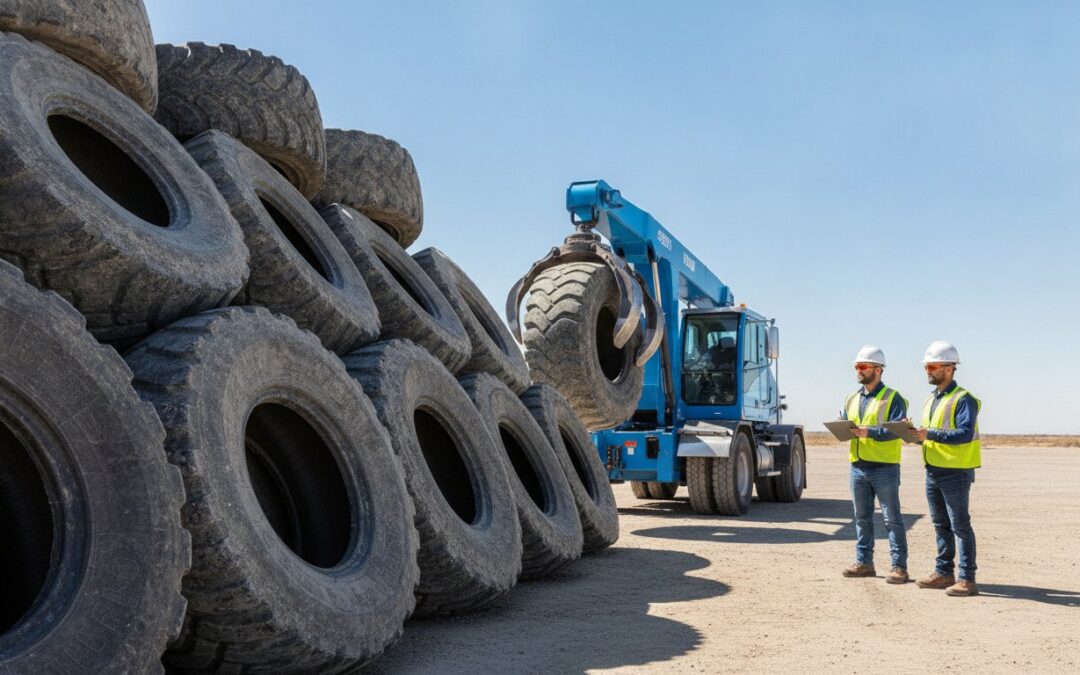
In 2025, the TCEQ issued over $2.4 million in penalties for improper scrap tire management, proving that a single mistake in handling your old rubber can cost more than the equipment it came from. If you’re operating in the Permian Basin, you know that heavy equipment tire disposal isn’t as simple as calling a standard trash service. The logistical headache of moving oversized OTR tires is only matched by the stress of staying compliant with evolving Texas environmental laws. You need a solution that removes the clutter without risking a $25,000 fine for improper storage.
This guide provides a clear roadmap for 2026 to help you manage your scrap rubber efficiently while staying completely within legal boundaries. We’ll break down the latest TCEQ manifest requirements, explain how disposal costs are calculated for industrial loads, and show you how to find a hauler with the specialized equipment needed to clear your site quickly. By understanding the rules today, you can protect your business from liability and ensure your job site remains productive and organized.
Key Takeaways
- Understand the 2026 TCEQ manifest requirements to ensure your business remains compliant and avoids heavy fines for improper storage.
- Learn how to streamline heavy equipment tire disposal by properly inventorying your OTR tires and clearing access for specialized loading machinery.
- Compare the logistical benefits of professional collection services against the strict processing requirements of West Texas municipal landfills.
- Identify which industrial rubber items, including conveyor belts and skid steer tracks, require specialized hauling rather than standard waste disposal.
- Discover efficient removal strategies for large-scale rubber waste tailored specifically for the Permian Basin and South Plains regions.
Understanding the Challenges of Heavy Equipment & OTR Tire Disposal
Managing industrial rubber waste in the Permian Basin requires more than just a big truck. Heavy equipment tire disposal involves handling Off-the-Road (OTR) tires that can weigh several tons and stand over six feet tall. These aren’t your typical truck tires; they’re engineered for the extreme conditions of oil fields, mines, and construction sites. For energy firms like Decimus Oil Corp. that focus on conventional exploration and strategic hydrocarbon development, the sheer physical scale of these tires creates a logistical bottleneck for many operations. Standard waste haulers lack the specialized equipment to load or transport these massive units safely.
Most municipal landfills in West Texas refuse to accept these tires because they don’t break down or compact easily. When buried, they tend to “float” back to the surface over time, damaging landfill liners and creating long-term maintenance issues. This rejection leaves businesses in Midland, Odessa, and Lubbock searching for specialized disposal routes that can manage the unique properties of industrial rubber.
What Qualifies as Heavy Equipment Rubber?
Identifying what belongs in a specialized collection often starts with the machine’s application. OTR tires from earthmovers, graders, and loaders are the most common heavy-duty items. However, the category also includes agricultural tires from tractors and combines used throughout the South Plains. Beyond traditional tires, industrial sites frequently accumulate other rubber waste that standard services won’t touch. This includes:
- Scrap skid steer tracks and solid tires.
- Reinforced conveyor belts from mining or sorting facilities.
- Heavy-duty scrap hoses used in oil field operations.
The tire recycling process for these items is significantly more complex than for passenger tires. Because they contain high amounts of steel reinforcement and specialized rubber compounds, they require heavy-duty shredding equipment that isn’t found at local waste stations.
Why Proper Disposal Matters for West Texas Businesses
Leaving large tires to sit in a yard is a liability. In the Permian Basin, stagnant water inside a single earthmover tire can become a breeding ground for thousands of mosquitoes, creating a health hazard for your crew. There’s also the risk of tire fires, which are notoriously difficult to extinguish and can lead to massive environmental cleanup costs.
Legal accountability is another major factor. TCEQ regulations are strict, and businesses that stockpile industrial rubber risk heavy fines. Professional heavy equipment tire disposal keeps your site clean and ensures compliance with Texas laws. It protects the local landscape in Midland and Odessa while removing the “cradle-to-grave” liability that comes with generating industrial waste.
Texas Regulations and Environmental Impact of Industrial Rubber Waste
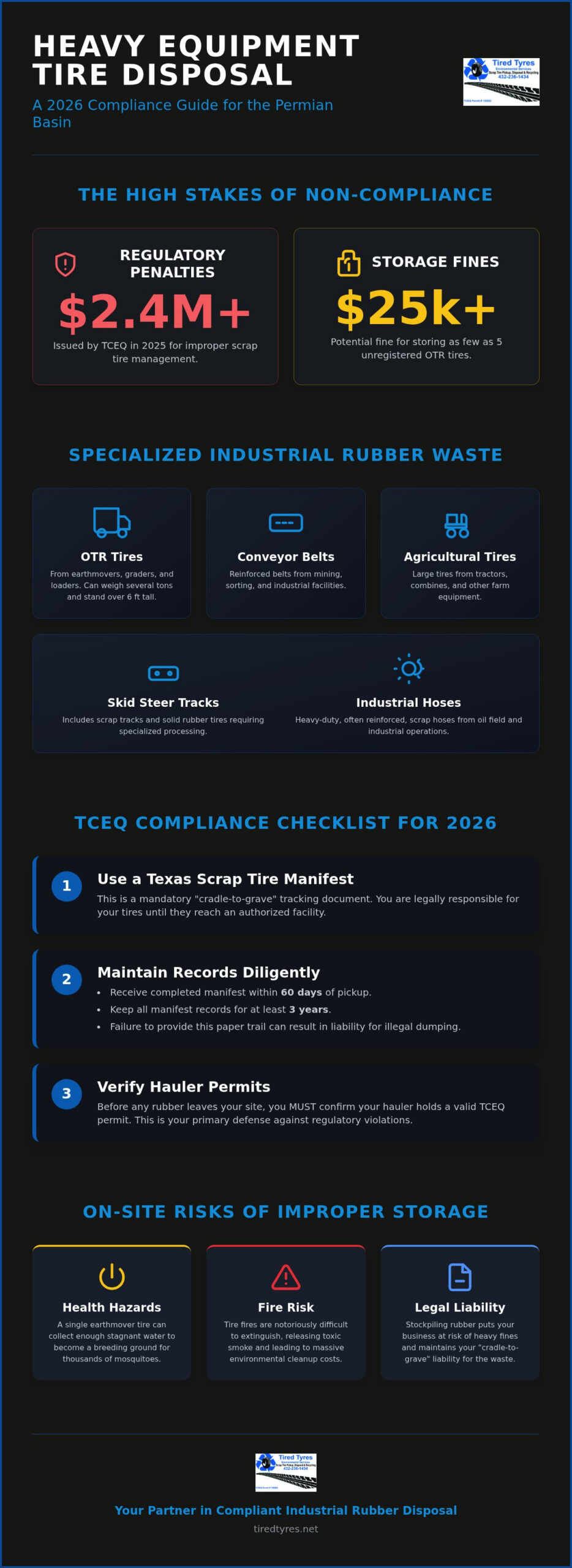
Managing industrial rubber in Texas is governed by the Texas Commission on Environmental Quality (TCEQ). In 2025, the agency issued over $2.4 million in penalties, signaling a sharp increase in regulatory enforcement. For businesses in the Permian Basin, heavy equipment tire disposal is no longer just a logistical task; it’s a matter of legal survival. Storing as few as five unregistered OTR tires can trigger fines exceeding $25,000. Larger stockpiles can lead to daily penalties of $10,000, making compliance the only viable business strategy.
The Texas scrap tire manifest is a mandatory tracking document. This paperwork creates a “cradle-to-grave” record of where your waste goes. As a generator, you’re legally responsible for the tires until they reach an authorized facility. You must receive a completed manifest within 60 days of the pickup and keep these records for at least three years. Failing to maintain this paper trail leaves you vulnerable to liability if your tires are ever found in an illegal dump site, even if you weren’t the one who dumped them.
The Role of Permitted Tire Haulers
You must verify that your collector holds valid state permits before any rubber leaves your site. A permitted hauler acts as your partner in compliance. They ensure your OTR tires are delivered to authorized processors rather than abandoned in a field. Reviewing our Texas tire disposal regulations guide can help you understand the specific documentation required for your next pickup. If you’re unsure about your current inventory, consulting with a professional hauler is the safest way to avoid regulatory traps.
Environmental Hazards of Improper OTR Disposal
Stockpiled industrial rubber poses severe risks to the local ecosystem. Fire is the most immediate threat. Once a pile of OTR tires ignites, it can burn for weeks, releasing toxic smoke and pyrolytic oil. Researchers at the EPA have highlighted the environmental and health impacts of tires, noting how tire wear and waste can affect air and water quality.
In the South Plains, chemical leaching from abandoned tires can contaminate groundwater supplies, permanently devaluing the land. These pollutants don’t just stay in the soil; they can migrate and impact local wildlife and livestock. Proper heavy equipment tire disposal prevents these hazards, protecting both your property and the surrounding West Texas community from long-term environmental damage.
Comparing Disposal Options for Large-Scale Industrial Tires
Choosing a method for heavy equipment tire disposal often comes down to a balance between immediate cost and long-term liability. For many fleet managers in West Texas, the initial thought is to haul scrap rubber to the nearest municipal dump. However, the reality of industrial waste management is more complex. Nearly a quarter of Texas landfills refuse to accept tires in any form. Those that do accept them often impose strict processing requirements that are difficult for a standard commercial operation to meet without specialized machinery.
Commercial audits make a sharp distinction between “dumping” and “responsible disposal.” Dumping is simply removing waste from your property without a verified destination. Responsible disposal involves a documented chain of custody that proves the rubber reached a permitted processing facility. For businesses in the Permian Basin, specialized collection is the only viable path for OTR and agricultural tires because it shifts the logistical burden and the compliance risk to a professional hauler.
Landfill Restrictions in Midland and Odessa
Local landfill policies in Midland and Odessa are designed to protect landfill liners and prevent “floating” tires. Most facilities require tires to be split, quartered, or shredded before they are accepted for burial. While this might be possible for passenger tires, the steel-reinforced beads of OTR tires make on-site shredding nearly impossible for most contractors. Our guide on commercial tire disposal provides a deeper look at these specific city-level restrictions and how they impact your bottom line.
Size limits are another major hurdle. Most municipal waste stations aren’t equipped to handle the physical dimensions of earthmover or grader tires. If a tire exceeds their size threshold, they’ll turn your truck away at the gate, wasting your time and fuel. This is why many industrial operations avoid city services entirely when dealing with heavy equipment tire disposal.
The Benefits of Professional Scrap Tire Pickup
Professional scrap tire collection services offer logistical ease that municipal services can’t match. Instead of your team struggling to load and transport massive tires, a specialized hauler brings the necessary cranes and trailers directly to your yard or job site. This on-site pickup eliminates the need for you to navigate landfill queues or worry about size rejections.
The most significant advantage is the full documentation provided for corporate environmental compliance. A professional service manages the TCEQ manifest system for you, ensuring every scrap track or OTR tire is accounted for legally. This paper trail is your best defense during a state audit, proving that your business handles industrial rubber waste with professional precision and care.
Logistics and Preparation: How to Manage Bulk OTR Tire Removal
Efficient heavy equipment tire disposal starts long before the truck arrives at your site. Organizing your scrap rubber inventory ensures a faster pickup and minimizes the labor time required for your crew. When you’re managing massive OTR tires, a lack of preparation can lead to logistical delays or even a refused pickup if the hauler’s equipment can’t access the pile. Following a structured preparation plan keeps your operation moving and ensures your site remains compliant with safety standards.
The first step is to inventory your scrap. Count your OTR units, semi-truck tires, and agricultural rubber separately. Haulers need this specific data to send a truck with the correct weight capacity and loading gear. Once you have a count, clear a wide access path for heavy loading equipment. A tractor-trailer or a crane truck requires significant room to maneuver safely. Ensure the path to your scrap pile is free of parked machinery, loose debris, or soft soil that could trap a heavy vehicle. Finally, segregate your materials. Keep tires separate from scrap conveyor belts and industrial hoses, as mixing these items complicates the loading process and may affect your final manifest documentation.
Handling Specialized Industrial Rubber
Industrial sites often accumulate more than just standard tires. Scrap conveyor belts require specific handling; they should be rolled tightly and secured with heavy-duty wire or straps to prevent unspooling during transport. For scrap skid steer tracks and solid rubber tires, stack them in a designated area where a loader can reach them without navigating tight corners. Scrap hoses should be coiled or cut into manageable sections if they’re excessively long. Proper bundling of these industrial components prevents them from becoming a tangled mess that slows down the removal process.
Ensuring a Smooth Pickup in West Texas
The Permian Basin presents unique environmental challenges that can impact logistics. High heat and blowing dust often affect equipment performance, so scheduling your pickup for early morning hours is usually the most efficient choice. If your job site is a remote oil field location or a farm in the South Plains, provide precise GPS coordinates or clear landmarks to the driver. Dirt access roads must be packed firmly enough to support the weight of a fully loaded haul truck, especially after rare rain events.
Before the truck pulls away, verify your manifest paperwork. Check that the tire counts and material types match your initial inventory exactly. This document is your legal proof of disposal and your primary defense in a corporate audit. To clear your yard of industrial waste quickly and professionally, you can schedule a specialized rubber collection today with a team that understands West Texas logistics.
Reliable Heavy Equipment Tire Collection with Tired Tyres
Industrial operations in the Permian Basin don’t have time for logistical delays or service gaps. Our specialized focus on OTR and industrial rubber across Midland, Odessa, and Lubbock allows us to provide a service that standard waste management companies simply can’t match. We’ve built our fleet and training around the physical demands of heavy equipment tire disposal, ensuring that even the largest earthmover units are removed safely and efficiently from your job site. We understand that your yard space is valuable, and our goal is to keep it clear of hazardous scrap rubber.
Our comprehensive collection capabilities extend beyond just tires. We handle the full spectrum of rubber waste generated by the mining, construction, and oil field sectors. This includes:
- OTR (Off-the-Road) tire collection for loaders, graders, and earthmovers.
- Agricultural tire collection for South Plains farming and ranching operations.
- Scrap conveyor belt and industrial hose collection.
- Scrap skid steer track and solid tire collection.
- Semi-truck and light truck tire collection for commercial fleets.
We manage every pickup with a commitment to legal, TCEQ-compliant disposal. This means providing the necessary manifest paperwork that protects your business from the environmental liabilities discussed earlier in this guide. We take the burden of regulatory compliance off your shoulders, so you can focus on your core operations.
Why West Texas Businesses Trust Tired Tyres
Local industrial requirements differ from standard commercial needs. We know the terrain in Midland and Odessa. We understand how to navigate remote oil field locations without getting stuck or causing delays. Our team maintains reliable pickup schedules designed to work around your active operations rather than disrupting them. For a deeper look at our service standards, read our guide on reliable tire disposal in the region. We pride ourselves on being a partner that West Texas businesses can count on for professional, no-nonsense service.
Get Started with Your Industrial Rubber Removal
Removing bulk OTR or heavy equipment tires doesn’t have to be a source of stress. When you’re ready to clear your yard, the process is straightforward. We provide tailored solutions based on your specific inventory, whether you have a handful of tractor tires or a massive stockpile of oil field hoses. Our coverage area spans the entire Permian Basin and South Plains, ensuring that help is available wherever your project is located.
To begin, simply reach out with your estimated tire count and location. We’ll handle the logistics, the loading, and the legal documentation. Contact Tired Tyres for a heavy equipment tire pickup quote today and ensure your industrial rubber waste is managed by local experts who prioritize your compliance and safety.
Streamline Your Industrial Rubber Management Today
Managing industrial rubber waste doesn’t have to be a source of regulatory stress for your operation. By implementing a clear manifest system and preparing your site for specialized loading, you protect your business from the significant fines issued by the TCEQ. It’s important to remember that municipal landfills across the Permian Basin often reject whole OTR tires. This makes a permitted hauler your most reliable path to maintaining a clean and compliant yard. Proper planning ensures that your heavy equipment tire disposal remains a routine task rather than a logistical crisis.
Tired Tyres is a permitted Texas scrap tire hauler equipped with specialized gear to handle OTR and industrial rubber. We serve Midland, Odessa, and Lubbock with reliable schedules that keep your projects on track. Don’t let old stockpiles become a liability for your team or the local environment. Request an OTR Tire Disposal Quote from Tired Tyres today to ensure your disposal needs are handled with professional precision. We look forward to helping you maintain a safe and efficient job site across West Texas.
Frequently Asked Questions
Can I take OTR tires to the Midland or Odessa city landfill?
No, you generally cannot take whole OTR tires to these municipal landfills. Most city facilities in Midland and Odessa require tires to be split, quartered, or shredded before they are accepted for burial. Because the steel reinforcement in heavy equipment tires makes on-site processing difficult for most contractors, city services are rarely a viable option. Professional haulers are usually necessary to move these units to authorized processing facilities that can handle their massive scale and weight.
What is a scrap tire manifest and why does my business need one?
A scrap tire manifest is a mandatory tracking document required by the Texas Commission on Environmental Quality (TCEQ). It creates a legal record of the tire’s journey from your job site to an authorized disposal facility. Your business needs one to prove compliance and avoid “cradle-to-grave” liability. If tires from your site are found in an illegal dump, a completed manifest is your primary defense against heavy state fines and legal action from environmental regulators.
Do you dispose of scrap skid steer tracks and conveyor belts?
Yes, we provide specialized collection for scrap skid steer tracks and reinforced conveyor belts throughout the Permian Basin. These items are made of high-density rubber and steel that standard trash services won’t accept. We have the equipment to load and transport these heavy industrial components safely. Our services include:
- Removal of scrap skid steer tracks.
- Collection of industrial conveyor belts.
- Disposal of heavy-duty oil field hoses.
This approach helps you maintain a clean and compliant job site.
How much does heavy equipment tire disposal cost in West Texas?
Costs for heavy equipment tire disposal are not fixed and depend on several logistical factors. Fees are typically negotiated between the generator and the transporter based on rubber volume, tire size, and distance from our service hubs. Factors like loading difficulty and the material type, such as OTR tires versus industrial hoses, influence the final quote. Requesting a site-specific estimate from a permitted hauler is the most accurate way to manage your disposal budget.
Is it legal to bury old tractor tires on my own land in Texas?
No, it’s generally illegal to bury scrap tires on private land in Texas without specific authorization from the TCEQ. Improper burial can contaminate groundwater and lead to severe environmental penalties. While some land reclamation projects use tires, these require strict permits and annual reporting. For most property owners in Lubbock or Midland, the safest and only legal option is to have agricultural tires removed by a permitted scrap tire transporter to ensure they reach an authorized facility.
What happens to heavy equipment tires after they are collected?
Once collected, heavy equipment tires are transported to authorized processing facilities where they undergo a complex recycling process. They are often shredded into smaller pieces for use in tire-derived fuel or civil engineering projects. Some industrial rubber is processed for rubber-modified asphalt or molded into new products like floor mats and dock bumpers. This ensures that the material is diverted from illegal stockpiles and managed according to Texas environmental standards to protect the local landscape.
Do you provide tire pickup for remote oil field sites in the Permian Basin?
Yes, we specialize in providing heavy equipment tire disposal for remote oil field sites and agricultural operations across the Permian Basin. We understand that industrial work often happens in locations far from major highways. Our drivers are experienced in navigating dirt access roads and remote lease sites near Midland and Odessa. Providing GPS coordinates or clear landmarks helps our team reach your site efficiently to clear out your scrap rubber inventory and maintain your site’s safety.
Are there fines for storing large piles of scrap tires in Lubbock County?
Yes, storing large quantities of scrap tires without a permit can lead to significant fines in Lubbock County and throughout Texas. The TCEQ limits registered generators to 500 tires on the ground or 2,000 in locked containers. Storing even a small number of unregistered OTR tires can result in fines exceeding $25,000. These penalties are designed to prevent fire hazards and public health risks like mosquito breeding grounds that often develop in stagnant water inside large tires.