
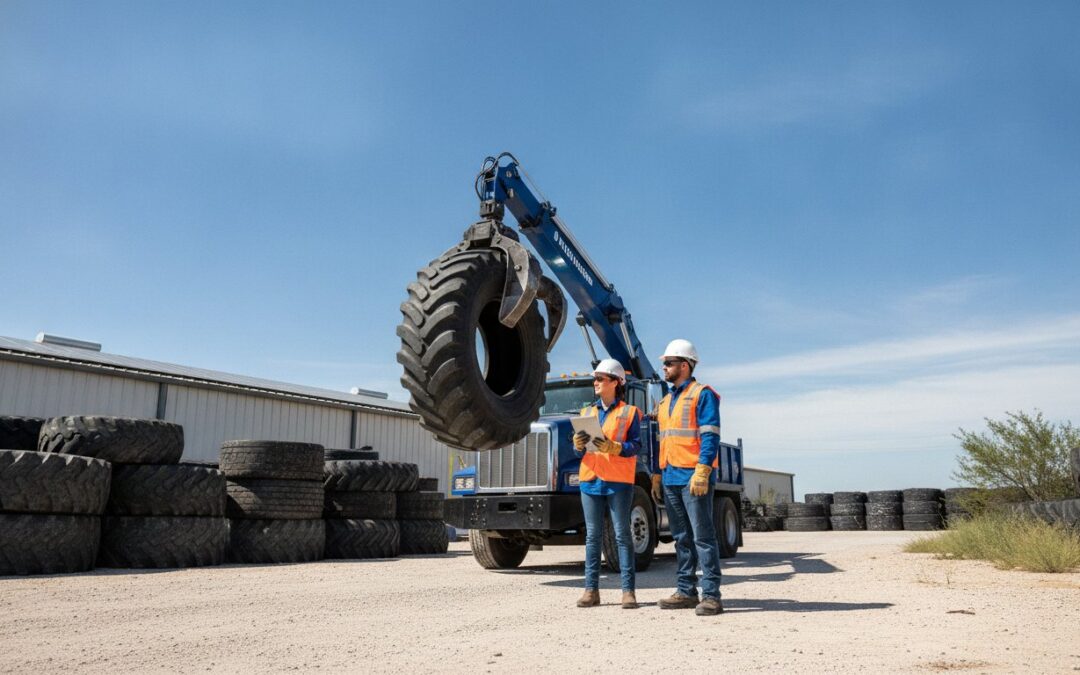
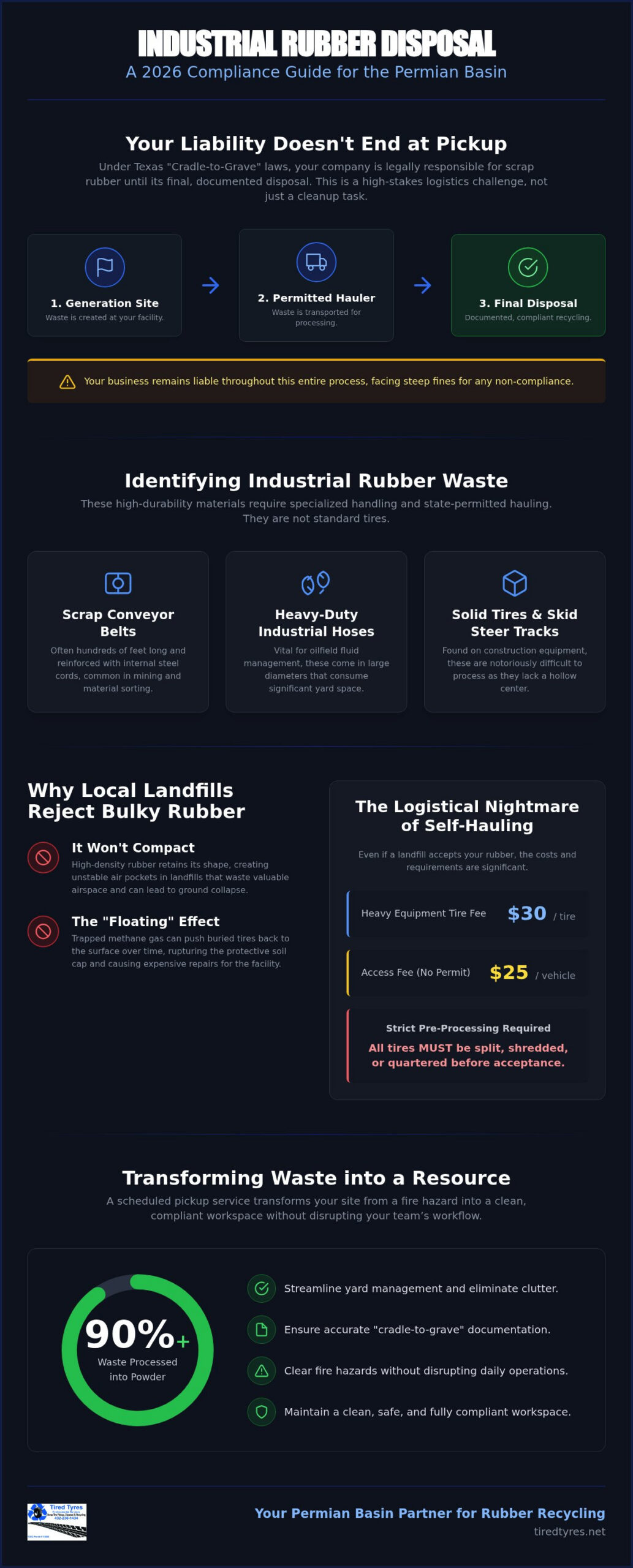
In the Permian Basin, your company’s legal liability for a scrap OTR tire doesn’t end when a truck hauls it away. Under Texas “cradle-to-grave” laws, you’re responsible for that waste until its final, documented disposal. This reality makes industrial rubber disposal Midland a high-stakes logistics challenge rather than a simple cleanup task. You’ve likely already dealt with the frustration of the City of Midland landfill refusing whole tires or watched bulky conveyor belts and hoses slowly consume your valuable yard space. It’s a common headache for local operators who want to do things the right way but struggle to find haulers equipped for heavy, industrial-grade loads.
We understand that you need a solution that’s as efficient as your daily operations. This 2026 guide provides the roadmap for disposing of heavy equipment tires and scrap rubber while meeting every TCEQ requirement. You’ll learn about current landfill restrictions, the latest manifest protocols, and how to avoid the steep fines associated with improper storage. We’ll also explore how a scheduled pickup service can transform your site from a fire hazard into a clean, compliant workspace without disrupting your team’s workflow.
Key Takeaways
- Understand your “cradle-to-grave” liability under 2026 TCEQ regulations to ensure your business remains fully compliant and avoids heavy fines.
- Discover why local landfills reject bulky items and how to find a reliable partner for professional industrial rubber disposal Midland services.
- Learn to identify which specific materials—from OTR tires to scrap conveyor belts—require specialized handling and state-permitted hauling.
- Streamline your yard management by coordinating bulk pickups that clear fire hazards without disrupting your daily site operations.
- See how choosing a recycler that processes over 90% of waste into powder helps maintain a clean and safe workspace in the Permian Basin.
What Qualifies as Industrial Rubber Waste in Midland, TX?
Industrial rubber waste is defined as high-durability polymers used in commercial machinery that require specialized processing. In the Permian Basin, the scale of this waste is directly tied to the region’s intense oilfield and transportation activity. Thousands of tons of heavy-duty rubber are retired every year from drilling rigs and logistics fleets. Unlike standard passenger tires, these materials are engineered for extreme durability. This strength is a benefit during the product’s life but a major obstacle during disposal. They don’t compact like household trash. Industrial rubber disposal Midland involves navigating unique logistical hurdles that simple junk removal services aren’t equipped to solve.
Common Industrial Rubber Items Found on West Texas Sites
West Texas job sites frequently accumulate specific types of rubber waste that require professional removal. These aren’t just large versions of car tires; they’re complex industrial components. Common items found in our region include:
- Scrap conveyor belts: Frequently found in mining and material sorting, these belts are often hundreds of feet long and reinforced with internal steel cords.
- Heavy-duty industrial hoses: These are vital for oilfield fluid management and often come in large diameters that take up significant yard space.
- Solid rubber tires and scrap skid steer tracks: These are found on construction equipment and are notoriously difficult to process because they lack a hollow center.
These items are high-value candidates for the global recycling and reuse of rubber. When diverted from landfills, they can be transformed into new industrial products like asphalt additives and durable mats.
Why Proper Identification Matters for Compliance
Properly classifying your waste is essential for TCEQ compliance. The state of Texas maintains strict rules on how scrap tires and industrial rubber are tracked from the job site to the processing facility. If a load is improperly labeled or mixed with prohibited materials, landfills will reject the entire shipment. This rejection often results in additional hauling fees and potential liability for the generator.
Volume and weight play massive roles in these logistics. A single OTR tire can weigh several thousand pounds, requiring specialized trailers and loading equipment. Identifying these items early allows for accurate volume estimation. This helps you schedule a pickup window that clears the site efficiently without causing operational downtime. It also ensures that your “cradle-to-grave” documentation is accurate, protecting your business from future legal issues.
Why Local Landfills Often Reject Industrial Rubber
Landfills operate on a simple economic principle: they sell airspace. Industrial rubber is a nightmare for this model because it refuses to compact. While organic waste or construction debris can be crushed to save room, high-density rubber items like conveyor belts and OTR tires retain their shape. This lack of compaction creates air pockets that destabilize the landfill’s structure. These pockets can eventually lead to collapses or shifts in the ground that compromise the entire facility’s integrity.
Over time, buried tires often exhibit a “floating” effect. Trapped methane gas and the natural buoyancy of the rubber can push these items back to the surface. This process ruptures the protective soil cap, leading to expensive repairs for the landfill operator. Because of these risks, the City of Midland Landfill maintains a strict ban on whole tires. All tires must be split, shredded, or quartered before they are accepted. Even then, the fees are significant. Commercial operations face a $30 charge per heavy equipment tire, plus a $25 access fee for vehicles lacking a specific Garbage Hauler’s Permit. These costs and requirements make industrial rubber disposal Midland a complex task for any business.
The Logistical Nightmare of Self-Hauling
Attempting to manage your own disposal often creates more problems than it solves. OTR tires aren’t standard cargo. They require specialized trailers and heavy-duty loading equipment to transport safely. On West Texas highways, an improperly secured 3,000-pound tire is a lethal projectile. Beyond safety, there’s a clear time-loss factor. Pulling a crew away from a job site to spend hours at a landfill gate only to be turned away for non-compliance is a massive drain on resources. Most businesses find it’s more cost-effective to partner with a permitted hauler who understands the specific gate requirements for industrial loads.
Environmental Liability for Business Owners
Stockpiling rubber on your property is a temporary fix that carries long-term risks. Accumulated piles are notorious fire hazards. Once an industrial rubber fire starts, it’s incredibly difficult to extinguish and can burn for weeks, releasing toxic smoke into the Permian Basin air. These stockpiles also collect rainwater, creating breeding grounds for pests. You can read more about the specific waste tire problems facing our region to understand the full scope of the risk. Remember that your liability doesn’t end just because the waste is out of sight. If your rubber is found in an illegal dump site, your company remains legally responsible for the cleanup costs and TCEQ fines.
Navigating Texas Disposal Regulations and TCEQ Compliance
In 2026, the Texas Commission on Environmental Quality (TCEQ) maintains strict oversight of how businesses handle scrap polymers. Compliance isn’t a suggestion; it’s a legal mandate that protects your company from massive financial exposure. For any operation requiring industrial rubber disposal Midland, the process begins with understanding Title 30, Chapter 328 of the Texas Administrative Code. Texas law holds the waste generator responsible for rubber until it is documented at a permitted facility. This means if a hauler dumps your old conveyor belts in a ravine, the TCEQ will look at your manifest, or lack thereof, to assign blame.
Manifest tracking is the backbone of this system. A manifest is a multi-part document that records the type and amount of waste, the hauler’s permit number, and the final destination. You must ensure your waste reaches a state-permitted recycling facility that can process industrial-grade materials. Without this paper trail, you have no proof of legal disposal during a state audit. Relying on a permitted hauler ensures that this documentation is handled correctly from the moment the load is weighed.
Avoiding Illegal Dumping Fines in Midland County
The penalties for cutting corners are severe. Dumping over 200 pounds of waste, which is roughly the weight of ten passenger tires or a single small OTR tire, is a state jail felony in Texas. Fines for these violations often exceed $4,000 per occurrence. Additionally, the TCEQ can issue administrative penalties of up to $10,000 per violation for improper waste management. “Midnight haulers” often offer lower prices because they lack the permits and insurance required by the state. Using an unpermitted hauler doesn’t absolve you of liability. Always verify a hauler’s state permit number before any material leaves your yard.
Maintaining Records for Environmental Audits
Organization is your best defense against an audit. In 2026, digital tracking has become the industry standard for waste management. It provides a real-time, unalterable record of your disposal history. You should keep all physical and digital manifests for at least three years to satisfy state record-keeping requirements. For a deeper look at specific compliance steps, review our guide on Texas tire disposal regulations. Proper documentation ensures that when an inspector calls, you can prove every pound of rubber was handled correctly and safely.
The Logistics of Bulk Industrial Rubber Pickup
Managing large-scale waste requires a systematic approach to ensure safety and efficiency. Industrial rubber disposal Midland is a specialized process that involves four critical steps. First, a site assessment is conducted to estimate the total volume and weight of the material. This isn’t just about counting items; it’s about determining the equipment needed for removal. Second, we coordinate a pickup window that aligns with your operational schedule. Minimizing downtime is essential for Permian Basin businesses. Third, professional loading teams use heavy-duty equipment like grapples and loaders to secure the waste. Finally, the material is transported to a state-permitted recycling facility where it is processed into industrial powder.
The loading phase utilizes specialized machinery because manual handling of these items is often impossible and dangerous. We bring the right loaders to your site so your own crews can stay focused on their primary tasks. Once loaded, the material is taken to a permitted facility that recycles over 90% of the waste into powder. This ensures your business contributes to a circular economy while remaining fully compliant with state laws. If you are ready to clear your yard of accumulated waste, schedule a site assessment today to get started.
Handling OTR and Agricultural Tires
Oversized off-the-road (OTR) and agricultural tires present the greatest logistical challenge due to their sheer mass. A single OTR tire can weigh as much as a small vehicle. Moving these requires specialized trailers, such as lowboys or high-sided scrap haulers, equipped to handle extreme weight. Safety protocols are strictly enforced during this phase to prevent crush injuries or equipment failure. Our teams are trained to secure these loads specifically for West Texas highway conditions, where wind and vibration can shift heavy rubber components. Proper securing is not just a safety issue; it’s a legal requirement for transporting bulk industrial waste.
Conveyor Belt and Hose Collection Strategies
Conveyor belts and industrial hoses require a different strategy to maximize load efficiency. Rolled conveyor belts are significantly easier to transport than loose, tangled scrap. Whenever possible, we recommend rolling and securing belts before pickup to reduce the total number of trips required. For oilfield sites with large volumes of scrap hoses, we focus on densification. Maximizing the weight per load is the most effective way to reduce your total disposal costs. This organized approach prevents your yard from becoming a fire hazard and ensures that every foot of material is accounted for in your environmental manifest. Efficient loading directly translates to a cleaner site and lower operational overhead for your facility.
Tired Tyres: Your Permian Basin Partner for Rubber Recycling
Tired Tyres serves the entire Permian Basin and South Plains from our local hubs. We understand the unique pressures of West Texas industry because we live and work here. Our commitment to Midland, Odessa, and Lubbock goes beyond simple collection. We aim to clear your site of hazards while ensuring your waste contributes to the state’s growth. By focusing on a high-efficiency processing model, we take the burden of compliance off your shoulders. Choosing a local expert for industrial rubber disposal Midland means faster response times and a deeper understanding of regional environmental needs.
Our mission is built on the “Pickup. Recycle. REDUCE.” philosophy. We don’t just move waste from one pile to another. We recycle over 90% of the material we collect into fine rubber powder. This powder serves as a high-value raw material for new industrial products. Your old conveyor belts and OTR tires find a second life rather than taking up valuable space in a landfill. This high recycling rate significantly reduces your company’s environmental footprint and enhances your sustainability profile.
Supporting the West Texas Circular Economy
The transformation of oilfield waste into useful products is a win for everyone in Texas. Once we process scrap rubber into powder, it’s often used in state infrastructure projects. This includes rubber-modified asphalt that creates more durable, crack-resistant highways. In the agricultural sector, this recycled material becomes comfortable horse stall mats or protective playground mulch. Local recycling is inherently more sustainable than long-distance hauling. It keeps resources within the region and reduces the fuel consumption associated with transporting bulky waste to distant facilities. Every load we collect helps keep Texas beautiful while supporting local manufacturing.
Request a Quote for Midland Industrial Disposal
Getting an accurate estimate for your bulk rubber removal is a straightforward process. We provide site-specific quotes based on the volume and type of material you need cleared. Whether you have a stockpile of scrap skid steer tracks or miles of retired industrial hoses, we can build a collection schedule that works for you. High-volume industrial clients often benefit from customized pickup windows that prevent waste from accumulating. This proactive approach keeps your yard clean and ensures you’re always ready for a surprise inspection. Contact Tired Tyres for reliable tire disposal and industrial rubber solutions that protect your business and the environment.
Protect Your Business with Compliant Rubber Disposal
Managing industrial rubber isn’t just about clearing yard space; it’s about protecting your company from the legal and environmental risks of 2026. You now know that Texas “cradle-to-grave” laws make you responsible for every scrap of waste until it reaches a permitted facility. By identifying your materials correctly and avoiding the “airspace” issues at local landfills, you prevent costly rejections and potential TCEQ fines. Proper documentation is your best defense during an audit, and it starts with choosing a partner who understands the manifest process.
Professional industrial rubber disposal Midland services ensure that your OTR tires and conveyor belts are handled with the right equipment and safety protocols. As a state-permitted hauler, Tired Tyres recycles 90% of the waste we collect into industrial powder, helping you reduce your environmental footprint while serving Midland, Odessa, and Lubbock. We take the stress out of logistics so your team can focus on their primary operations. We’re committed to keeping the Permian Basin clean and safe through reliable, professional recycling.
Ready to clear your yard? Book a Bulk Industrial Rubber Pickup in Midland to ensure your operations stay clean, safe, and fully compliant. Let’s work together to keep Texas beautiful.
Frequently Asked Questions
Is industrial rubber disposal different from standard tire disposal in Texas?
Industrial rubber disposal Midland differs from standard tire removal because of the material’s density and scale. Items like conveyor belts and skid steer tracks are classified as industrial waste and require specialized processing. Standard passenger tires are often accepted at municipal facilities if shredded, but high-density industrial polymers usually require a state-permitted hauler. These materials don’t compact under normal landfill pressure, making specialized recycling the only legal and practical solution for West Texas businesses.
What happens if I dump industrial rubber at a Midland landfill?
If you attempt to dump whole industrial rubber items at the City of Midland landfill, your load will be rejected. Local regulations require all tires to be split or shredded before acceptance. Commercial tires also carry a $30 disposal fee and a $25 access fee for unpermitted haulers. Improperly dumping these items elsewhere in Midland County can result in Class C misdemeanors or state jail felonies, depending on the weight of the material.
Does Tired Tyres handle OTR (Off-the-Road) tires from mining or oil sites?
Yes, we provide OTR tire collection for mining, construction, and oilfield operations. These oversized tires are too heavy for standard junk removal trucks and require specialized lowboy trailers or high-sided scrap haulers. Our team handles the heavy lifting with professional loading equipment. We ensure every off-the-road tire is safely transported to a permitted facility, clearing your yard and removing the fire hazards associated with stockpiled rubber.
How much does industrial rubber disposal cost in Midland?
Disposal costs vary based on the total volume, weight, and the specific type of rubber material you have on-site. Because OTR tires and reinforced conveyor belts require different loading equipment, we provide customized quotes for every project. Factors such as site accessibility and the frequency of your collection schedule also play a role. We focus on maximizing load efficiency to help you manage industrial rubber disposal Midland costs while remaining fully compliant.
Can you pick up scrap conveyor belts and industrial hoses?
Yes, we specialize in the collection of scrap conveyor belts and heavy-duty industrial hoses. These items are common on oilfield and mining sites but are notoriously difficult to dispose of through traditional waste streams. We recommend rolling and securing conveyor belts before our arrival to ensure the most efficient use of trailer space. This organized approach reduces the number of trips required and helps keep your disposal operations as cost-effective as possible.
What documentation do I need to prove legal disposal in Texas?
You must maintain a TCEQ-compliant manifest for every load that leaves your property. This document serves as a legal paper trail, proving that your waste reached a permitted recycling facility. It must include the hauler’s state permit number and a detailed description of the waste. Texas law requires you to keep these records for at least three years. Digital tracking is the current industry standard for ensuring your documentation is accurate and audit-ready.
Do you offer scheduled pickups for industrial facilities in Odessa?
Yes, we offer scheduled pickup services for industrial facilities throughout Odessa, Midland, and Lubbock. Many of our high-volume clients prefer a recurring schedule to prevent rubber waste from accumulating and taking up valuable yard space. We work with your facility manager to establish a timeline that doesn’t interfere with your daily operations. This ensures your site remains clean, compliant, and free from the fire risks associated with rubber stockpiles.
What is the recycling process for industrial rubber waste?
We process over 90% of the scrap rubber we collect into a fine industrial powder. This powder is then sold as a raw material for various Texas infrastructure and manufacturing projects. It’s used to create rubber-modified asphalt for more durable roads and high-quality mats for agricultural use. This recycling process diverts thousands of tons from landfills every year, supporting a circular economy and protecting the natural environment of the Permian Basin.