
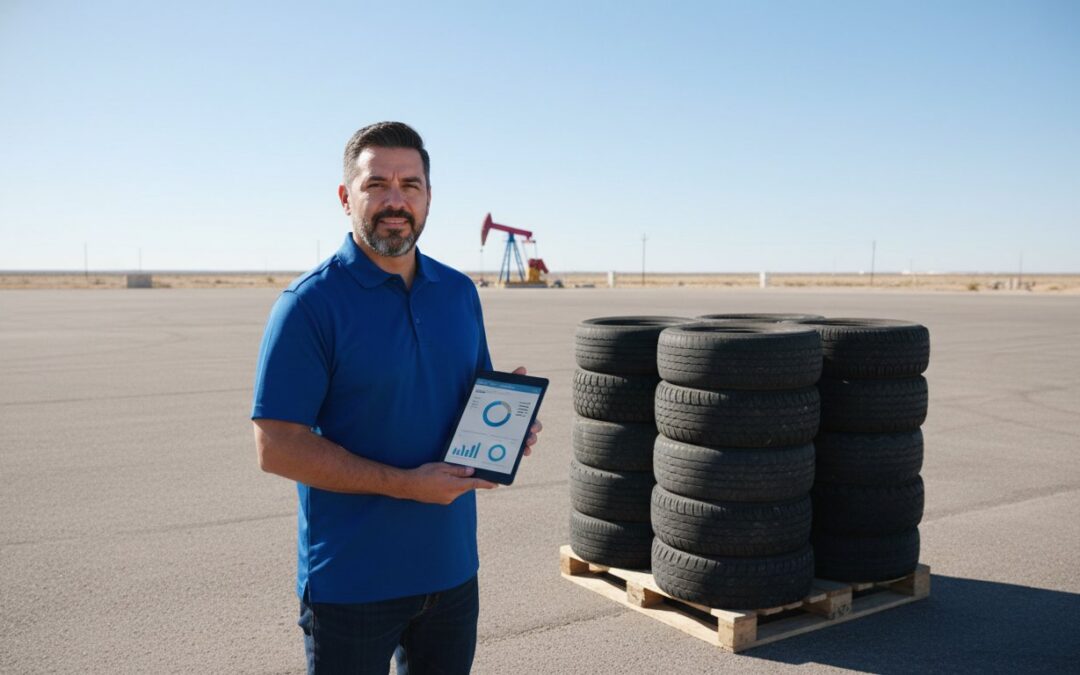
Did you know that the TCEQ issued over $2.4 million in penalties for improper scrap tire management in 2025? For businesses operating in Midland and across the Permian Basin, staying ahead of the TCEQ scrap tire regulations 2026 is no longer optional; it’s a critical shield against administrative fines that can reach $25,000 per violation, per day. If you feel like the rules are constantly shifting under your feet, you aren’t alone.
We know that keeping up with digital reporting and finding permitted haulers can be a major headache when you’re focused on daily operations. This guide will help you master the 2026 TCEQ compliance landscape so you can protect your West Texas business from liability and costly errors. You’ll learn exactly how to navigate the new STEERS portal requirements, manage the five-part manifest system with ease, and understand the specific storage limits that keep you off the regulator’s radar. We’ve broken down the complex legal language into a clear, actionable plan. Let’s turn these confusing mandates into a streamlined process that gives you back your peace of mind.
Key Takeaways
- Identify if your business is classified as a scrap tire generator and why this status shifts the burden of environmental liability onto you.
- Learn how to navigate the transition to digital-first reporting through the STEERS portal to stay compliant with the TCEQ scrap tire regulations 2026.
- Master the “500 vs. 2000” storage rule to avoid massive daily fines and reduce the risk of fire and vector hazards on your property.
- Access a five-point checklist to verify that your tire hauler is fully permitted, protecting your business from the legal fallout of illegal dumping.
- Discover how a professional partnership can streamline your manifest management and ensure your scrap rubber collection meets every legal standard.
Understanding Your Role as a Scrap Tire Generator in 2026
The TCEQ scrap tire regulations 2026 have shifted the weight of environmental responsibility directly onto the shoulders of West Texas business owners. If your operations result in waste tires, the state classifies you as a “generator,” a title that carries significant legal weight. This classification isn’t just for tire shops. It covers any business that removes tires from vehicles or equipment, including fleet maintenance hubs and industrial sites. Understanding this role is the first step in avoiding the steep administrative penalties that the state now enforces with increased frequency. For a broader context on why these rules exist, this Tire recycling overview explains the environmental necessity of tracking rubber waste from cradle to grave.
A Scrap Tire Generator is any entity producing waste tires as part of business operations. Texas law makes a sharp distinction between “used tires” and “scrap tires.” A tire is only considered “used” if it has sufficient tread depth, is free of defects, and is intended for immediate resale for its original purpose. If a tire is destined for disposal, recycling, or energy recovery, it’s legally a scrap tire. In 2026, generators must report their operational status annually through the STEERS portal by December 31st. This digital trail ensures that every casing is accounted for, preventing illegal dumping in our West Texas landscapes.
Who is Regulated in West Texas?
The scope of regulation in the Permian Basin is broad. Auto repair shops, vehicle dismantlers, and industrial warehouses are the most common generators. However, fleet operators managing semi-truck tire collections or agricultural tire collections are also strictly regulated. The TCEQ identifies unregistered generators in areas like Midland and Odessa through a combination of site inspections and digital tracking of tire manifest flows. If you are accepting tires from the public or generating them through your own fleet maintenance, you fall under these rules. Local landfills have also tightened their intake policies, often rejecting whole tires or those still on rims, which forces businesses to rely more heavily on compliant, registered transporters.
The 2026 Registration Thresholds
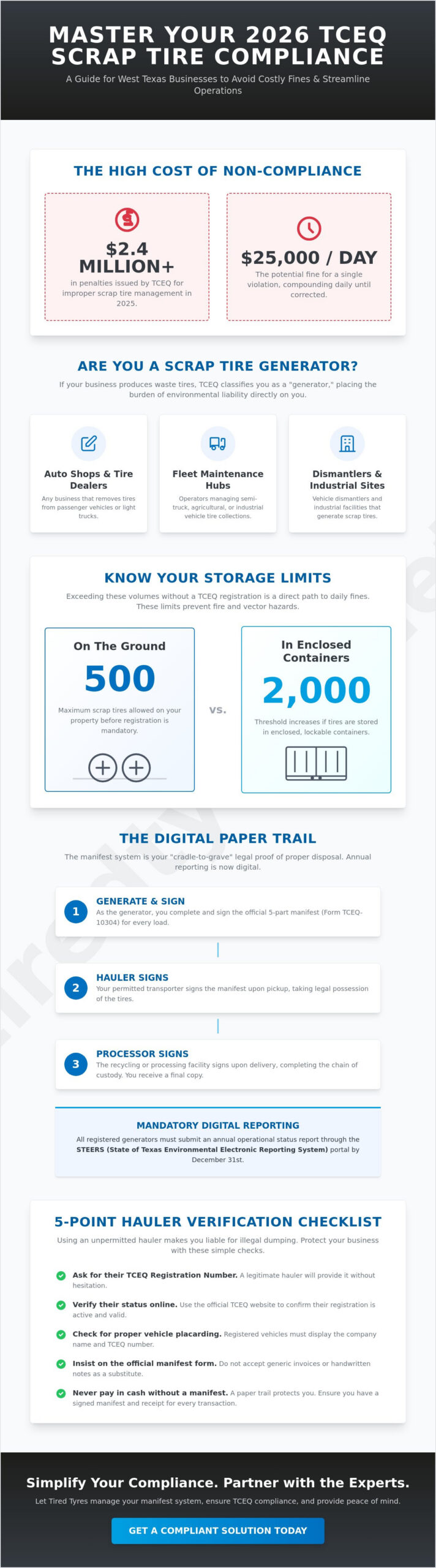
Registration with the TCEQ is mandatory once you hit specific storage volumes. You are legally required to register as a generator if you store more than 500 scrap tires on the ground at any single time. If you use enclosed, lockable containers, this threshold increases to 2,000 tires. Maintaining an active TCEQ registration number is vital for your legal protection. Without it, you cannot legally contract a permitted hauler or document your compliance during an audit. These limits are designed to prevent the massive stockpiles that create fire hazards and mosquito breeding grounds in the intense Texas heat. Staying below these numbers, or registering promptly when you exceed them, is the only way to operate without the constant threat of a $25,000 per day fine.
Navigating the 2026 TCEQ Manifest and STEERS Reporting Requirements
The TCEQ scrap tire regulations 2026 represent a significant shift in how Midland businesses handle their environmental paperwork. The days of relying solely on stained paper carbon copies are fading fast. Now, the state is pushing for a digital-first approach to ensure every casing is tracked from the moment it leaves your facility until its final processing. This “cradle-to-grave” system is your strongest legal defense. If an inspector visits your site, those manifests are the only verified proof that you didn’t dump your waste in a West Texas canyon or an unauthorized lot.
The STEERS portal is the central hub for this new era. It stands for the State of Texas Environmental Electronic Reporting System. While the interface can feel technical, it’s a necessary tool for maintaining your compliance. All registered generators must use this system to report their operational status by the December 31st deadline each year. Missing this date is a simple way to attract unwanted attention from regulators and potential fines. Keeping your digital profile updated is just as important as the physical management of your tire piles.
The Digital Manifest System
A valid manifest, specifically Form TCEQ-10304, must follow every tire load from start to finish. You must record the exact count and type of tires, whether they are part of a passenger & light truck tire collection or heavy-duty OTR units. The process involves a three-part signature chain: you as the generator, the transporter who picks them up, and the final processor who receives them. Don’t just hand over the tires and forget about the paperwork. You are responsible for obtaining the final signed copy back from the processor. State law requires you to keep these records for at least three years. If you’re looking to simplify this process, partnering with a professional for scrap rubber collection ensures your manifests are handled with professional precision.
Avoiding Common STEERS Reporting Errors
Many Permian Basin businesses run into trouble when their annual STEERS report doesn’t match their manifest totals. Discrepancies often occur when tires are recorded by weight in one place and by unit count in another. Always reconcile your manifest logs monthly rather than waiting until the end of the year. If you have trouble logging in or filing, the TCEQ provides a technical help desk, but the best strategy is to start your filing at least 30 days before the deadline. Double-check your TCEQ registration number before submitting. An incorrect ID is one of the most common reasons for rejected filings and subsequent compliance audits. Accurate, consistent data is what keeps your business safe from the state’s $25,000 per day penalty structure.
Storage Limits and the High Cost of Non-Compliance
In 2026, the TCEQ doesn’t just rely on physical drive-bys to find non-compliant sites in West Texas. They use high-resolution satellite imagery to spot unauthorized stockpiles in the Permian Basin. If your yard has grown beyond the legal limits, it’s only a matter of time before an inspector arrives at your gate. The TCEQ scrap tire regulations 2026 are designed to prevent the environmental disasters associated with large-scale tire accumulation. Storing tires on the ground is particularly dangerous in the Texas heat. Large piles create a massive fire risk; rubber fires burn at extremely high temperatures and are nearly impossible for local departments to extinguish. They also trap stagnant water, becoming prime breeding grounds for mosquitoes. Under current rules, outdoor storage requires vector control measures every two weeks to protect public health in cities like Lubbock and Odessa.
Texas Storage Threshold Comparison
Understanding where your business falls in the registration hierarchy is essential for avoiding fines. The state makes a clear distinction between open storage and secured storage. If you exceed these numbers without a “Scrap Tire Storage Site” registration, you are in immediate violation of state law.
- On the Ground: Maximum of 500 tires. Anything over this requires formal registration and strict vector control.
- Enclosed or Lockable Containers: Maximum of 2,000 tires. This includes trailers or specialized bins that prevent water accumulation and unauthorized access.
If you plan to store more than these amounts, you must register your location as a formal storage site. This involves submitting detailed site plans and demonstrating how you will manage fire safety and pest control. For most West Texas businesses, it’s much safer and more cost-effective to schedule regular pickups rather than managing the complexities of a registered storage facility.
Liability Risks for Business Owners
Liability doesn’t end when the tires leave your property. This is the most dangerous misconception in the industry. If you hire an unpermitted hauler because they offer a cheaper rate, you remain legally responsible for those tires. If that hauler dumps your load in a Lubbock alley or a Midland pasture, the state traces those tires back to your business via the manifest system. This is known as the “Landowner Liability” trap. You can be held responsible for the entire cost of the cleanup plus administrative penalties. For a deeper dive into these legal frameworks, consult our guide on Texas tire disposal regulations. In 2026, the TCEQ is aggressive about pursuing generators who fail to vet their transporters. Protecting your business means ensuring every load is backed by a valid, five-part manifest and a registered partner.
How to Verify a Permitted Tire Hauler in Midland, Odessa, and Lubbock
Choosing the right transporter is the only way to ensure your business remains on the right side of the TCEQ scrap tire regulations 2026. In West Texas, you’ll often find individuals offering “cheap” tire removal services. While the price might look attractive, these unlicensed haulers are the primary cause of illegal dumping. Because the state uses a digital chain of custody, any tire dumped in a Permian Basin pasture can be traced back to your shop or fleet yard. If you can’t prove the tires were handled by a registered professional, you’re the one facing the $25,000 daily penalty. Verifying your partner isn’t just a best practice; it’s your primary insurance policy against environmental liability.
The Hauler Verification Checklist
Don’t take a transporter’s word for their compliance. The TCEQ maintains a public database, and you should use it before every new contract. Follow this five-point checklist to protect your interests:
- Request the Registration Number: Every legal hauler must have a TCEQ Transporter Registration Number.
- Check the Status: Download the active registered scrap tire handlers list from the TCEQ website. Ensure their status is “Active” and not “Expired” or “Revoked.”
- Demand Form TCEQ-10304: A permitted hauler will always provide a multi-part manifest at the time of pickup. If they offer a generic invoice instead, they aren’t compliant.
- Inspect the Vehicle: Registered transporters are required to display their TCEQ registration number on the side of their trucks.
- Confirm the Destination: Ask exactly which authorized facility will receive your tires. A legitimate hauler will have no problem naming the processor.
Local Logistics in West Texas
Operating in the Permian Basin presents unique challenges that national providers often overlook. Local expertise matters when you’re dealing with a massive semi-truck tire collection or heavy OTR units from industrial sites. Because local landfills in Midland and Odessa have implemented stricter rules, such as rejecting whole tires or those on rims, you need a hauler who understands these regional restrictions. Proximity also reduces your environmental footprint and ensures that your storage levels stay below the mandatory registration thresholds.
Efficient logistics are especially critical for high-volume operations. You can find more details on managing large-scale loads in our guide to commercial tire disposal. Maintaining a schedule for scrap rubber collection prevents the “500-tire” storage limit from becoming a legal headache. If you’re ready to secure a compliant, manifest-backed partner for your scrap rubber collection, our team is ready to help you navigate the 2026 landscape with confidence.
Simplifying Your Environmental Compliance with Tired Tyres
Managing the TCEQ scrap tire regulations 2026 shouldn’t pull you away from your core operations. At Tired Tyres, we serve as your boots-on-the-ground compliance partner in the Permian Basin. We’ve built our service to remove the guesswork from state mandates. Every load we haul is backed by a 100% legal, manifest-driven process. This digital and physical paper trail is your ultimate shield. It proves to regulators that your waste reached an authorized facility, effectively neutralizing the liability risks associated with scrap rubber. We understand that your reputation in West Texas is built on reliability, and our goal is to ensure your environmental standing is just as solid.
Our capabilities extend far beyond standard automotive casings. We provide specialized solutions for high-volume and heavy-duty needs, including:
- Passenger & Light Truck Tire Collection
- Semi-Truck Tire Collection
- Agricultural Tire Collection
- OTR (Off-the-Road) Tire Collection
We also help businesses solve complex waste tire problems by accepting industrial items that many haulers reject. Our team is equipped to handle scrap conveyor belt collection and scrap skid steer track collection. Whether you’re cleaning out an oilfield warehouse or maintaining a large construction fleet, we ensure these specialized materials are documented and disposed of according to the latest 2026 standards.
The Tired Tyres Advantage for Local Businesses
Our professional manifest management is designed to simplify your life. We take the lead on Form TCEQ-10304, ensuring every detail is captured correctly for your STEERS reporting. This precision saves you hours of administrative troubleshooting. We maintain dedicated routes throughout Midland, Odessa, and Lubbock, providing the consistent service required to keep your on-site storage below the mandatory registration thresholds. Our local expertise means we’re already familiar with the specific logistics of the Permian Basin. We don’t just pick up tires; we provide a professional buffer between your business and the threat of state audits.
Get Started with a Compliance Audit
Don’t wait for a TCEQ inspection to find out if your storage and manifest logs are in order. We help local businesses assess their current disposal needs to identify potential compliance gaps before they lead to fines. Securing reliable tire disposal is a critical investment in your company’s future. We invite you to schedule a professional consultation today to secure your 2026 compliance status. Whether you need a one-time OTR tire collection or a recurring scrap rubber collection service, we offer the direct, honest, and expert solution your business deserves.
Secure Your Business Against Future Liability
Adapting to the TCEQ scrap tire regulations 2026 is a necessary step for any West Texas operation that wants to avoid the state’s aggressive penalty structure. By mastering the STEERS digital reporting system and staying within your storage thresholds, you’ve already done the heavy lifting. The final piece of the puzzle is ensuring every load is handled by a partner who values your legal safety as much as you do. Remember, the manifest is your only proof of compliance once those tires leave your property.
Tired Tyres is a TCEQ Permitted Transporter serving Midland, Odessa, and Lubbock. We’re specialists in OTR and industrial rubber, providing the manifest-backed certainty you need to operate without fear of audits. We take the complexity out of environmental logistics so you can stay focused on what you do best. Don’t leave your business’s future to chance in an era of increased oversight. Request a 2026 Compliance Quote for Your West Texas Business today. We’re ready to help you turn these new mandates into a seamless, worry-free part of your routine.
Frequently Asked Questions
Is a scrap tire manifest required for every pickup in 2026?
Yes, a five-part manifest is mandatory for every load leaving your facility. Under the TCEQ scrap tire regulations 2026, Form TCEQ-10304 acts as your primary chain of custody. It requires signatures from the generator, the transporter, and the final processor. Without this document, you have no legal proof that your waste tires were disposed of at an authorized facility; this leaves your business vulnerable to massive administrative penalties.
Can I take my business scrap tires to a local landfill in Midland?
It’s increasingly difficult for businesses to use local landfills for tire disposal. Facilities in Midland have implemented stricter rules, often rejecting whole tires or those still on rims. If you choose to self-haul to an authorized collection point, expect to pay between $3.00 and $7.00 per tire depending on size. Most businesses find that hiring a permitted transporter is more efficient and ensures full manifest compliance.
How much are the fines for illegal tire dumping in Texas?
Fines for illegal dumping or improper storage are extremely severe. The TCEQ can assess administrative penalties of up to $25,000 per violation, per day. During the 2025 calendar year, the agency issued over $2.4 million in total penalties for scrap tire mismanagement. These costs often exceed the price of professional disposal by a massive margin; making legal compliance the only logical choice for West Texas business owners.
Do I need to register with the TCEQ if I only have 100 tires?
You don’t need to register as a storage site if you have fewer than 500 tires on the ground. The registration threshold is 500 tires for outdoor storage or 2,000 tires if they’re kept in enclosed, lockable containers. However, even with only 100 tires, you’re still classified as a generator. This means you’re legally required to follow all manifest and disposal rules to avoid environmental liability.
What happens if my tire hauler doesn’t have a TCEQ permit?
You retain total environmental liability for those tires until they reach a permitted processor. If an unpermitted hauler dumps your load in a Midland alley or an Odessa pasture, the state will trace those tires back to your business. You’ll likely face heavy fines and the full cost of the cleanup. The state views the generator as responsible for the waste’s entire lifecycle; so vetting your hauler is critical.
How long do I need to keep my scrap tire records?
You must keep all manifest copies and disposal records for at least three years. These documents are your primary evidence during a TCEQ compliance audit or site inspection. It’s best to keep them organized in a dedicated file, either physically or digitally. Being able to produce these records on demand shows inspectors that you’re operating a responsible, compliant business and helps you avoid unnecessary legal complications.
What is the STEERS reporting deadline for the 2025-2026 cycle?
The primary deadline for registered generators to submit their annual operational status report via the STEERS portal is December 31st each year. For the 2025 activity cycle, transporters and processing facilities must file their annual reports by March 1, 2026. Following these deadlines is essential to remain in good standing with the TCEQ scrap tire regulations 2026. Missing these dates can trigger automatic compliance reviews and potential site inspections.
Can Tired Tyres handle OTR and industrial rubber waste along with passenger tires?
Yes, our team is equipped to manage diverse rubber waste streams for industrial and commercial clients. We handle passenger and light truck tires, semi-truck tires, and specialized OTR tire collections. We also provide disposal services for scrap conveyor belts, skid steer tracks, and solid tires. Whether you’re clearing a fleet yard or an industrial site, we ensure every item is disposed of through a fully manifest-backed, legal process.