
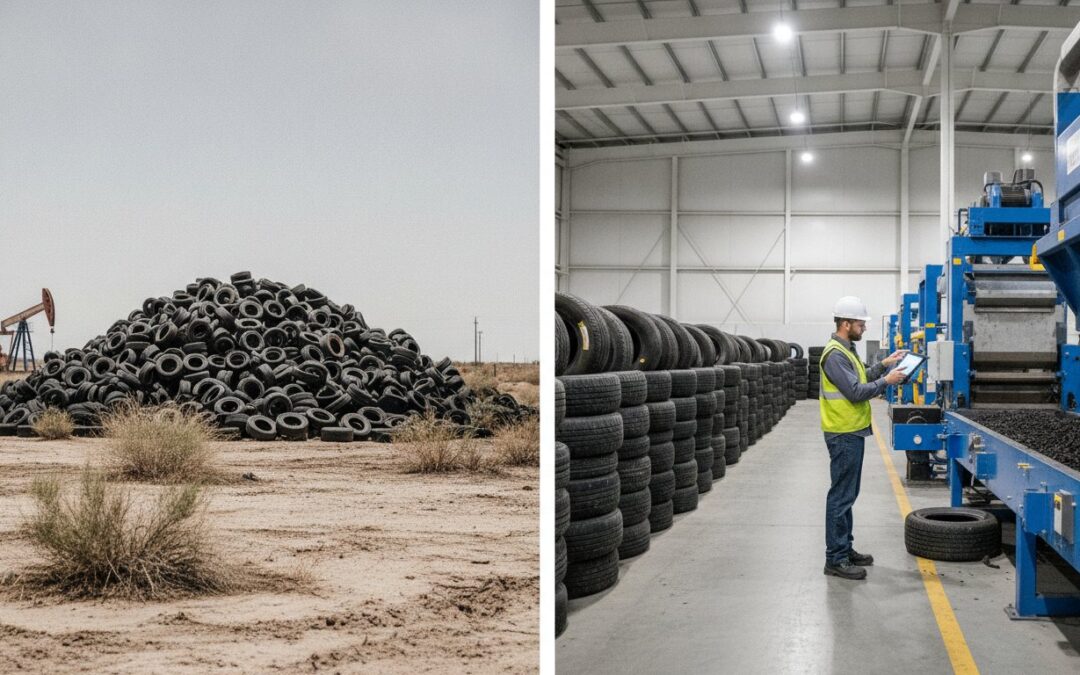
Would you gamble your business license on a cheap disposal quote? In Texas, the commissioners court can now fine you $500 for every single tire an unregistered transporter hauls away from your shop. The risks of using an unlicensed tire hauler aren’t just environmental; they’re financial and legal landmines that can lead to the total revocation of your permit to sell tires. It’s frustrating to manage rising disposal costs while trying to stay compliant with complex TCEQ manifest requirements. We know you want to protect your bottom line without ending up legally responsible for someone else’s illegal dumping in a West Texas field.
This 2026 guide will show you exactly how to shield your business from massive fines and verify hauler credentials. We’ll break down the latest legislative updates, explain the mandatory manifest system, and help you find a reliable, compliant partner for your scrap rubber. By the end of this article, you’ll have a clear path to total compliance and professional peace of mind.
Key Takeaways
- Learn about the updated 2025 Texas laws that allow counties to impose massive fines and revoke business licenses for improper tire disposal.
- Understand why “Cradle-to-Grave” responsibility means you remain legally liable for your scrap tires until they reach a TCEQ-authorized facility.
- Discover the specific risks of using an unlicensed tire hauler, including the legal nightmare of being held responsible for illegal dumping sites.
- Get a practical 5-step checklist to verify a hauler’s TCEQ registration status before any rubber leaves your property.
- Find out how partnering with a fully permitted disposal expert ensures 100% manifest transparency and protects your professional reputation.
What is a Licensed Tire Hauler and Why Does Texas Require One?
A licensed tire hauler is a commercial transporter who has officially registered with the Texas Commission on Environmental Quality (TCEQ). These professionals aren’t just people with a truck and a trailer. They’re registered entities that follow strict state guidelines for moving and disposing of scrap rubber. Texas treats scrap tires as “special waste” rather than general refuse. This distinction is vital because improper storage leads to environmental and safety hazards such as difficult-to-extinguish fires and mosquito-borne illnesses.
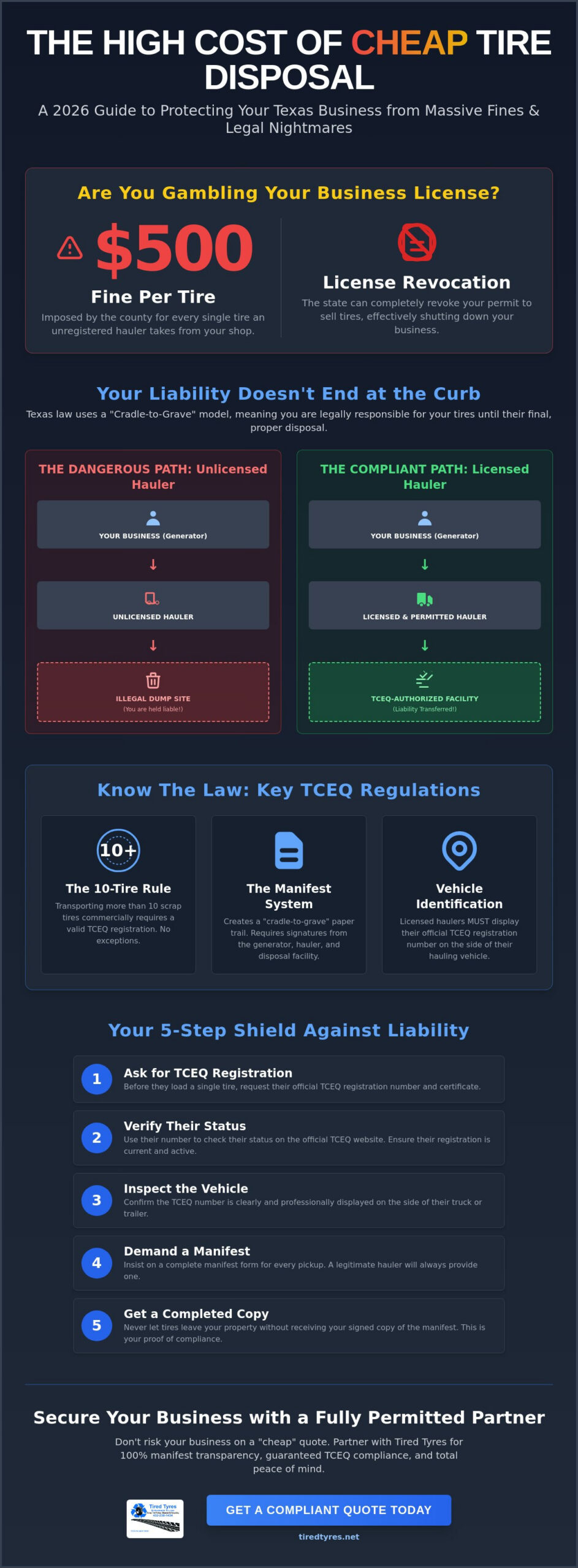
The state uses the “10-tire rule” as a legal line in the sand. Any person or business transporting more than 10 scrap tires at once for commercial reasons must have a valid TCEQ registration. This rule exists to stop illegal dumping before it starts. If you hire a guy who says he can “take care of” 50 tires without a permit, you’re inviting trouble. One of the biggest risks of using an unlicensed tire hauler is that the state doesn’t just go after the driver. They come after the business that provided the tires in the first place.
You might think your regular trash service can handle a few old tires. However, general waste collectors often aren’t equipped or permitted to take scrap rubber to the correct processing facilities. Specialized haulers focus exclusively on scrap tires, agricultural tracks, and OTR collections. They have the equipment and the legal standing to move these materials safely across county lines.
TCEQ Regulations for the Permian Basin
For businesses in Midland and Odessa, compliance is a top priority. The Texas Health and Safety Code Chapter 361 governs how solid waste is managed in our region. Local enforcement officers look for the mandatory TCEQ registration number on the side of every hauling vehicle. If a hauler can’t show you their current certificate, they aren’t legal. In the dry West Texas climate, the state is especially aggressive about preventing unauthorized stockpiles that could spark a massive fire.
The Purpose of the Scrap Tire Manifest System
The manifest system creates a “cradle-to-grave” record for every tire. It’s a multi-part form that requires signatures from the generator, the hauler, and the final disposal site. By 2026, many Texas businesses have transitioned to digital manifests for faster reporting, but the core requirement remains. A single missing signature can trigger a state audit. These records prove that your tires ended up at a legitimate recycling center instead of a roadside ditch. Failing to secure these documents is one of the preventable risks of using an unlicensed tire hauler who might disappear before the tires reach their destination.
The Legal and Financial Liability of ‘Cradle-to-Grave’ Responsibility
Many West Texas business owners believe that once a trailer full of old tires leaves their lot, their responsibility ends. This is a dangerous misconception. Texas law operates under a “Cradle-to-Grave” liability model. This means you are legally responsible for those tires from the moment they are removed from a vehicle until they are officially processed at a permitted facility. You can’t simply pay someone to take your problem away; you’re paying them to handle your property according to state law.
One of the most significant risks of using an unlicensed tire hauler is that you remain the legal owner of the waste even if you’ve already paid for its removal. Under the Texas Health and Safety Code, the penalties for non-compliance are severe. If an unlicensed hauler dumps your tires in a field, the commissioners court in that county can fine your business up to $500 for every single tire. For a shop disposing of 100 tires, that’s a $50,000 liability. In some cases, the county may even suspend or revoke your license to sell tires entirely.
Unlicensed haulers often resort to “midnight dumping.” They take your money, drive a few miles into the desert near Midland or Odessa, and unload in a ditch. If those tires are traced back to your shop through invoices, markings, or witness reports, you’re on the hook for the cleanup. Site remediation is expensive. You’ll be required to reimburse the municipality for every dollar spent on labor, transportation, and proper disposal of the dumped material. If you need a partner that handles semi-truck or OTR tire collections with full transparency, choosing a permitted professional is the only way to stay safe.
Generator Liability in Texas Law
Hiring someone without a TCEQ permit doesn’t legally transfer ownership of the waste. It makes you an accomplice to an environmental violation. Case studies across Texas show that businesses are regularly fined for third-party dumping because they failed to verify the hauler’s credentials. Beyond the fines, environmental violations can cause your commercial insurance premiums to skyrocket. Most policies have “illegal act” exclusions that could leave you paying the entire bill out of pocket.
Reputational Risks for Local Businesses
Beyond the money, there’s the damage to your name. In tight-knit communities like Lubbock and Midland, being labeled an environmental polluter is toxic for business. Local customers value the West Texas landscape and prefer shops that respect it. A single news report about your tires being found in a local creek can destroy years of community trust. To learn more about protecting your professional standing, read our Texas Tire Disposal Regulations: A 2026 Guide for West Texas Businesses.
Environmental and Safety Hazards of Improper Tire Disposal
Improperly discarded tires are more than just an eyesore. They represent a significant physical threat to the West Texas landscape. When tires are left in unauthorized piles by unpermitted transporters, they become permanent fixtures that don’t biodegrade. Instead, they slowly leach chemicals into the ground. One of the most severe risks of using an unlicensed tire hauler is the creation of these illegal stockpiles, which can lead to catastrophic environmental damage that lasts for decades.
The dry heat in our region makes these piles a massive fire risk. Once a tire stack ignites, it’s nearly impossible to extinguish. The hollow shape of a tire creates a “chimney effect” that provides a constant supply of oxygen to the core of the fire. Firefighters often have to let these fires burn out or use specialized foam, as water simply runs off the rubber. This process creates a thick, oily residue that can seep into the soil and contaminate local groundwater supplies. Following TCEQ requirements for tire transporters is the only way to ensure your scrap rubber doesn’t end up in one of these dangerous situations.
Tire Fires and Air Quality in West Texas
The chemistry of a tire fire is particularly toxic. Burning rubber releases heavy metals like lead and arsenic, along with polycyclic aromatic hydrocarbons. In cities like Odessa and Midland, the frequent high winds can carry this toxic smoke across entire neighborhoods in minutes. This creates an immediate public health crisis for local residents. For a deeper look at these localized risks, see our guide on Waste Tire Problems in Midland, Odessa, and Lubbock: A 2026 Environmental Guide.
Disease Vectors and Community Health
Even if a fire never breaks out, abandoned tires cause health problems. The curved shape of a tire is an ideal incubator for stagnant water. It only takes a small amount of rainfall to create a breeding ground for thousands of mosquito larvae. In the South Plains, this increases the local risk of West Nile virus and other mosquito-borne illnesses. Rodents also use these piles as nesting sites, creating further sanitation issues for nearby properties. The risks of using an unlicensed tire hauler extend far beyond your shop’s walls; they directly impact the safety of your neighbors and the health of the community.
How to Verify a Tire Hauler’s License: A 5-Step Checklist
Protecting your business requires more than just a verbal agreement. To avoid the legal risks of using an unlicensed tire hauler, you must actively verify their credentials before any rubber leaves your property. In 2026, the TCEQ has made it easier to check registrations, but the responsibility still rests on your shoulders. Use this 5-step checklist for every pickup to ensure you aren’t left holding the bill for someone else’s mistake.
- Ask for the TCEQ Registration Number: Every legitimate hauler has a specific number issued by the state. If they can’t provide it immediately, don’t let them load your tires.
- Verify the Status: Don’t take their word for it. Use the official Texas state database to confirm the registration is active. A status listed as “pending” or “expired” is a major liability for your shop.
- Inspect the Vehicle: Registered haulers must display their TCEQ number and business name on both sides of the truck. Look for current permit decals and DOT markings that match their paperwork.
- Demand a Manifest: You need a completed scrap tire manifest for every single transaction. This document is your primary defense during a state audit.
- Confirm the Destination: Ask exactly which permitted facility or processor the tires are going to. Legitimate haulers will name a specific, authorized site rather than giving vague answers.
Following these steps might take a few extra minutes, but it’s the only way to shield your business from $500-per-tire fines. If a hauler hesitates at any of these requests, it’s time to find a new partner. To ensure your business stays compliant, always work with a fully permitted tire disposal partner who prioritizes transparency.
Red Flags of an Unlicensed Hauler
Trust your instincts when a hauler seems unprofessional. If they insist on cash-only payments or refuse to provide a formal written receipt, they’re likely operating off the books. Unmarked trucks or trailers without clearly visible TCEQ markings are another sign of trouble. If they can’t explain their recycling process for OTR or semi-truck tires, they’re likely planning to dump them illegally in a West Texas field. These are the immediate risks of using an unlicensed tire hauler that can lead to a visit from local law enforcement.
The Importance of Accurate Record Keeping
Compliance doesn’t end when the truck drives away. You’re legally required to keep all scrap tire manifests on file for at least 3 years for potential TCEQ audits. Organizing these records is a critical part of Commercial Tire Disposal in Midland, Odessa & Lubbock: The 2026 Guide. Keep your digital and paper records in a secure, easily accessible location. If an inspector visits your shop, having these documents ready can mean the difference between a routine check and a business-ending fine.
Secure Your Business with Tired Tyres: Fully Permitted Disposal
Tired Tyres provides the professional security West Texas businesses need to operate without fear of state intervention. We understand that the Permian Basin operates on trust and reliability; we’ve built our reputation on both. Our team handles the heavy lifting so you can focus on your daily operations without worrying about surprise state audits. We maintain 100% TCEQ compliance for every load we carry. Every pickup comes with manifest transparency. This ensures your scrap rubber is tracked accurately from your lot to a permitted processor.
The risks of using an unlicensed tire hauler are simply too high for any serious business owner in 2026. We offer specialized collection for OTR tire collections, semi-truck tire collections, and agricultural tire collections. Whether your shop is in Midland, Odessa, or Lubbock, we provide a consistent and legal disposal path for your scrap materials. We don’t just move tires; we provide a shield against the legal liabilities that come with improper disposal.
Comprehensive Rubber Waste Solutions
Our services go beyond standard passenger tires to meet the unique needs of West Texas industrial sites. We handle scrap skid steer track collection, scrap hose collection, and scrap conveyor belt collection. These industrial items often fall into a gray area for general waste haulers, but we treat them with the same regulatory precision as our tire collections. We offer scheduled pickups for auto shops and industrial sites to keep your property clear and compliant. For more details on our local service, check out our Reliable Tire Disposal in Midland, Odessa & Lubbock: The 2026 West Texas Guide.
Get a Compliant Quote Today
Switching to a professional, licensed hauling service is the most effective way to protect your bottom line from future environmental litigation. You shouldn’t have to guess where your waste ends up or fear a $500 per tire fine. We provide transparent, legal quotes that reflect our commitment to the West Texas community. Contact us today to secure your business and eliminate the risks of using an unlicensed tire hauler once and for all. We’ll handle the paperwork while you handle your customers.
Future-Proof Your West Texas Business
Success in the Permian Basin depends on trust and strict adherence to state law. We’ve explored how “Cradle-to-Grave” liability means your responsibility doesn’t end when the truck leaves your lot. Understanding the risks of using an unlicensed tire hauler is the first step in shielding your shop from $500-per-tire fines and potential license revocation. Verification isn’t just a hurdle; it’s your primary defense against legal and environmental nightmares.
Tired Tyres is here to take the weight of compliance off your shoulders. We’re fully TCEQ permitted and insured, serving businesses across the South Plains with specialized collections. We provide comprehensive manifest documentation for every single pickup we handle. Request a compliant scrap tire pickup quote from Tired Tyres to ensure your disposal process is 100% transparent and legal. You’ve worked hard to build your business, and we’re ready to help you protect it.
Frequently Asked Questions
Is it illegal to transport my own scrap tires in Texas?
You can transport up to 10 scrap tires without a registration. However, if you move more than 10 tires for commercial purposes, you must register with the TCEQ as a transporter. This “10-tire rule” is strictly enforced to prevent unauthorized stockpiling and dumping. If you’re a business owner moving a large load, it’s safer to use a permitted professional to avoid the risks of using an unlicensed tire hauler.
How do I check if a tire hauler is registered with the TCEQ?
You can verify a hauler’s status by visiting the official TCEQ website and downloading the active scrap tire transporter list. This database is updated regularly and includes registration numbers and business names. Always cross-reference the hauler’s provided number with this list before allowing them to load any materials. If their name doesn’t appear or their registration is listed as inactive, they aren’t authorized to transport your scrap rubber.
What is a scrap tire manifest and why do I need one?
A scrap tire manifest is a mandatory state document that tracks the movement of tires from the generator to the final processor. You need one because it serves as your legal proof of compliance during a state audit. The manifest requires signatures from you, the hauler, and the disposal site. Without a completed copy on file for three years, you remain legally liable for where those tires eventually end up.
What are the penalties for illegal tire dumping in Midland or Odessa?
Penalties in the Permian Basin are severe and can reach $500 per tire for improper disposal. Under the Texas Litter Abatement Act, dumping more than 1,000 pounds of tires is a state jail felony. Local county commissioners also have the authority to revoke your business’s license to sell tires if you’re found using an unregistered transporter. These financial and legal consequences far outweigh the temporary savings of a cheap hauling quote.
Can I take my commercial tires to a local landfill myself?
Most landfills in Texas won’t accept whole tires unless they have a specific TCEQ permit for tire storage or disposal. Typically, tires must be split, quartered, or shredded before a landfill can take them. Even if you transport them yourself, you must still follow the 10-tire rule. For commercial volumes, working with a specialized recycler is usually the most efficient way to ensure the rubber is processed legally.
Does ‘Cradle-to-Grave’ liability apply to small businesses or just large corporations?
Cradle-to-Grave liability applies to every business in Texas, regardless of size. Whether you’re a single-bay auto shop or a large industrial fleet operator, you’re legally responsible for your scrap tires until they reach an authorized recycling facility. Small businesses are often targeted for audits because they may be less familiar with the risks of using an unlicensed tire hauler. Compliance is a universal requirement for everyone in the industry.
What happens if a hauler I hired dumps tires illegally without my knowledge?
You remain legally and financially responsible for the cleanup costs and fines, even if you didn’t know the dumping occurred. Since the tires originated from your business, the “Cradle-to-Grave” doctrine holds you accountable. This is why obtaining a signed manifest is critical. If you can’t prove the tires reached a permitted site, the state assumes you’re responsible for the environmental violation and the resulting site remediation.
How can I tell if a tire recycling center is legitimate?
A legitimate recycling center will always have a visible TCEQ facility registration number and will provide a signed receipt or manifest upon delivery. You can verify these facilities through the same TCEQ database used for haulers. Professional centers are open about their processing methods, whether they’re creating tire-derived fuel or rubber mulch. If a site refuses to sign your manifest or lacks clear state markings, it’s not a compliant disposal destination.