
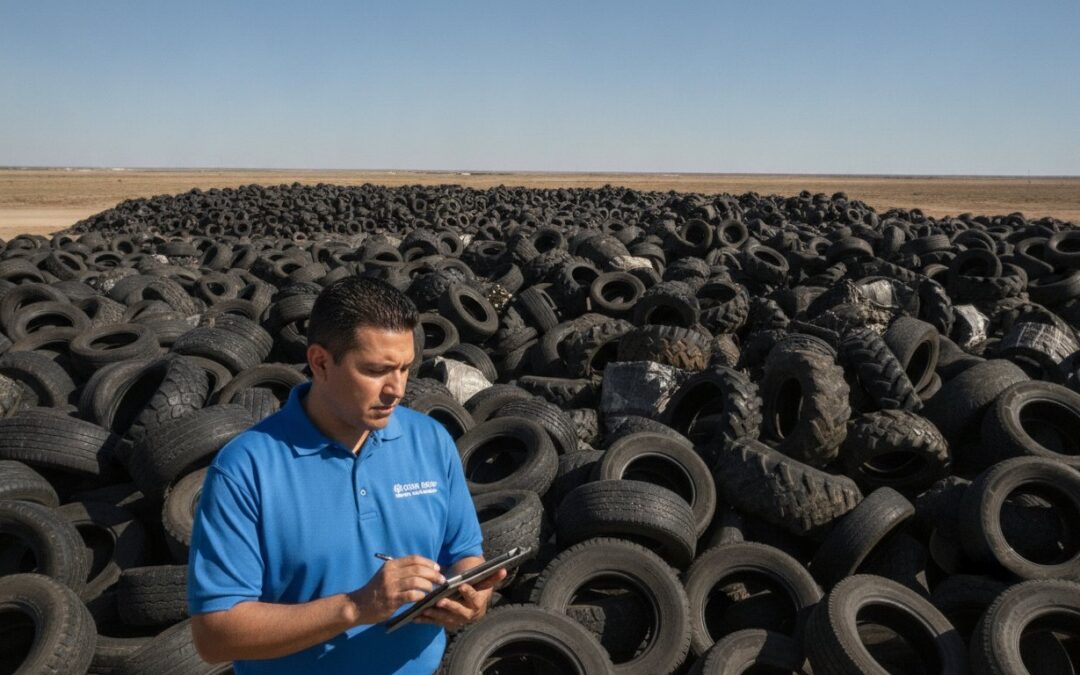
Did you know that storing just 50 unregistered scrap tires at your Midland business can trigger TCEQ penalties of $10,000 per day? In April 2026 alone, Texas authorities approved over $1.4 million in fines against entities failing to manage their rubber waste correctly. It’s a staggering figure that highlights just how serious the state is about avoiding tire disposal fines Midland businesses often face due to simple paperwork errors or improper storage.
You’re likely aware that getting rid of old tires isn’t as simple as a quick trip to the dump. Between the City of Midland Landfill’s strict ban on whole tires and the complex manifest system required for hauling, the process is intentionally rigorous. We understand the pressure of trying to stay compliant while managing fire risks and mosquito hazards on your property. This guide will help you navigate the 2026 regulations with confidence. You’ll learn how to handle TCEQ manifest requirements, understand local disposal restrictions, and ensure your business stays on the right side of the Texas Health and Safety Code.
Key Takeaways
- Understand the specific Texas Health and Safety Code penalties and how Midland Code Enforcement identifies illegal stockpiles before they become a liability.
- Learn to navigate the TCEQ manifest system to create a compliant paper trail, a critical step in avoiding tire disposal fines Midland businesses face during audits.
- Compare the real costs of DIY hauling against professional services, especially considering local landfill restrictions on whole, un-split tires.
- Identify the exact TCEQ storage limits and vector control requirements to keep your site safe from fire hazards and mosquito-borne illnesses.
- Explore how a professional collection service handles diverse rubber waste, including agricultural tires, OTR tires, and scrap conveyor belts.
The Financial Reality of Tire Disposal Fines in Midland (2026)
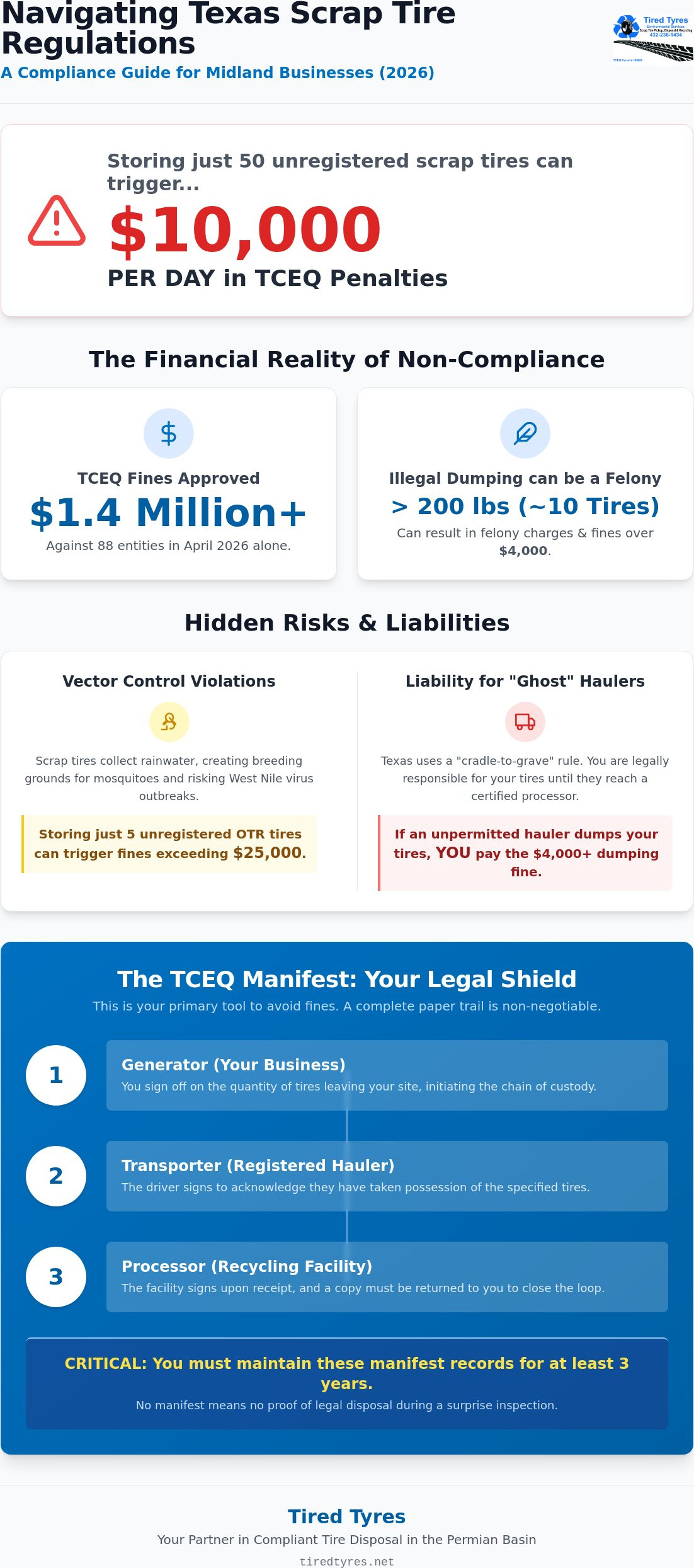
Midland Code Enforcement doesn’t just wait for neighbor complaints. They’re proactive. Inspectors use trail cameras in known dumping spots and conduct routine sweeps of commercial zones to identify illegal stockpiles. If they find an unauthorized collection on your property, they apply the Texas Health and Safety Code Chapter 361. Under this law, Illegal dumping is measured by weight. Dumping more than five pounds of waste is a Class C misdemeanor. However, the threshold for a state jail felony is surprisingly low. Dumping over 200 pounds of tires, which is roughly 10 standard passenger tires, can result in felony charges and fines exceeding $4,000 per occurrence. In April 2026 alone, the TCEQ approved more than $1.4 million in fines against 88 regulated entities in Texas for these types of violations.
Vector control is another financial trap many businesses overlook. Scrap tires collect rainwater, creating perfect breeding grounds for mosquitoes. In 2026, Midland health officials are strictly enforcing vector control ordinances to prevent West Nile virus outbreaks. If an inspector finds larvae in your tire pile, you face separate “nuisance” fines on top of environmental penalties. Storing as few as five unregistered off-the-road (OTR) tires can trigger fines exceeding $25,000. These hidden costs make “waiting to dispose” a very expensive strategy for any business owner.
Municipal vs. State-Level Penalties
City nuisance ordinances are frustrating, but state-level TCEQ audits are devastating. While a city ticket might cost a few hundred dollars, TCEQ administrative penalties can reach $10,000 per violation. For a commercial entity, storing 50 unregistered scrap tires can lead to a fine of $10,000 for every single day the violation persists. This “per day” accumulation is the primary reason avoiding tire disposal fines Midland businesses prioritize today is so critical. The state’s goal is to penalize enough to ensure the mistake never happens again, and these amounts can easily bankrupt a small operation before they can correct the issue.
The Liability of “Ghost” Haulers
Hiring an unpermitted “guy with a truck” is the fastest way to get hit with a massive fine. Texas law uses a “cradle-to-grave” responsibility rule. This means you’re legally responsible for your tires until they reach a certified processor. If your tires are found in a Midland alley or on a county road, authorities will trace them back to you. Without a valid TCEQ manifest to prove you handed them to a registered transporter, you’re the one who pays the $4,000+ dumping fine. Local law enforcement now uses high-resolution trail cameras specifically to catch these “ghost” haulers and trace their cargo back to the source business.
TCEQ Compliance: The Manifest System is Your Shield
The TCEQ Scrap Tire Manifest is the most important document in your office. It’s not just a receipt; it’s a multi-part tracking tool designed to prove you followed the law. When state inspectors visit your Midland facility, they don’t look at your tires first. They look at your paperwork. A properly completed manifest is your primary tool for avoiding tire disposal fines Midland authorities issue during routine audits. Without this paper trail, you have no legal way to prove your rubber waste didn’t end up in a West Texas ravine.
The system relies on a three-part chain of custody. First, you, the Generator, sign off on the number of tires leaving your site. Second, the Transporter signs to acknowledge they’ve taken possession. Finally, the Processor signs once the tires reach a permitted recycling facility. You must receive a copy back from the processor to complete the loop. According to TCEQ scrap tire storage regulations, you’re required to maintain these records for at least three years. If you can’t produce a manifest from two years ago during a surprise inspection, the TCEQ can assume the tires were disposed of illegally.
Incomplete documentation is a major red flag. Inspectors look for missing signatures, vague tire counts, or unregistered transporter numbers. If your manifest doesn’t show the final disposal site’s permit number, the document is essentially worthless in a legal dispute. Even a small error can trigger an enforcement action that leads to those five-figure penalties mentioned earlier.
The Role of a Registered Transporter
Never hand your scrap tires to someone who can’t provide a TCEQ registration number. It’s your responsibility to verify this number before any rubber leaves your property. An unregistered hauler cannot provide a valid manifest, which leaves you fully liable for where those tires end up. The “Final Destination” stamp on your returned paperwork is your ultimate protection. It confirms the tires were processed at a facility that meets 2026 environmental standards. Working with a TCEQ-registered transporter ensures every manifest is filed correctly from the start.
Record Keeping for Permian Basin Businesses
Midland auto shops and industrial sites should treat manifests like tax documents. We recommend keeping both physical and digital copies. Scanning your signed manifests into a secure cloud folder ensures you’re always ready for a surprise visit from Midland County health officials. This level of organization is the best defense against administrative errors. Understanding Texas tire disposal regulations helps you build a bulletproof defense for your bottom line while keeping your operations running smoothly.
DIY Hauling vs. Professional Service: Risk Analysis
Many Midland business owners consider hauling scrap tires themselves to save on costs. While this seems straightforward, the hidden expenses often outweigh the benefits. You have to account for staff labor, fuel, and the $25 access fee charged by the City of Midland landfill for vehicles without a Garbage Hauler’s Permit. Beyond the visible costs, there’s a significant insurance gap. Standard commercial auto policies rarely cover environmental cleanup or liability for transporting scrap rubber. If an accident occurs on Highway 80, your business is fully responsible for the resulting environmental impact and cleanup fees.
The “Time-to-Compliance” factor is another critical consideration. A single DIY trip might only handle a dozen tires, requiring multiple runs for a standard shop cleanup. Each trip increases the window of risk for avoiding tire disposal fines Midland inspectors issue for improper transport or lack of documentation. Professional services provide an immediate legal shield through the manifest system. This effectively ends your liability the moment the tires are loaded onto a registered vehicle, ensuring you aren’t caught in a multi-day hauling project that pulls staff away from their primary duties.
The Landfill Hurdle in West Texas
The City of Midland Landfill at 7904 S. Garden City Highway has very specific requirements. They don’t accept whole tires. To dispose of them legally, you must split, shred, or quarter every tire before arrival. This process is labor-intensive and requires specialized equipment that most businesses don’t own. Attempting to mix tires with regular waste is a direct violation of the Midland municipal code on illegal dumping. For those managing bulk waste, comparing tire disposal Midland TX options is the only way to ensure you don’t end up with a rejected load and a municipal citation.
Professional Pickup: The Compliance Guarantee
Choosing a professional service shifts the legal burden of transport from your business to the transporter. This is particularly valuable for large-scale operations involving OTR or agricultural tires, where the weight and volume make DIY hauling nearly impossible. A “one-and-done” bulk removal clears your site of fire hazards and mosquito breeding grounds in a single afternoon. Ultimately, reliable tire disposal is an investment in business continuity. It provides the certified paper trail you need to satisfy state auditors while allowing your team to focus on serving customers instead of processing scrap rubber.
Best Practices for On-Site Scrap Tire Storage
Correct on-site storage isn’t just about tidiness; it’s a legal requirement. In the eyes of the TCEQ, a small pile of rubber can quickly be reclassified as an “unauthorized storage site” if it exceeds specific thresholds. For most Midland businesses, the “100-tire rule” is the critical boundary. Once you have more than 100 scrap tires on your property, you’re typically required to register as a formal storage facility. However, the financial risk starts much sooner. Storing as few as 50 tires without proper registration can lead to fines of $10,000 per day. This is why avoiding tire disposal fines Midland inspectors levy requires a proactive approach to your inventory management.
The Permian Basin heat presents unique challenges for bulk rubber storage. When tires sit in the sun, they can reach temperatures high enough to facilitate chemical breakdown or even spontaneous combustion in extreme cases. A tire fire is notoriously difficult to extinguish and releases toxic oils into the West Texas soil. To stay compliant, you must maintain clear buffer zones. This means keeping tire piles at least 50 feet away from property lines and any flammable structures. These zones provide essential access for fire crews and prevent a small incident from becoming a total loss for your business.
Preventing Vector Breeding
Stagnant water in tires is the primary breeding ground for mosquitoes carrying West Nile and Zika viruses. Inspectors check for water accumulation during every site visit. You should stack tires in a “barrel” or “laced” pattern to minimize the chance of water getting trapped inside. While chemical larvicides are an option, physical covering with waterproof tarps is the gold standard for compliance. Understanding the specific waste tire problems in our region helps you anticipate what local health officials will look for during an inspection.
Security and Fire Prevention
Midnight dumping is a real threat in Midland. If someone else drops tires on your property, you’re still legally responsible for them. Secure fencing and well-lit storage areas are essential to prevent unauthorized additions to your stockpile. Additionally, you should never store tires near power lines or heat sources. Implementing scheduled commercial tire disposal ensures your inventory never reaches the 100-tire threshold. This regular rotation is the most effective way to maintain a safe, compliant workplace. If you need to clear your site today, contact Tired Tyres for professional removal services that protect your business from liability.
Compliant Solutions with Tired Tyres in the Permian Basin
Tired Tyres operates as a fully TCEQ-registered transporter dedicated to West Texas businesses. We understand that local operators don’t want to be waste experts; they want to run their shops and job sites without legal interference. By partnering with a certified professional, you take the most effective step toward avoiding tire disposal fines Midland authorities issue for improper waste management. We act as your compliance partner. We ensure every load is documented, every manifest is signed, and every tire reaches a permitted processing facility. Our team handles the entire paper trail, giving you the “cradle-to-grave” protection required by Texas law.
We provide a complete manifest guarantee with every pickup. This isn’t just a promise; it’s a structural part of our service. When we collect your scrap rubber, we provide the necessary TCEQ documentation on the spot. Once the tires reach the final processor, we ensure the loop is closed so your records are audit-ready at all times. This level of precision is why Midland auto dealerships and industrial sites trust us to manage their liability. We take the burden of environmental compliance off your shoulders so you can focus on your customers.
Serving Midland, Odessa, and Lubbock
Our service area covers the heart of the Permian Basin, including Midland, Odessa, and Lubbock. We offer customized pickup schedules that prevent your on-site storage from ever reaching dangerous or illegal levels. Our fleet is equipped with specialized machinery designed to handle the heaviest loads in the region. We provide comprehensive collection for a variety of rubber waste, including:
- Passenger & Light Truck Tire Collection
- Semi-Truck Tire Collection
- Agricultural Tire Collection
- OTR (Off-the-Road) Tire Collection
- Scrap skid steer track and solid tire collection
- Scrap hose and conveyor belt collection
Industrial operations often struggle with non-standard rubber waste. We bridge that gap by collecting scrap conveyor belts and industrial hoses that municipal services won’t touch. This “one-stop” approach simplifies your logistics and ensures all your rubber waste is handled under a single, compliant manifest system.
Get Started with a Compliance Quote
We believe in transparent, straightforward pricing. Our model is built on honesty, with no hidden environmental fees or surprise surcharges. We provide clear quotes based on the volume and type of material you need removed. Whether you have a stack of passenger tires or a massive OTR tire from a mining site, we provide a professional solution that keeps you in the clear. Don’t let a growing pile of rubber become a $10,000-per-day liability. Protect your business and get a tire pickup quote in Midland today.
Secure Your Compliance and Protect Your Bottom Line
Managing rubber waste in West Texas doesn’t have to be a legal gamble. You’ve seen how the TCEQ manifest system acts as your primary defense and why exceeding the 100-tire storage limit can lead to devastating financial consequences. By maintaining a clear paper trail and following strict vector control protocols, you protect your business from the aggressive enforcement actions seen across the state in 2026. Professional handling is the only way to ensure your liability is fully cleared.
The most reliable strategy for avoiding tire disposal fines Midland businesses face is partnering with a professional who understands the local landscape. Tired Tyres is a TCEQ-Registered Transporter serving the entire Permian Basin since our founding. We provide full manifest documentation with every load, ensuring your liability ends the moment we leave your property. Whether you’re dealing with passenger tires or heavy OTR rubber, we handle the logistics so you can focus on your core operations.
Take the first step toward a cleaner, safer, and fully compliant facility. Avoid Fines: Schedule Your Legal Tire Pickup Today. Your business deserves the peace of mind that comes with expert waste management.
Frequently Asked Questions
Is it illegal to dump tires on my own property in Midland, TX?
Yes, it’s illegal to dispose of scrap tires on your own property under Texas Health and Safety Code §365.012. Tires must be taken to a permitted facility that’s authorized to handle or process rubber waste. Even on private land, dumping more than 200 pounds of tires is classified as a state jail felony, which can result in significant jail time and fines exceeding $4,000.
How much are the fines for illegal tire dumping in Texas for 2026?
The TCEQ can issue administrative penalties of up to $10,000 per violation for improper tire management. For businesses, storing 50 unregistered scrap tires can lead to fines of $10,000 for every day the violation persists. In April 2026, the state approved over $1.4 million in total penalties against entities failing to follow these rules, making avoiding tire disposal fines Midland operators face a top priority.
Can I take old tires to the Midland city landfill?
You can take tires to the City of Midland Landfill, but they’ll only accept them if they’ve been split, shredded, or quartered. The facility at 7904 S. Garden City Highway strictly prohibits whole tires because they damage shredding equipment. You’ll also need to pay a $25 access fee if your vehicle doesn’t have a Garbage Hauler’s Permit, plus any additional disposal costs for the processed rubber.
What is a TCEQ tire manifest and do I really need one?
A TCEQ tire manifest is a mandatory multi-part document that tracks scrap tires from the generator to the final disposal site. You absolutely need one if you’re a business transporting more than five tires at once. This document is your only legal proof that your tires were handled by a registered transporter and reached a licensed processor, protecting you from “cradle-to-grave” liability.
How many tires can I legally store at my business without a permit?
Most Midland businesses can store up to 100 scrap tires on-site without needing to register as a formal storage facility. However, even with fewer than 100 tires, you must still comply with all municipal vector control and fire safety ordinances. Exceeding this limit without TCEQ registration triggers much stricter oversight and can lead to daily fines until the stockpile is reduced.
Does Tired Tyres provide disposal for large OTR or tractor tires?
Yes, Tired Tyres provides specialized collection services for OTR (Off-the-Road) and Agricultural Tire Collections. We have the heavy-duty equipment required to safely load and transport large-scale industrial rubber that standard haulers can’t manage. Every pickup includes full manifest documentation to ensure your large-scale disposal remains compliant with 2026 state regulations.
What happens to the tires after Tired Tyres picks them up?
Once we collect your tires, they’re transported directly to a TCEQ-permitted processing or recycling facility. These centers shred the rubber for use in civil engineering projects, tire-derived fuel, or new rubber products. We ensure the loop is closed by providing you with the final destination stamp on your manifest, proving the tires were recycled or disposed of legally.
How do I report illegal tire dumping in Midland County?
You can report illegal dumping by contacting the Midland County Road and Bridge office or local law enforcement. Authorities in Midland are currently using high-resolution trail cameras in known dumping areas to identify and prosecute violators. Reporting these sites helps reduce the 1,500 tires per month that were historically dumped on county roads before stricter enforcement programs began.