
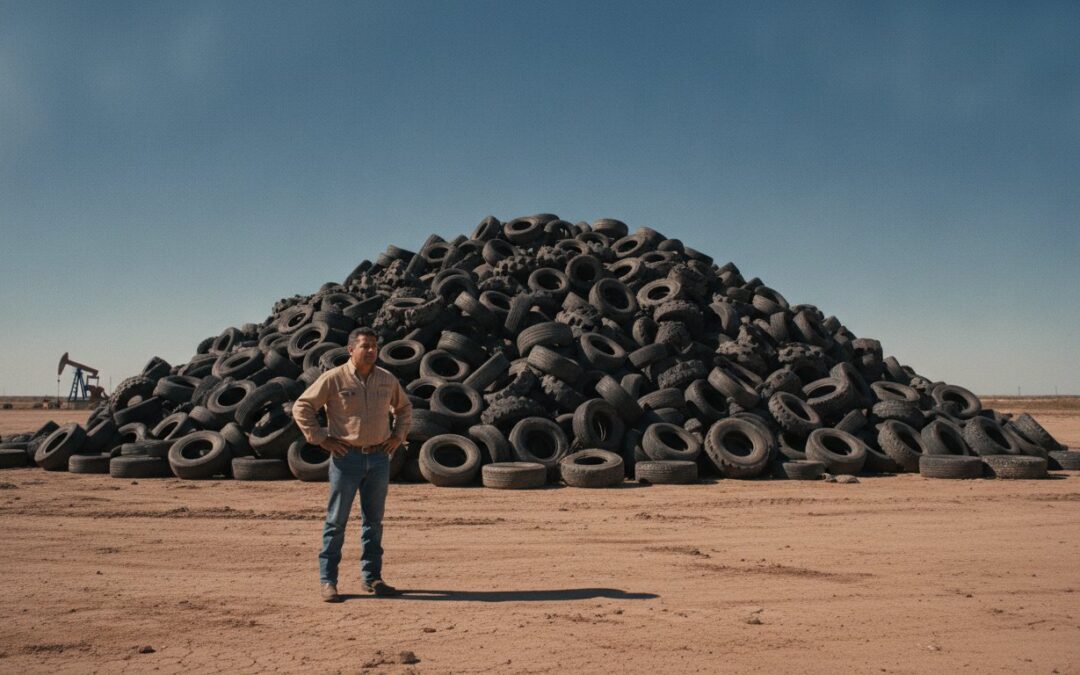
Did you know the Texas Commission on Environmental Quality (TCEQ) can issue fines of up to $25,000 per day for improper tire management? For a West Texas business, a single oversight in your storage lot or a missing piece of paperwork isn’t just a headache; it’s a potential financial catastrophe. The business risks of improper tire disposal have never been higher as we head into 2026. State regulators are cracking down on unauthorized dump sites and tightening the “cradle-to-grave” tracking requirements for every scrap tire your operation generates.
You’ve likely felt the pressure of keeping up with changing environmental laws while trying to run a profitable shop, farm, or oilfield service company. It’s frustrating to worry about your liability after waste leaves your property. This article identifies the legal, financial, and reputational liabilities of improper tire management so you can protect your West Texas business. We’ll examine the latest TCEQ penalties, the impact of new legislation like HB1463, and the exact steps you need to take to ensure a documented, compliant disposal process.
Key Takeaways
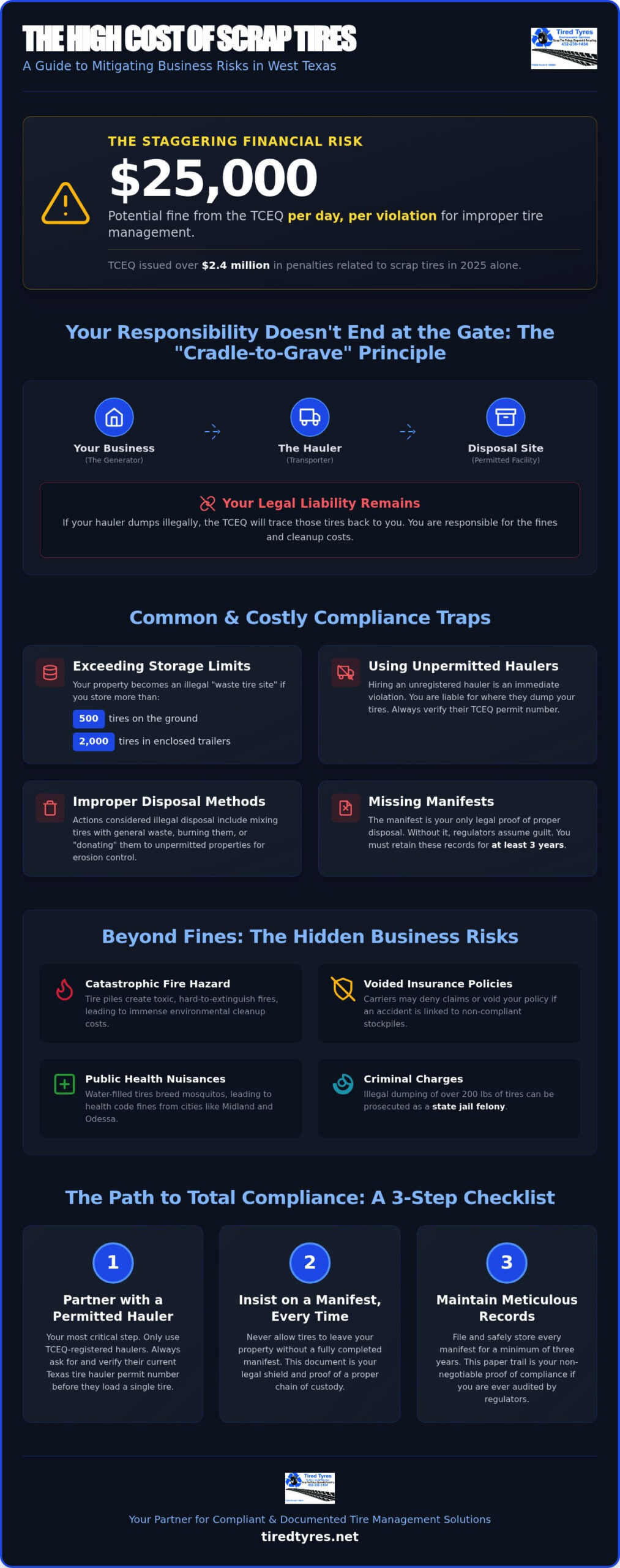
- Understand the latest TCEQ enforcement trends and how daily fines for non-compliance can reach $25,000.
- Learn why “cradle-to-grave” liability means your business remains legally responsible for tires even after they leave your property.
- Identify the hidden business risks of improper tire disposal, including the potential for voided commercial insurance and catastrophic fire liabilities.
- Discover sector-specific requirements for managing specialized waste like OTR tires, agricultural rubber, and industrial tracks.
- Get a clear roadmap for transitioning to a documented, permitted collection schedule that ensures total regulatory compliance.
What Constitutes Improper Tire Disposal for Businesses?
In Texas, improper disposal goes far beyond simply dumping tires in a ravine. For a commercial operation, it includes any action that breaks the documented chain of custody or violates storage thresholds. Common mistakes like mixing rubber with general waste or burning old casings on-site carry heavy penalties. Many West Texas businesses also fall into the trap of “donating” tires to local ranchers for erosion control or fence lines. Unless that ranch is a permitted site, this is considered illegal disposal under state law.
The core of the business risks of improper tire disposal lies in the “cradle-to-grave” liability principle. This means you’re legally responsible for every tire your business generates until it reaches a permitted processing facility. If a hauler you hired dumps your tires in a field, the TCEQ will trace those tires back to your shop or yard. You, not just the hauler, will face the enforcement action and cleanup costs. Understanding the Tire recycling process and the regulations surrounding it is the only way to shield your assets from these liabilities.
Stockpiling vs. Storage: When Does it Become a Risk?
Texas law is very specific about how many tires you can keep on your property. Registered generators can store up to 500 scrap tires on the ground or up to 2,000 tires in enclosed, lockable trailers. Once you exceed these numbers, your property may be reclassified. According to TCEQ standards, a scrap tire facility is any site used for the storage or processing of scrap tires, including those that have exceeded storage limits without a specific permit. Crossing this line turns your inventory into a “waste tire site,” which triggers immediate regulatory scrutiny and potential daily fines.
The Danger of Unpermitted Tire Haulers
It’s tempting to hire the “cheap guy” with a pickup truck and a trailer to clear out your yard. However, this is one of the most significant business risks of improper tire disposal. If that individual isn’t a registered TCEQ tire hauler, you’ve already committed a violation. You must verify their status by asking for their current Texas tire hauler permit number. A professional service will always provide a manifest. This document is your only legal proof of a proper chain of custody. You’re required to keep these records for at least three years to prove you followed the law. Without that paper trail, you have no defense if those tires are found at an illegal dump site later.
Legal and Regulatory Risks: TCEQ and Texas Law
The Texas Commission on Environmental Quality (TCEQ) doesn’t view tire mismanagement as a minor clerical error. It’s a significant regulatory violation. Under Title 30 of the Texas Administrative Code, the business risks of improper tire disposal include administrative, civil, and even criminal penalties. In 2025 alone, the TCEQ issued more than $2.4 million in penalties related to scrap tire management. For a business owner, the most staggering figure is the potential fine amount: up to $25,000 per day for each violation.
These fines can quickly outpace the annual revenue of a small auto shop or fleet operation. Beyond the immediate cash drain, regulatory non-compliance creates a “black mark” on your business record. This can prevent you from renewing essential operating permits or securing government contracts. In severe cases, illegal dumping is prosecuted as a state jail felony if the weight of the tires exceeds 200 pounds or the volume exceeds 200 cubic feet. Local authorities are increasingly using these statutes to clear out unauthorized stockpiles that pose public health risks.
TCEQ Manifest Requirements for 2026
The manifest is your primary shield against liability. It must document the number of tires collected, the type of tires (such as Passenger, Semi, or OTR), and the signatures of the generator, the hauler, and the final disposal site official. You’re legally required to retain these records for at least three years. If an inspector visits your facility and you can’t produce a matching manifest for your missing inventory, they’ll assume illegal disposal occurred. You can find more details on staying compliant in our guide to Texas tire disposal regulations.
Local Enforcement in Midland, Odessa, and Lubbock
Cities across the Permian Basin and South Plains are tightening their own ordinances. In Midland and Odessa, code enforcement officers focus heavily on vector control. Stagnant water inside tire piles serves as a breeding ground for mosquitoes, leading to additional fines for public health nuisances. Lubbock County has also increased patrols in rural areas to catch businesses that “offload” rubber waste on backroads. You can stay ahead of these local inspectors by following this Lubbock County checklist for proper facility management. Working with a partner for legal tire collection services is the simplest way to ensure your paperwork is always audit-ready.
Financial Liabilities: Fires, Health, and Property Value
While TCEQ fines are a major concern, they represent only the tip of the iceberg when it comes to the financial business risks of improper tire disposal. The most catastrophic financial threat to your operation is a tire fire. These incidents are notoriously difficult to extinguish because the hollow shape of a tire traps air, feeding the flames from the inside. Once a fire starts, it releases pyrolytic oil, a thick, toxic liquid that quickly seeps into the soil and groundwater. The EPA often intervenes in these large-scale events, and the resulting cleanup bill can easily reach seven figures, far exceeding the value of the tires themselves.
Insurance companies are also quick to deny claims if they find a business was operating outside of state regulations. Most commercial property policies contain clauses requiring the insured to follow all local and state laws. If you’re storing 3,000 tires but are only permitted for 500, you’ve breached your contract. This means if a fire occurs, your insurance carrier may refuse to pay for the damage to your buildings or equipment. Additionally, contaminated land is almost impossible to sell or use as collateral. Banks don’t finance buyers for properties with environmental liens, effectively trapping your capital in a devalued asset that nobody wants to touch.
The Hidden Cost of Vector Control
Tire piles are the primary breeding ground for West Nile and Zika-carrying mosquitoes in the Permian Basin. Because tires trap heat and stagnant water, they create a perfect incubator for larvae that are shielded from many common pesticides. If a local disease outbreak is traced back to a specific property, the business owner could face massive public health lawsuits and civil liability claims. You can learn more about specific waste tire problems in West Texas and how they impact your long-term liability.
Environmental Remediation and Cleanup Costs
The price of professional bulk site remediation is significantly higher than the cost of regular, scheduled pickups. Once the ground is contaminated by melting rubber and toxic runoff, you’re looking at years of soil and groundwater monitoring required by law. Many West Texas businesses have faced financial ruin because they ignored a growing stockpile until it became a “legacy” site. At that point, the cost to clear the land often exceeds the market value of the property. Staying proactive with a permitted hauler protects your balance sheet from these long-term environmental liabilities and ensures your land remains a sellable asset.
Sector-Specific Risks: Oilfield, Agriculture, and Fleets
Specific industries in West Texas face unique business risks of improper tire disposal because of the sheer scale and variety of rubber waste they generate. In the Permian Basin, oilfield service companies often deal with massive Off-the-Road (OTR) tires and industrial rubber that standard waste haulers won’t touch. Similarly, South Plains farmers and fleet managers in Lubbock must handle high-volume turnover without letting stockpiles exceed TCEQ limits. Each sector has its own regulatory traps that can lead to unexpected enforcement actions.
OTR and Heavy Equipment Tire Liability
OTR tires used in mining and oilfield operations present a massive logistics challenge. Because of their size and weight, they’re significantly more expensive to transport to permitted facilities. This often leads to tires being abandoned on remote leases or “pushed into a corner” of a yard. However, leaving these tires behind doesn’t end your liability. If an abandoned site is discovered, the original owner is typically held responsible for the high cost of remediation. You can avoid these heavy equipment headaches by utilizing professional commercial tire disposal solutions designed for industrial-scale waste.
Industrial Rubber: Hoses and Conveyor Belts
Many businesses mistakenly believe that industrial rubber waste like conveyor belts, hydraulic hoses, and skid steer tracks can be thrown in a standard dumpster. This is a dangerous assumption. In many Texas jurisdictions, industrial rubber is classified as controlled waste. It requires specialized handling and documented disposal to prevent environmental contamination. Solid rubber tires and tracks are particularly scrutinized because they don’t break down like standard air-filled tires. If your facility is found mixing these materials with general trash, you could face immediate citations for permit violations.
Fleet operators face a different kind of pressure. With dozens of semi-trucks on the road, the volume of scrap casings can grow exponentially in just a few months. A “wait and see” approach to pile management often leads to exceeding the 500-tire storage limit before you even realize it. For farmers, the risk often comes from using old ag tires for silage weights or erosion control. While there are some narrow exemptions for agricultural use, these tires must still be managed to prevent vector issues. The safest route for any commercial operation is to partner with a permitted hauler for scrap rubber collection services today.
How to Mitigate Risk: Professional Collection Solutions
Mitigating the business risks of improper tire disposal requires a shift from reactive pile management to a proactive strategy. If you wait until your yard is overflowing to call for a pickup, you’ve likely already violated TCEQ storage limits or triggered insurance red flags. A professional tire management plan ensures that rubber waste is removed before it becomes a liability. This approach transfers the physical risk away from your facility and replaces it with a robust, legally defensible paper trail. By establishing a recurring schedule, you maintain a clean site and ensure that your business stays within the 500-tire storage threshold for generators.
The most effective way to protect your balance sheet is to hire a hauler that assumes responsibility for the tires the moment they leave your property. A legitimate partner doesn’t just take the tires; they provide the manifest that proves your compliance. This documentation is your only defense during a TCEQ audit or a local health department inspection. For businesses in the Permian Basin and South Plains, having a partner who understands the specific business risks of improper tire disposal in Texas is the difference between a routine operation and a costly legal battle.
Auditing Your Current Disposal Process
You can’t manage what you don’t measure. Start by conducting a thorough site walk to identify potential storage violations, such as tires stored near property lines or in areas prone to stagnant water. Review your current waste provider’s credentials. Are they registered with the TCEQ? Do they provide a signed manifest for every single load? If your current provider can’t tell you exactly which permitted facility your tires are going to, you’re still carrying the liability. Verification is a critical step in ensuring your disposal process is audit-ready and compliant with 2026 standards.
Choosing Tired Tyres for Peace of Mind
Tired Tyres is the preferred partner for businesses in Midland, Odessa, and Lubbock because we specialize in high-stakes commercial waste. We provide comprehensive collection services for passenger, semi-truck, and OTR tires, as well as specialized industrial rubber like skid steer tracks and conveyor belts. Our team focuses on 100% regulatory compliance, ensuring that every manifest is accurate and every load is handled according to Texas law. We don’t just clear your yard; we protect your reputation and your property value by managing the entire chain of custody. Protect your business and get a tire pickup quote today to ensure your operations remain secure and fully compliant.
Protecting Your Property and Professional Future
The regulatory landscape in Texas is shifting toward stricter enforcement and higher accountability. You’ve seen how the business risks of improper tire disposal extend from daily TCEQ fines to the catastrophic costs of uninsured property damage and environmental remediation. Whether you’re managing a fleet in Lubbock or an oilfield yard in Midland, the “cradle-to-grave” liability remains your responsibility. Relying on unpermitted haulers or allowing stockpiles to grow past legal limits isn’t just a risk; it’s a threat to your company’s survival.
Professional tire management is the most effective way to eliminate these liabilities. As a Texas-permitted tire hauler, Tired Tyres specializes in OTR and industrial rubber removal, ensuring every load is documented with manifest accuracy. We serve Midland, Odessa, and Lubbock, helping businesses stay 100% compliant without the stress of managing waste themselves. Don’t leave your property value or business license to chance. Request a Professional Scrap Tire Pickup Quote for Your Business today and move forward with confidence. It’s time to clear your lot and your conscience with a partner you can trust.
Frequently Asked Questions
What is the maximum fine for illegal tire dumping in Texas?
The maximum administrative penalty issued by the TCEQ for improper tire management is $25,000 per day for each violation. These fines apply to unauthorized stockpiling, illegal dumping, or failing to maintain proper records. For a West Texas operation, the business risks of improper tire disposal often start with these massive financial penalties. Criminal charges can also apply if the volume of illegally dumped waste exceeds 200 cubic feet, potentially leading to state jail felony prosecutions.
Does my business really need a manifest for only 10 scrap tires?
Yes, any commercial generator in Texas must document the disposal of scrap tires through a manifest system. Whether you have 10 tires or 1,000, you’re required to use a registered hauler and obtain a signed manifest. This document proves the tires reached a permitted facility. You must retain these records for at least three years. Failing to provide these manifests during a TCEQ inspection can result in immediate citations and fines for your business.
Can I be held liable if a hauler dumps my tires illegally?
Absolutely. Texas law follows a “cradle-to-grave” liability model, meaning the generator is responsible for the waste until it reaches its final permitted destination. If you hire an unpermitted hauler who dumps your tires on a Lubbock backroad, the TCEQ will trace those tires back to you. You’ll be held liable for the cleanup costs and the associated administrative fines. This is one of the most significant business risks of improper tire disposal for local companies.
Are there specific rules for OTR tire disposal in the Permian Basin?
While the primary TCEQ regulations are statewide, Permian Basin companies face higher risks due to the size of OTR tires and industrial rubber waste. Specialized waste like scrap conveyor belts, skid steer tracks, and heavy-duty hoses are often classified as controlled waste in Midland and Odessa. These materials can’t be mixed with general trash. They require specific disposal manifests to ensure they don’t end up in unauthorized sites, which would trigger major environmental remediation liabilities.
How do I verify if a tire hauler is properly permitted in Texas?
You should always ask the hauler for their current TCEQ tire hauler registration number before allowing them to load your waste. You can verify this number through the TCEQ Central Registry database online. A legitimate hauler, like Tired Tyres, will also provide a professional manifest for you to sign. Never trust a provider who only accepts cash or refuses to provide a paper trail, as this leaves your business completely unprotected in a legal audit.
Can I take my business’s scrap tires to a local landfill myself?
Most municipal landfills in Midland, Odessa, and Lubbock have strict limits on commercial tire disposal. They often require tires to be split, quartered, or shredded before acceptance, and they may charge high tipping fees. Even if you transport them yourself, you must still follow state manifesting rules if you’re a registered generator. Using a professional collection service is usually more efficient and ensures that your documentation is handled correctly to satisfy state and local inspectors.
What are the fire safety requirements for storing scrap tires outdoors?
Texas requires scrap tire generators to limit piles to specific dimensions and maintain clear fire lanes for emergency vehicle access. Tires must be stored in a way that prevents water from pooling inside them to avoid mosquito breeding. If you store more than 500 tires on the ground, your site may be classified as a waste tire facility. This status requires a specific permit and much stricter fire safety oversight from both state and local Lubbock or Midland authorities.
How does professional tire recycling reduce my business’s long-term liability?
Professional recycling transfers the physical liability of the waste from your property to a permitted facility. By using a registered hauler, you gain a legal paper trail that proves you followed all Texas environmental laws. This protection is vital for maintaining your commercial property insurance and land value. It also ensures that your business won’t be held responsible for future environmental cleanup costs or public health lawsuits related to improper rubber waste management.